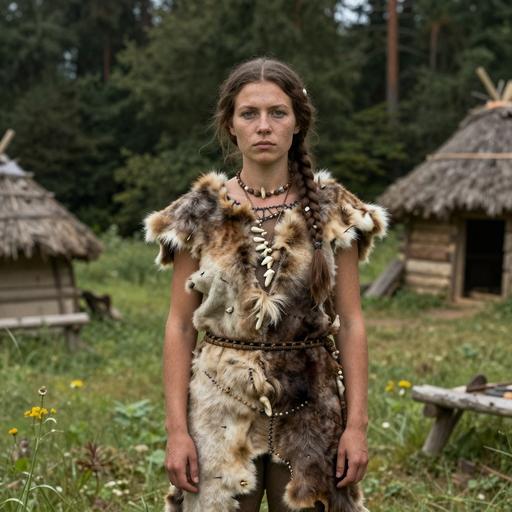
The Kamienskie Culture, also referred to as the Kamienska Culture, is a significant prehistoric culture associated with the Mesolithic period in Eastern Europe, particularly within the geographical region that would later become part of the territories known as pre-Slavic lands. This era is marked by a transition from purely nomadic hunter-gatherer communities to more settled, semi-permanent cultures that began to exploit a broader spectrum of resources and develop more complex social structures. While precise details about the Kamienskie Culture remain under scholarly investigation, a synthesis of archaeological findings provides useful insights.
Geographic Distribution
The Kamienskie Culture is primarily located in the area surrounding present-day Poland and parts of Belarus and Ukraine. This region is characterized by a mix of dense forests, open plains, and numerous rivers and lakes, offering a rich and diverse environment for Mesolithic communities to exploit. The lush, resource-rich landscape provided ample opportunities for fishing, hunting, and foraging.
Chronological Context
The Mesolithic period generally spans from approximately 10,000 BCE to 5,000 BCE, following the Paleolithic era and preceding the Neolithic period. The Kamienskie Culture is situated within this timeframe, with evidence suggesting it flourished around 7,000 to 5,000 BCE. This era is defined by the adaptation to post-glacial environments and the development of new technologies.
Subsistence and Economy
The inhabitants of the Kamienskie Culture were primarily hunter-gatherers, relying heavily on the natural resources of their environment. They hunted game such as deer, wild boar, and aurochs, and they fished extensively in the region’s rivers and lakes. Over time, there is evidence of a broader subsistence strategy, including gathering nuts, berries, and other plant resources, showing an adaptation to the changing climate and environmental conditions.
Tools and Technology
Members of the Kamienskie Culture developed a range of stone tools characteristic of Mesolithic cultures. Microliths—small, sharp flint tools—were used as tips for spears and arrows, suggesting an advanced understanding of hunting technology. These tools often exhibit fine craftsmanship and are sometimes embedded in wooden or bone shafts, indicating significant skill in tool-making. Additionally, evidence of pottery usage is seen, though less common than in later Neolithic cultures.
Settlements and Structures
While primarily mobile, the Kamienskie people did establish semi-permanent settlements, particularly near water bodies, which acted as focal points for resources. Archaeological findings indicate hut-like structures built from wood and other natural materials. These structures likely served as temporary shelters or seasonal bases, reflecting a transition to more sedentary lifestyles.
Social Organization and Culture
The social organization of the Kamienskie Culture would have likely been tribal or kin-based, with leadership possibly tied to hunting prowess or experience. While concrete evidence of social stratification is limited due to the transient nature of their settlements, increased sedentism often leads to more complex social hierarchies. Cultural expressions, such as carvings on tools or personal ornaments made from bone and amber, suggest a growing sense of identity and artistic development.
Spiritual and Ritual Practices
Though direct evidence of spiritual practices among the Kamienskie Culture is sparse, the placement of artifacts in specific contexts implies ritualistic behaviors. Remnants of what might be considered burial sites have been discovered, suggesting potential beliefs in an afterlife or reverence for ancestors. It is possible they engaged in animistic or shamanistic practices, common in many Mesolithic societies.
Influence and Legacy
The Kamienskie Culture, like many Mesolithic cultures, provides a crucial link between Paleolithic hunter-gatherer societies and the agricultural societies of the Neolithic. They represent an adaptive response to their environment and a foundation upon which later cultural developments in the region would be built. Though the Kamienskie Culture itself did not directly transform into future Slavic cultures, it contributed to the broader prehistoric tapestry of Europe, influencing subsequent cultural and technological advancements.
In summary, the Kamienskie Culture holds an important place in the understanding of Mesolithic societies in Eastern Europe, marking a period of transition and adaptation that set the stage for future cultural evolutions.