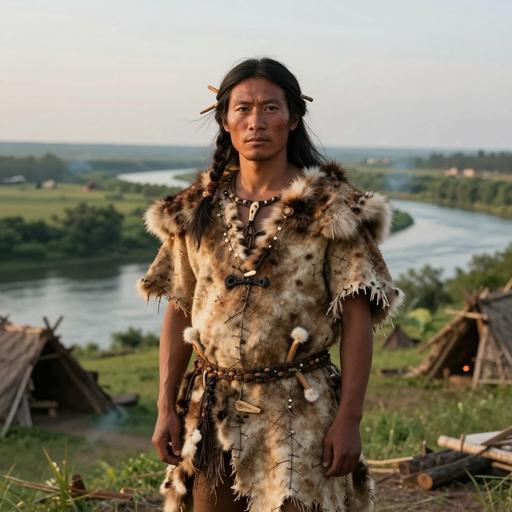
A man buried in China in the era

Download PDF creates a visual, rasterized copy. Use Print for selectable text and better assistive-technology support.

Loading Report

Preparing your ancestry journey

Preparing the available report content...

Your report will open automatically.

Skip to main content
Reference library / Sample profile

A man buried in China in the era

Explore the recorded context, genetic comparisons and research behind this reference sample.

ChinaAncient Hunter-Gatherers of East Asia

A reference profile describes this sample. It does not establish a personal or family relationship.

AI portrait reconstruction for A man buried in China in the  era
AI-generated artistic reconstruction, not a photograph of the individual.
Record

Sample details

Recorded details and available lineage markers.

Individual

Asia East Hg individual, China

Sample ID: NE56

Date Range

17605 BCE - 17301 BCE

Cultural Period

Ancient Hunter-Gatherers of East Asia

Biological Sex

Male

mtDNA Haplogroup

G2

Y-DNA Haplogroup

C-F1906

Social Role

Hunter (AI estimate, era-typical)

Geography

Location

Where this individual was discovered

Country China
Locality Amur River Basin
Chronology

Date range

When this individual lived in the broader context of human history

Asia East Hg individual, China 17605 BCE - 17301 BCE
Context

Historical context

Background information associated with the reference record.

Overview

Ancient hunter-gatherer lifeways in East Asia during the deep Pleistocene reflect human adaptation to changing environments over tens of thousands of years. Archaeological evidence mainly consists of stone tools and related remains that indicate flexible subsistence strategies.

Region & Environment

East Asia includes extensive high-latitude and temperate zones as well as diverse coastal and river settings. During the Pleistocene, climate fluctuations transformed habitats, affecting the distribution of plants, animals, and suitable travel routes.

Historical Context

This era covers a very long time span (as provided) and includes many phases of climatic change. Rather than a single historical moment, it represents repeated cycles of adaptation, with technological and subsistence strategies shaped by local ecosystems.

Populations & Lifeways

Hunter-gatherer populations likely moved seasonally or across larger territories to follow resources such as game and edible plants. Their lifeways involved complex knowledge of landscapes, water sources, and animal behavior, supported by toolkits for butchery and processing.

Archaeology & Material Culture

Stone artifacts are the most frequent archaeological evidence for ancient hunter-gatherers, showing how tool-making techniques were maintained or modified over time. Preservation conditions affect what survives, but assemblages typically focus on cutting and scraping tools and debitage from on-site or nearby tool production.

Culture & Society

Because written records do not exist and organic materials rarely survive, social organization must be inferred cautiously. The repeated appearance of patterned lithic technologies suggests learning traditions and shared practices within groups or between neighboring groups.

Legacy & Transition

Long-term hunter-gatherer adaptations created a deep cultural and technological foundation that later Neolithic and Bronze Age communities built upon. As climates stabilized and food production expanded, the archaeological signature shifted from predominantly mobile toolkits to more settled domestic material culture.

Analysis

Genetic comparisons

These comparisons show genetic similarity, not identity or origin. The populations listed are those whose genomes show statistical alignment to this ancient individual.

Similarity reflects shared history, not shared identity. These are analytical comparisons, not claims about who this person was.

Modern Genetic Admixture

This analysis compares the DNA profile with present-day reference populations, showing statistical similarity to modern reference populations from different regions. The excavation site records where this individual was found, not a fixed modern genetic identity.

Asia 95.0%
Chinese & Southeast Asian 40.9%
Chinese 35.8%
Tibetan 5.1%
Japanese & Korean 33.3%
Japanese 33.3%
Northern Asian 20.9%
Mongolian 10.8%
Siberian 10.1%
America 2.9%
America 2.9%
Native American 2.9%
Africa 2.1%
West African 1.2%
Ghanaian, Liberian, Sierra Leonean 1.0%
African Hunter-Gatherer 0.9%

Closest Modern Populations

These are the modern populations showing the closest statistical alignment to A man buried in China in the era, ranked by genetic distance. Lower distance values indicate closer statistical similarity. Cross-region similarity can reflect shared ancestry, population movement, continuity, or later admixture.

1
Mongola
4.1625
2
Japanese
4.5385
3
Xibo
4.8366
4
Korean Antu
4.8757
5
Korean
4.9697
6
Yugur
5.6021
7
Manchu Jinzhou
6.0218
8
Manchu
6.0745
9
Tu
6.1469
10
Han Shanxi
6.1655
Context

Related Samples

This individual exists within a broader network of ancient samples. No ancient genome stands alone.

Individual Culture/Period Date Location Action
Amur River Basin Mesolithic individual, China Mesolithic China 9243 BCE Amur River Basin, China View
Amur River Basin N individual, China Early Neolithic China 8175 BCE Amur River Basin, China View
Amur River Basin N individual, China Early Neolithic China 7172 BCE Amur River Basin, China View
Amur River Basin N individual, China Neolithic China 5471 BCE Amur River Basin, China View
Ancient Chinese Civilization individual, China Bronze Age China 1510 BCE Amur River Basin, China View
East Asian Neolithic individual, China Early Neolithic China 7458 BCE Amur River Basin, China View
East Asian Neolithic individual, China Early Neolithic China 7456 BCE Amur River Basin, China View
East Asian Paleolithic individual, China Late Paleolithic China 17605 BCE Amur River Basin, China View
East Asian Paleolithic individual, China Late Paleolithic China 12896 BCE Amur River Basin, China View
East Asian Paleolithic individual, China Late Paleolithic China 12371 BCE Amur River Basin, China View
East Asian Paleolithic individual, China Late Paleolithic China 10774 BCE Amur River Basin, China View
East Asian individual, China Mesolithic China 8782 BCE Amur River Basin, China View
East Asian individual, China Mesolithic China 8740 BCE Amur River Basin, China View
East Asian individual, China Mesolithic China 9442 BCE Amur River Basin, China View
East Asian individual, China Mesolithic China 8810 BCE Amur River Basin, China View
Ancient Chinese Civilization individual, China Neolithic China 4448 BCE Amur River Basin, China View
Ancient Chinese Civilization individual, China Neolithic China 4999 BCE Amur River Basin, China View
Ancient Chinese Civilization individual, China Neolithic China 5210 BCE Amur River Basin, China View
Ancient Chinese Civilization individual, China Neolithic China 6375 BCE Amur River Basin, China View
Ancient Chinese Civilization individual, China Neolithic China 4445 BCE Amur River Basin, China View
Ancient Chinese Civilization individual, China Neolithic China 6690 BCE Amur River Basin, China View
Ancient Chinese Civilization individual, China Neolithic China 6465 BCE Amur River Basin, China View
Ancient Chinese Civilization individual, China Neolithic China 4990 BCE Amur River Basin, China View
Ancient Chinese Civilization individual, China Neolithic China 5210 BCE Amur River Basin, China View
East Asian Paleolithic individual, China Paleolithic China 32159 BCE Amur River Basin, China View
Palaeolithic individual, China 32159 BCE Amur River Basin, China View
Asia East Hg individual, China 17605 BCE Amur River Basin, China View
Asia East Hg individual, China 12896 BCE Amur River Basin, China View
Late Paleolithic individual, China 12371 BCE Amur River Basin, China View
Late Paleolithic individual, China 10774 BCE Amur River Basin, China View
Mesolithic individual, China 9442 BCE Amur River Basin, China View
Asia East En individual, China 8810 BCE Amur River Basin, China View
Mesolithic individual, China 8782 BCE Amur River Basin, China View
Mesolithic individual, China 8740 BCE Amur River Basin, China View
Asia East En individual, China 7458 BCE Amur River Basin, China View
Asia East En individual, China 7456 BCE Amur River Basin, China View
Neolithic individual, China 6690 BCE Amur River Basin, China View
Asia East En individual, China 6465 BCE Amur River Basin, China View
Asia East En individual, China 6375 BCE Amur River Basin, China View
Asia East Mn individual, China 5210 BCE Amur River Basin, China View
Asia East Mn individual, China 4999 BCE Amur River Basin, China View
Asia East Ba individual, China 1510 BCE Amur River Basin, China View
Amur River Basin Late Paleolithic individual, China 10812 BCE Zhaodong on the northern bank of the Songhua River (Amur River Basin, southwest Heilongjiang Province, Songnen Plain), China View
Amur River Basin N individual, China 4457 BCE Zhaodong on the northern bank of the Songhua River (Amur River Basin, southwest Heilongjiang Province, Songnen Plain), China View
Amur River Basin Late Paleolithic individual, China 12462 BCE Zhaodong on the northern bank of the Songhua River (Amur River Basin, southwest Heilongjiang Province, Songnen Plain), China View
Page 1
Individual Culture/Period Date Location Action
Asia East Hg individual, China 17605 BCE Amur River Basin, China View
Asia East Hg individual, China 12896 BCE Amur River Basin, China View
Page 1
Sources

References

Scientific publications and genetic data that inform this profile.

G25 Coordinates

These coordinates represent a position in genetic space, a tool for comparison, not a conclusion. You can use these to perform custom admixture analysis in G25 Studio.

NE56,0.00916934,-0.42738726,0.02210338,-0.04781646,0.01816712,-0.00184782,-0.0023914,-0.00270784,-0.00281628,0.0079819,-0.0609981,-0.00747266,0.0107508,-0.00927076,-0.01119124,-0.0031127,-0.00044638,-0.00020434,0.0063037,-0.00178594,0.015375,-0.01423736,0.00162878,0.0054281,-0.02223406
Continue in G25 Studio
Use code for 30% off • Expires Nov 16