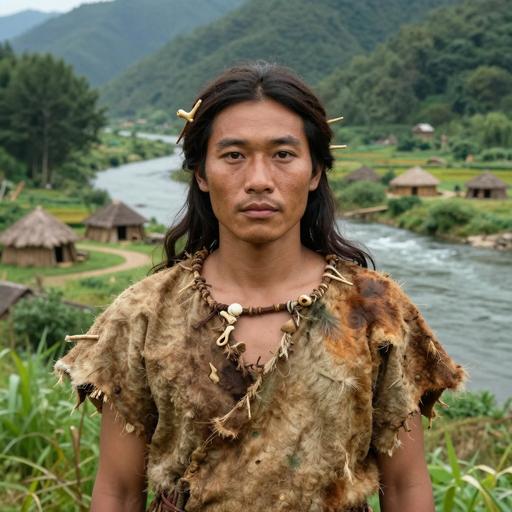
A man buried in China in the era

Download PDF creates a visual, rasterized copy. Use Print for selectable text and better assistive-technology support.

Loading Report

Preparing your ancestry journey

Preparing the available report content...

Your report will open automatically.

Skip to main content
Reference library / Sample profile

A man buried in China in the era

Explore the recorded context, genetic comparisons and research behind this reference sample.

ChinaMiddle Neolithic East Asia

A reference profile describes this sample. It does not establish a personal or family relationship.

AI portrait reconstruction for A man buried in China in the  era
AI-generated artistic reconstruction, not a photograph of the individual.
Record

Sample details

Recorded details and available lineage markers.

Individual

Asia East Mn individual, China

Sample ID: NE19

Date Range

5210 BCE - 4955 BCE

Cultural Period

Middle Neolithic East Asia

Biological Sex

Male

mtDNA Haplogroup

F1b1-a

Y-DNA Haplogroup

C-F1918

Social Role

Laborer (AI estimate, era-typical)

Geography

Location

Where this individual was discovered

Country China
Locality Amur River Basin
Chronology

Date range

When this individual lived in the broader context of human history

Asia East Mn individual, China 5210 BCE - 4955 BCE
Context

Historical context

Background information associated with the reference record.

Region & Environment

Middle Neolithic East Asia is associated with the temperate zones of East Asia, where river valleys and loess-like fertile landscapes supported cultivation. Seasonal water availability and productive soils favored semi-sedentary or sedentary village life, with nearby uplands and woodland resources used to complement farming.

Historical Context

The Middle Neolithic sits within the longer arc of Neolithic development, when communities shifted away from foraging toward sustained food production. Across the region, local sequences show differences in pottery traditions, settlement density, and the pace of technological change, but the overall period remains within farming-based economies.

Populations & Lifeways

Populations were generally organized around villages and agricultural cycles. Diets likely relied primarily on cultivated plants, supplemented by hunting, fishing, and foraging where accessible. Household production is often visible archaeologically through the presence of domestic ceramics, groundstone tools, and household waste, suggesting day-to-day processing of food and materials.

Archaeology & Material Culture

Archaeology for this era commonly features ceramic assemblages (often with distinctive decorative schemes), stone tools for working plants and other materials, and evidence for storage or cooking activities through pottery and features. Settlement archaeology—when preserved—may show pits, floors, and refuse deposits that help reconstruct daily routines. Raw material choices in stone and pottery temper selection can indicate regional networks and local resource use.

Culture & Society

Cultural identity in the Middle Neolithic is frequently expressed through pottery style, tool traditions, and recurring patterns in site organization. While large-scale political states are not a defining feature of the Middle Neolithic, communities could still maintain shared stylistic conventions over wider areas through exchange, intermarriage, or mobile learning networks.

Legacy & Transition

As the Middle Neolithic progressed, regional differences accumulated, setting the stage for subsequent Neolithic phases and later changes in metallurgy and more complex settlement organization. The continuity of farming practices and the refinement of craft traditions (especially ceramics) formed a baseline for later developments.

Analysis

Genetic comparisons

These comparisons show genetic similarity, not identity or origin. The populations listed are those whose genomes show statistical alignment to this ancient individual.

Similarity reflects shared history, not shared identity. These are analytical comparisons, not claims about who this person was.

Modern Genetic Admixture

This analysis compares the DNA profile with present-day reference populations, showing statistical similarity to modern reference populations from different regions. The excavation site records where this individual was found, not a fixed modern genetic identity.

Asia 100.0%
Northern Asian 60.3%
Mongolian 37.6%
Siberian 22.6%
Japanese & Korean 35.0%
Japanese 35.0%
Chinese & Southeast Asian 4.7%
Indonesian Khmer Thai Myanma 3.7%
Chinese 1.1%

Closest Modern Populations

These are the modern populations showing the closest statistical alignment to A man buried in China in the era, ranked by genetic distance. Lower distance values indicate closer statistical similarity. Cross-region similarity can reflect shared ancestry, population movement, continuity, or later admixture.

1
Mongola
4.3518
2
Xibo
4.5364
3
Hezhen
5.8624
4
Korean Antu
5.9100
5
Daur
5.9641
6
Korean
6.0847
7
Yugur
6.2517
8
Manchu
6.2907
9
Manchu Jinzhou
6.2912
10
Han Shanxi
6.5677
Context

Related Samples

This individual exists within a broader network of ancient samples. No ancient genome stands alone.

Individual Culture/Period Date Location Action
Amur River Basin Mesolithic individual, China Mesolithic China 9243 BCE Amur River Basin, China View
Amur River Basin N individual, China Early Neolithic China 8175 BCE Amur River Basin, China View
Amur River Basin N individual, China Early Neolithic China 7172 BCE Amur River Basin, China View
Amur River Basin N individual, China Neolithic China 5471 BCE Amur River Basin, China View
Ancient Chinese Civilization individual, China Bronze Age China 1510 BCE Amur River Basin, China View
East Asian Neolithic individual, China Early Neolithic China 7458 BCE Amur River Basin, China View
East Asian Neolithic individual, China Early Neolithic China 7456 BCE Amur River Basin, China View
East Asian Paleolithic individual, China Late Paleolithic China 17605 BCE Amur River Basin, China View
East Asian Paleolithic individual, China Late Paleolithic China 12896 BCE Amur River Basin, China View
East Asian Paleolithic individual, China Late Paleolithic China 12371 BCE Amur River Basin, China View
East Asian Paleolithic individual, China Late Paleolithic China 10774 BCE Amur River Basin, China View
East Asian individual, China Mesolithic China 8782 BCE Amur River Basin, China View
East Asian individual, China Mesolithic China 8740 BCE Amur River Basin, China View
East Asian individual, China Mesolithic China 9442 BCE Amur River Basin, China View
East Asian individual, China Mesolithic China 8810 BCE Amur River Basin, China View
Ancient Chinese Civilization individual, China Neolithic China 4448 BCE Amur River Basin, China View
Ancient Chinese Civilization individual, China Neolithic China 4999 BCE Amur River Basin, China View
Ancient Chinese Civilization individual, China Neolithic China 5210 BCE Amur River Basin, China View
Ancient Chinese Civilization individual, China Neolithic China 6375 BCE Amur River Basin, China View
Ancient Chinese Civilization individual, China Neolithic China 4445 BCE Amur River Basin, China View
Ancient Chinese Civilization individual, China Neolithic China 6690 BCE Amur River Basin, China View
Ancient Chinese Civilization individual, China Neolithic China 6465 BCE Amur River Basin, China View
Ancient Chinese Civilization individual, China Neolithic China 4990 BCE Amur River Basin, China View
Ancient Chinese Civilization individual, China Neolithic China 5210 BCE Amur River Basin, China View
East Asian Paleolithic individual, China Paleolithic China 32159 BCE Amur River Basin, China View
Palaeolithic individual, China 32159 BCE Amur River Basin, China View
Asia East Hg individual, China 17605 BCE Amur River Basin, China View
Asia East Hg individual, China 12896 BCE Amur River Basin, China View
Late Paleolithic individual, China 12371 BCE Amur River Basin, China View
Late Paleolithic individual, China 10774 BCE Amur River Basin, China View
Mesolithic individual, China 9442 BCE Amur River Basin, China View
Asia East En individual, China 8810 BCE Amur River Basin, China View
Mesolithic individual, China 8782 BCE Amur River Basin, China View
Mesolithic individual, China 8740 BCE Amur River Basin, China View
Asia East En individual, China 7458 BCE Amur River Basin, China View
Asia East En individual, China 7456 BCE Amur River Basin, China View
Neolithic individual, China 6690 BCE Amur River Basin, China View
Asia East En individual, China 6465 BCE Amur River Basin, China View
Asia East En individual, China 6375 BCE Amur River Basin, China View
Asia East Mn individual, China 5210 BCE Amur River Basin, China View
Asia East Mn individual, China 4999 BCE Amur River Basin, China View
Asia East Ba individual, China 1510 BCE Amur River Basin, China View
Amur River Basin Late Paleolithic individual, China 10812 BCE Zhaodong on the northern bank of the Songhua River (Amur River Basin, southwest Heilongjiang Province, Songnen Plain), China View
Amur River Basin N individual, China 4457 BCE Zhaodong on the northern bank of the Songhua River (Amur River Basin, southwest Heilongjiang Province, Songnen Plain), China View
Amur River Basin Late Paleolithic individual, China 12462 BCE Zhaodong on the northern bank of the Songhua River (Amur River Basin, southwest Heilongjiang Province, Songnen Plain), China View
Page 1
Individual Culture/Period Date Location Action
Asia East Mn individual, China 5210 BCE Amur River Basin, China View
Asia East Mn individual, China 4999 BCE Amur River Basin, China View
Page 1
Sources

References

Scientific publications and genetic data that inform this profile.

G25 Coordinates

These coordinates represent a position in genetic space, a tool for comparison, not a conclusion. You can use these to perform custom admixture analysis in G25 Studio.

NE19,0.02679522,-0.4476258,0.03119882,-0.05502498,0.01676846,0.00103062,0.00923748,0.0084925,-0.00560504,0.00603108,-0.03081798,-0.00308244,0.0033943,-0.00438402,-0.00732208,-0.00264704,-0.00121728,0.0036595,0.00703974,-0.00212078,0.01692332,-0.00496942,0.01041242,0.00153534,0.00659395
Continue in G25 Studio
Use code for 30% off • Expires Nov 16