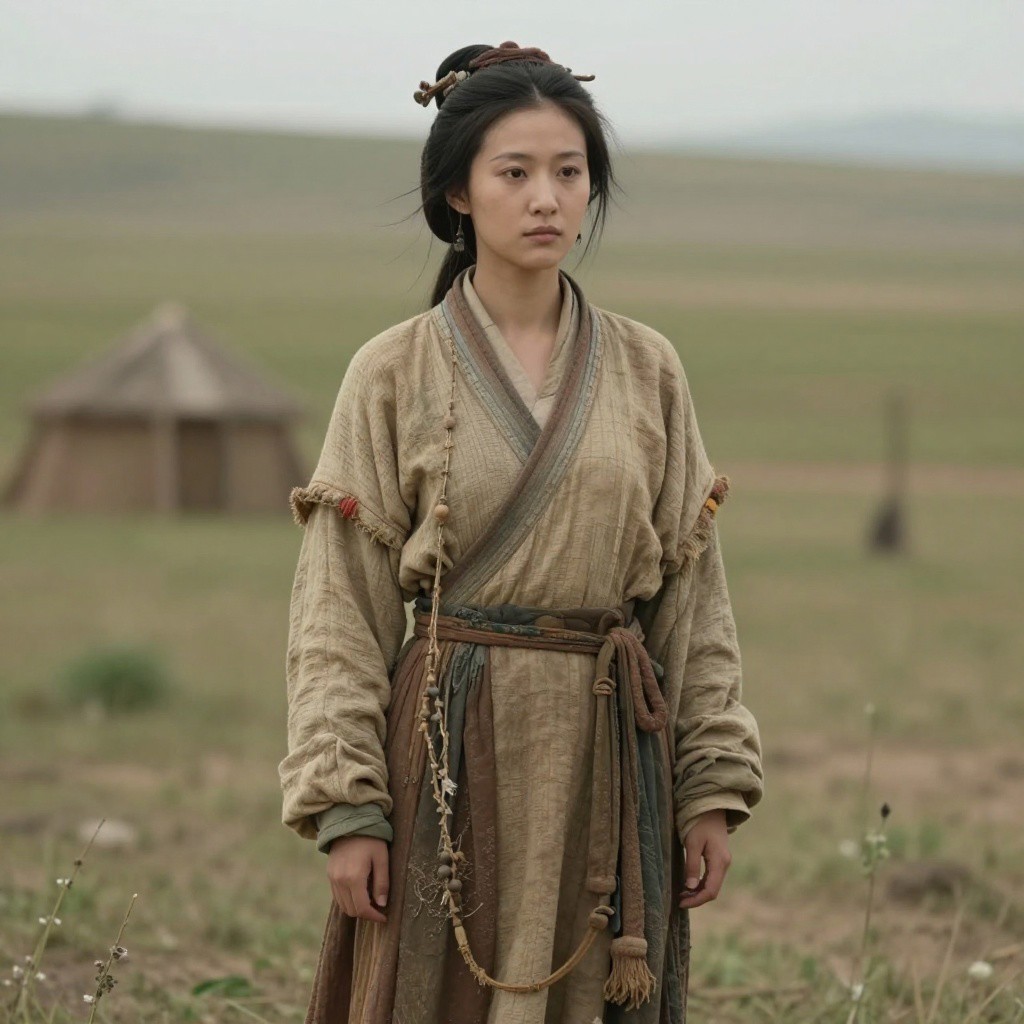
A woman buried in China in the era

Download PDF creates a visual, rasterized copy. Use Print for selectable text and better assistive-technology support.

Loading Report

Preparing your ancestry journey

Preparing the available report content...

Your report will open automatically.

Skip to main content
Reference library / Sample profile

A woman buried in China in the era

Explore the recorded context, genetic comparisons and research behind this reference sample.

ChinaChina AmurRiverBasin LatePaleolithic

A reference profile describes this sample. It does not establish a personal or family relationship.

AI portrait reconstruction for A woman buried in China in the  era
AI-generated artistic reconstruction, not a photograph of the individual.
Record

Sample details

Recorded details and available lineage markers.

Individual

Amur River Basin Late Paleolithic individual, China

Sample ID: NE1_AmurRiver

Date Range

10812 BCE - 10588 BCE

Cultural Period

China AmurRiverBasin LatePaleolithic

Biological Sex

Female

mtDNA Haplogroup

D4g

Y-DNA Haplogroup

Not available

Geography

Location

Where this individual was discovered

Country China
Locality Zhaodong on the northern bank of the Songhua River (Amur River Basin, southwest Heilongjiang Province, Songnen Plain)
Chronology

Date range

When this individual lived in the broader context of human history

Amur River Basin Late Paleolithic individual, China 10812 BCE - 10588 BCE
Context

Historical context

Background information associated with the reference record.

In China’s Amur River Basin, the Late Paleolithic records hunter-gatherer lifeways before widespread agriculture. Cultural variability across this broad region is reflected in lithic technologies and changing site use through the late glacial and early Holocene transition.

Region & Environment

The Amur River Basin spans river corridors, wetlands, and forested landscapes in northeastern China. Late Paleolithic environments were strongly influenced by climatic fluctuations, affecting river levels, seasonal availability of game, and the availability of plant resources. Occupations would have been sensitive to seasonal cycles and to the distribution of water, timber, and fauna.

Historical Context

This period precedes farming and long-term village agriculture in the region, so communities are best understood within a pre-agricultural framework. Over time, changing environmental conditions—especially around the Late Glacial to early Holocene transition—would have reshaped where and when groups camped and how mobility was organized.

Populations & Lifeways

Populations were primarily mobile hunter-gatherers. Their lifeways likely relied on hunting and fishing in productive riverine settings, supplemented by foraging for edible plants and small game. Groups may have used specialized task areas within larger landscapes, with repeated visits to familiar resource zones during favorable seasons.

Archaeology & Material Culture

Archaeological signatures for Late Paleolithic contexts commonly emphasize stone tool production and maintenance, since lithics preserve well and are informative about planning and skill. Site assemblages can include chipped-stone artifacts and evidence for on-site knapping or tool repair. Organic materials may survive only in exceptional circumstances, so interpretations often rely on tool types, raw material choices, and the spatial organization of activities.

Culture & Society

Cultural identities are typically inferred indirectly through technological choices in stone toolmaking and through patterns of site use. Differences between nearby assemblages may reflect variation in hunting strategies, mobility routes, or group traditions, rather than clear boundaries that can be traced through texts. Social organization would have supported coordinated hunting, tool production, and knowledge of seasonal landscapes.

Legacy & Transition

As climates shifted toward the early Holocene, subsistence strategies and settlement patterns likely changed, setting the stage for later prehistoric developments in northeastern Asia. The Late Paleolithic record in the Amur Basin provides the baseline for understanding continuity and change in lithic technologies and in how hunter-gatherers adapted to new environmental conditions.

Analysis

Genetic comparisons

These comparisons show genetic similarity, not identity or origin. The populations listed are those whose genomes show statistical alignment to this ancient individual.

Similarity reflects shared history, not shared identity. These are analytical comparisons, not claims about who this person was.

Modern Genetic Admixture

This analysis compares the DNA profile with present-day reference populations, showing statistical similarity to modern reference populations from different regions. The excavation site records where this individual was found, not a fixed modern genetic identity.

Asia 99.1%
Northern Asian 52.7%
Mongolian 35.1%
Siberian 17.6%
Japanese & Korean 34.0%
Japanese 34.0%
Chinese & Southeast Asian 12.4%
Chinese 10.4%
Indonesian Khmer Thai Myanma 2.0%
Africa 1.0%
West African 1.0%
Senegambian & Guinean 1.0%

Closest Modern Populations

These are the modern populations showing the closest statistical alignment to A woman buried in China in the era, ranked by genetic distance. Lower distance values indicate closer statistical similarity. Cross-region similarity can reflect shared ancestry, population movement, continuity, or later admixture.

1
Hezhen
2.4612
2
Daur
2.8953
3
Oroqen
3.9040
4
Mongol IMAR
5.5033
5
Xibo
5.5450
6
Nivkh
5.8671
7
Ulchi
6.4643
8
Mongola
6.7593
9
Nanai
6.8339
10
Mongol Inner Mongolia
7.2075
Context

Related Samples

This individual exists within a broader network of ancient samples. No ancient genome stands alone.

Individual Culture/Period Date Location Action
Amur River Basin Mesolithic individual, China Mesolithic China 9243 BCE Amur River Basin, China View
Amur River Basin N individual, China Early Neolithic China 8175 BCE Amur River Basin, China View
Amur River Basin N individual, China Early Neolithic China 7172 BCE Amur River Basin, China View
Amur River Basin N individual, China Neolithic China 5471 BCE Amur River Basin, China View
Ancient Chinese Civilization individual, China Bronze Age China 1510 BCE Amur River Basin, China View
East Asian Neolithic individual, China Early Neolithic China 7458 BCE Amur River Basin, China View
East Asian Neolithic individual, China Early Neolithic China 7456 BCE Amur River Basin, China View
East Asian Paleolithic individual, China Late Paleolithic China 17605 BCE Amur River Basin, China View
East Asian Paleolithic individual, China Late Paleolithic China 12896 BCE Amur River Basin, China View
East Asian Paleolithic individual, China Late Paleolithic China 12371 BCE Amur River Basin, China View
East Asian Paleolithic individual, China Late Paleolithic China 10774 BCE Amur River Basin, China View
East Asian individual, China Mesolithic China 8782 BCE Amur River Basin, China View
East Asian individual, China Mesolithic China 8740 BCE Amur River Basin, China View
East Asian individual, China Mesolithic China 9442 BCE Amur River Basin, China View
East Asian individual, China Mesolithic China 8810 BCE Amur River Basin, China View
Ancient Chinese Civilization individual, China Neolithic China 4448 BCE Amur River Basin, China View
Ancient Chinese Civilization individual, China Neolithic China 4999 BCE Amur River Basin, China View
Ancient Chinese Civilization individual, China Neolithic China 5210 BCE Amur River Basin, China View
Ancient Chinese Civilization individual, China Neolithic China 6375 BCE Amur River Basin, China View
Ancient Chinese Civilization individual, China Neolithic China 4445 BCE Amur River Basin, China View
Ancient Chinese Civilization individual, China Neolithic China 6690 BCE Amur River Basin, China View
Ancient Chinese Civilization individual, China Neolithic China 6465 BCE Amur River Basin, China View
Ancient Chinese Civilization individual, China Neolithic China 4990 BCE Amur River Basin, China View
Ancient Chinese Civilization individual, China Neolithic China 5210 BCE Amur River Basin, China View
East Asian Paleolithic individual, China Paleolithic China 32159 BCE Amur River Basin, China View
Palaeolithic individual, China 32159 BCE Amur River Basin, China View
Asia East Hg individual, China 17605 BCE Amur River Basin, China View
Asia East Hg individual, China 12896 BCE Amur River Basin, China View
Late Paleolithic individual, China 12371 BCE Amur River Basin, China View
Late Paleolithic individual, China 10774 BCE Amur River Basin, China View
Mesolithic individual, China 9442 BCE Amur River Basin, China View
Asia East En individual, China 8810 BCE Amur River Basin, China View
Mesolithic individual, China 8782 BCE Amur River Basin, China View
Mesolithic individual, China 8740 BCE Amur River Basin, China View
Asia East En individual, China 7458 BCE Amur River Basin, China View
Asia East En individual, China 7456 BCE Amur River Basin, China View
Neolithic individual, China 6690 BCE Amur River Basin, China View
Asia East En individual, China 6465 BCE Amur River Basin, China View
Asia East En individual, China 6375 BCE Amur River Basin, China View
Asia East Mn individual, China 5210 BCE Amur River Basin, China View
Asia East Mn individual, China 4999 BCE Amur River Basin, China View
Asia East Ba individual, China 1510 BCE Amur River Basin, China View
Amur River Basin Late Paleolithic individual, China 10812 BCE Zhaodong on the northern bank of the Songhua River (Amur River Basin, southwest Heilongjiang Province, Songnen Plain), China View
Amur River Basin N individual, China 4457 BCE Zhaodong on the northern bank of the Songhua River (Amur River Basin, southwest Heilongjiang Province, Songnen Plain), China View
Amur River Basin Late Paleolithic individual, China 12462 BCE Zhaodong on the northern bank of the Songhua River (Amur River Basin, southwest Heilongjiang Province, Songnen Plain), China View
Page 1
Individual Culture/Period Date Location Action
Amur River Basin Late Paleolithic individual, China 10812 BCE Zhaodong on the northern bank of the Songhua River (Amur River Basin, southwest Heilongjiang Province, Songnen Plain), China View
Amur River Basin Late Paleolithic individual, China 12462 BCE Zhaodong on the northern bank of the Songhua River (Amur River Basin, southwest Heilongjiang Province, Songnen Plain), China View
Page 1
Sources

References

Scientific publications and genetic data that inform this profile.

G25 Coordinates

These coordinates represent a position in genetic space, a tool for comparison, not a conclusion. You can use these to perform custom admixture analysis in G25 Studio.

NE1_AmurRiver,0.02662056,-0.42567706,0.05602278,-0.04437404,-0.02580774,-0.02035928,0.01312852,0.01682138,0.0085474,0.01315174,-0.03659532,0.00036934,0.00186816,0.00037698,-0.0079498,-0.008287,-0.00246988,0.00464952,0.00762254,0.00410228,0.01454312,-0.02141896,-0.0056801,0.00425418,-0.00651565
Continue in G25 Studio
Use code for 30% off • Expires Nov 16