Genetic position data
The coordinates behind comparative analysis
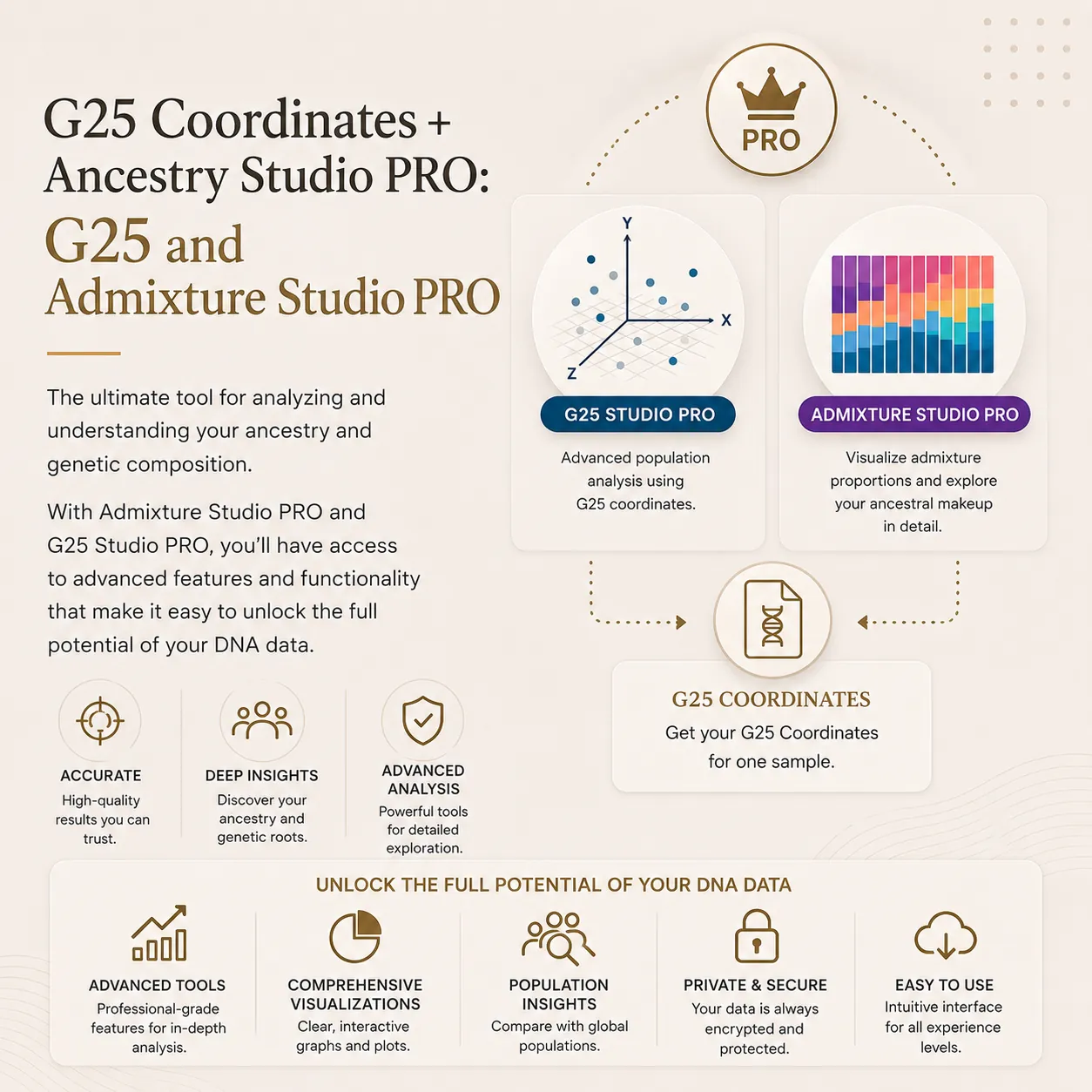
Receive a compact numerical representation of your genetic position for use in population-distance calculations, G25 Studio, compatible third-party tools, and independent research workflows.
Save 35% with code DISCOUNT35Ends Oct 12
- 25Model dimensions
- 2Scaling formats
- 22Autosomal chromosome sets
$15 one-time payment
Definition
A position in 25-dimensional space
Genome-wide autosomal variation is projected into a reference space derived with principal component analysis. The resulting sequence of values supports reproducible comparison within that framework.
Numerical representation
A compact sequence of 25 values encodes position across the dimensions retained by the model.
Global25 framework
The coordinates use the established Global25-style reference space for population comparison.
Relative position
Meaning comes from the selected references and distance method, not from an isolated value.
SampleName_scaled,0.0234,-0.0156,0.0089,...Interpretation boundaries
What coordinates are not
Clear boundaries help prevent a mathematical representation from being mistaken for a personal or historical conclusion.
Positional data
Coordinates do not directly state a percentage breakdown.
No personal labels
Reference labels are dataset descriptions, not cultural or national identity assignments.
Raw analytical input
The files do not include a narrative conclusion.
Context required
Coordinates require references, a distance measure, and a documented method.
Uses
The infrastructure layer for modeling
Coordinates provide a consistent input for several downstream questions about statistical genetic similarity.
Measure distance
Quantify similarity or difference to a chosen reference under a stated distance method.
Compare references
Inspect which modern or ancient references sit nearer in the selected model.
Test models
Evaluate how combinations of references approximate the target coordinates.
Deliverables
Standardized files for flexible workflows
The package provides genome-wide and chromosome-level data so you can choose the analysis appropriate to your research question.
Scaled coordinates
Eigenvalue-weighted coordinates used by most G25 calculators and distance tools.
Sample_scaled,val1,...,val25
Unscaled coordinates
PCA output without eigenvalue weighting for compatible specialized analysis.
Sample,val1,...,val25
Chromosomal coordinates
Scaled and unscaled coordinate sets for autosomal chromosomes 1 through 22.
Chr 1-22
Method
From raw DNA to coordinate files
The service follows a defined projection workflow and validates the outputs for consistent downstream use.
Extract
Read compatible autosomal SNP markers from the uploaded raw-data file.
Project
Project the genotype profile into the Global25-style reference space.
Calculate
Generate the genome-wide and chromosome-level coordinate sequences.
Validate
Check the scaled and unscaled outputs for structural consistency.
Supported source files
Compatible files include sufficiently complete autosomal exports from 23andMe, AncestryDNA, MyHeritage, FamilyTreeDNA, and Living DNA. Provider names are used only to describe file compatibility.
Audience
For users who want the analytical layer
This service is designed for people who want reusable data and are prepared to select references and interpret model-dependent results.
Advanced ancestry users
Move beyond simplified summaries into coordinate-based comparisons.
Researchers and analysts
Use standardized values for distance calculations and documented workflows.
G25 Studio users
Generate the required input for the Studio calculator and visualization environment.
Prefer an interpreted result? Compare the Explorer Pack and Starter Pack.
Responsible interpretation
Keep the model and its limits visible
Coordinate files are powerful precisely because they are reusable. That flexibility also makes methodological context and secure handling essential.
Analysis discipline
- Interpret distance relative to the chosen panel.
- Compare alternative references and plausible models.
- Treat fit scores as approximations, not historical records.
- Document scaling, calculator, and distance method.
Data care
- Treat coordinates as derived genetic data.
- Keep copies in secure, access-controlled storage.
- Review third-party privacy terms before upload.
- Share only what is necessary for the intended analysis.
Ecosystem
Data, analysis, interpretation
Each layer answers a different question. Keeping them separate makes the workflow easier to understand and audit.
Pricing
One order, reusable coordinate files
Purchase the existing G25 Coordinates service through the standard store and download the generated deliverables from your account.
Genome-wide and chromosomal package
$15
- Genome-wide scaled coordinates
- Genome-wide unscaled coordinates
- Chromosomes 1-22 in both formats
- Compatible downloadable text files
- No subscription required
Reference desk
Frequently asked questions
What are G25 coordinates?
G25 coordinates are a 25-dimensional numerical representation derived from genome-wide variation. They support statistical distance calculations and comparison with modern or ancient reference populations.
Are G25 coordinates ethnicity percentages?
No. Coordinates describe a position in a model. Percentage estimates are produced later by comparing that position with selected references, and remain model-dependent estimates rather than proof of ancestry or identity.
What is the difference between scaled and unscaled coordinates?
Scaled coordinates weight dimensions by their eigenvalues and are used by most G25 tools. Unscaled coordinates retain the PCA output without that weighting and support specialized workflows.
What files do I receive?
The service provides genome-wide scaled and unscaled coordinates plus scaled and unscaled coordinates for autosomal chromosomes 1 through 22 in compatible text formats.
Can I use the files outside G25 Studio?
Yes. The coordinate formats can be used with compatible third-party G25 tools or independent scripts. Check each tool's expected format and methodology before sharing data.
Which raw DNA providers are supported?
The service accepts sufficiently complete autosomal raw-data files from supported providers such as 23andMe, AncestryDNA, MyHeritage, FamilyTreeDNA, and Living DNA.
Do coordinates change over time?
Your underlying DNA does not change, but a future reference-space or projection-method update could produce a revised coordinate set.
How should I protect coordinate files?
Coordinates are derived genetic data. Store them securely, share them only with services you trust, and review the receiving service's privacy terms before upload.
Every analysis starts with a position
Generate the foundation for your G25 workflow
Receive compatible data for distance calculations, model comparison, and responsible exploration in G25 Studio.
Continue From Coordinates