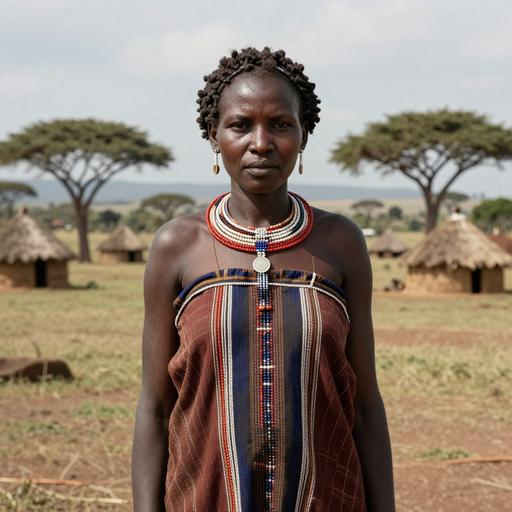
The Story
The journey of mtDNA haplogroup L3F2
Origins and Evolution
mtDNA haplogroup L3F2 is a subclade of L3f, itself a branch of the broader African macro-haplogroup L3. L3f has a Late Pleistocene origin in eastern/central Africa (commonly estimated near ~30 kya for the parent clade), and L3F2 represents a younger, regionally diversified lineage that most population genetic evidence suggests arose in the eastern African/Horn region during the Late Pleistocene to Early Holocene (we estimate on the order of ~10–15 kya for L3F2). As with most mtDNA subclades, L3F2 is defined by a combination of control-region and coding-region mutations derived from its parent nodes; these mutations mark a maternal lineage that subsequently expanded and admixed with neighboring groups.
Subclades
L3F2 sits beneath L3f in the phylogeny. Where sequencing coverage allows, L3f is commonly subdivided into multiple branches (for example L3f1, L3f2, and other minor clades). L3F2 itself may contain further minor internal diversity detectable in full mitogenomes, reflecting later regional differentiation; however, many published population surveys identify L3F2 primarily at the clade level rather than resolving deep internal structure, so the degree and age of any internal subclades are still refined as more complete mtDNA genomes are generated from diverse African populations.
Geographical Distribution
Empirical population surveys and mitogenome studies indicate that L3F2 is primarily an African maternal lineage with the strongest signals in eastern and central Africa and measurable presence in western and southern regions at lower frequencies. The pattern is consistent with an origin in or near the Horn/East Africa, followed by dispersal through gene flow, local drift, and historic demographic events (including the later Bantu expansions and recent trans-Atlantic slave trade).
- Higher relative frequencies are reported in some Horn of Africa and adjacent eastern African populations.
- Moderate frequencies can appear in Central African hunter-gatherer and West African groups where L3f lineages are present through prehistoric contacts and movements.
- Low frequencies are found in southern African Khoe-San groups and in North Africa or the Middle East due to historic admixture and trade.
- Presence in the Americas and Europe typically reflects the African diaspora (historic slave trade) and recent migrations.
Historical and Cultural Significance
While mtDNA haplogroups are not direct markers of archaeological cultures, the distribution and age of L3F2 allow reasonable associations with broad demographic processes in Holocene Africa. The emergence of L3F2 within East Africa coincides temporally with climatic improvement after the Last Glacial Maximum and cultural changes in the Later Stone Age and early Holocene. Subsequent demographic events that shaped its distribution include:
- Pastoral Neolithic and early Holocene movements in East Africa: regional demographic expansions and cultural transitions that redistributed maternal lineages across the Horn and adjacent areas.
- Bantu-associated expansions (mid–late Holocene): as Bantu-speaking groups expanded from a core area in West/Central Africa, they moved through regions where L3f-derived lineages were present; this produced local admixture and the appearance of L3F2 at varying frequencies in descendant populations.
- Historic era contacts and the trans-Atlantic slave trade: L3F2 appears in African-descended populations in the Americas and in some Mediterranean/Middle Eastern populations as a result of more recent movements and admixture.
These associations are population-genetic inferences based on phylogeography and dating; they do not imply a one-to-one correspondence between the haplogroup and particular cultural identifiers.
Conclusion
L3F2 is a regionally important maternal subclade of L3f that documents a strand of eastern African maternal ancestry with downstream dispersals into Central, West and Southern Africa and into the African diaspora. Continued sampling of complete mitochondrial genomes across underrepresented African populations will refine the internal structure and age estimates of L3F2 and help clarify its microevolutionary history across the continent.
Key Points
- Origins and Evolution
- Subclades
- Geographical Distribution
- Historical and Cultural Significance
- Conclusion