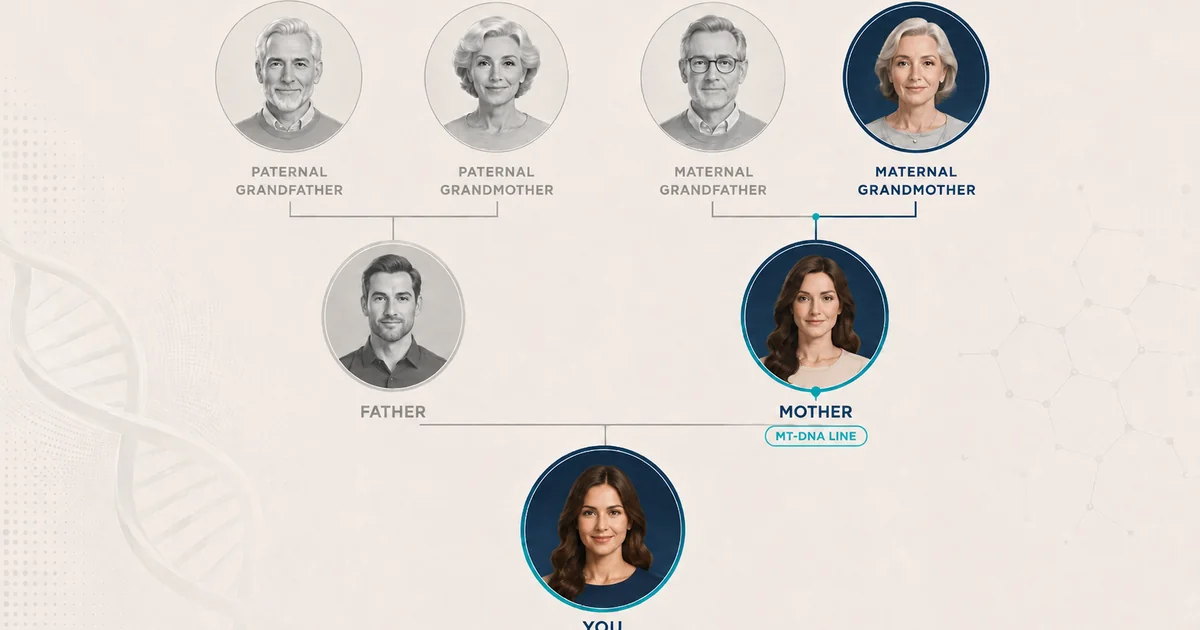
From mother to child, again and again— one line continued.
Mitochondrial DNA passes from mother to child in an unbroken chain. While your ancestry draws from countless forebears, this single lineage has traveled forward through time, unchanged in its essence, until it reached you.
What is Mitochondrial DNA?
A clear explanation without jargon or oversimplification.
Inside every cell, there are small structures called mitochondria. These contain their own DNA—separate from the DNA in your chromosomes.
Mitochondrial DNA (mtDNA) has a unique property: it passes almost exclusively from mothers to their children. Fathers rarely contribute mitochondrial DNA, meaning your mtDNA came from your mother, who inherited it from her mother, who received it from her mother—and so on, back through time.
Because mtDNA changes very slowly over generations, it preserves a record of your maternal lineage extending back thousands of years. These changes accumulate into distinct patterns called haplogroups, which mark ancient populations and their migrations across the world.
A Line That Never Split
Understanding what makes maternal lineage different.
Your ancestry is vast. Go back ten generations, and you have over a thousand direct ancestors. Go back twenty, and the number exceeds a million. Each contributed something to who you are today.
But mitochondrial DNA tells a different kind of story. Unlike your autosomal DNA—which recombines and mixes with each generation—mtDNA does not recombine. It passes whole from mother to child. This means your maternal lineage is a single, continuous thread through time.
"Many ancestors contributed to you.
This lineage never branched."
Your Full Ancestry
Thousands of ancestors, each contributing a portion of your genetic heritage. DNA recombines each generation, mixing paternal and maternal contributions. A complex web of inheritance.
Your Maternal Line
One path through generations. No recombination, no branching. A record of survival and transmission that extends back 175,000 years to the common maternal ancestor of all living humans.
Maternal Haplogroups and Deep Time
Markers of ancient populations shared across humanity.
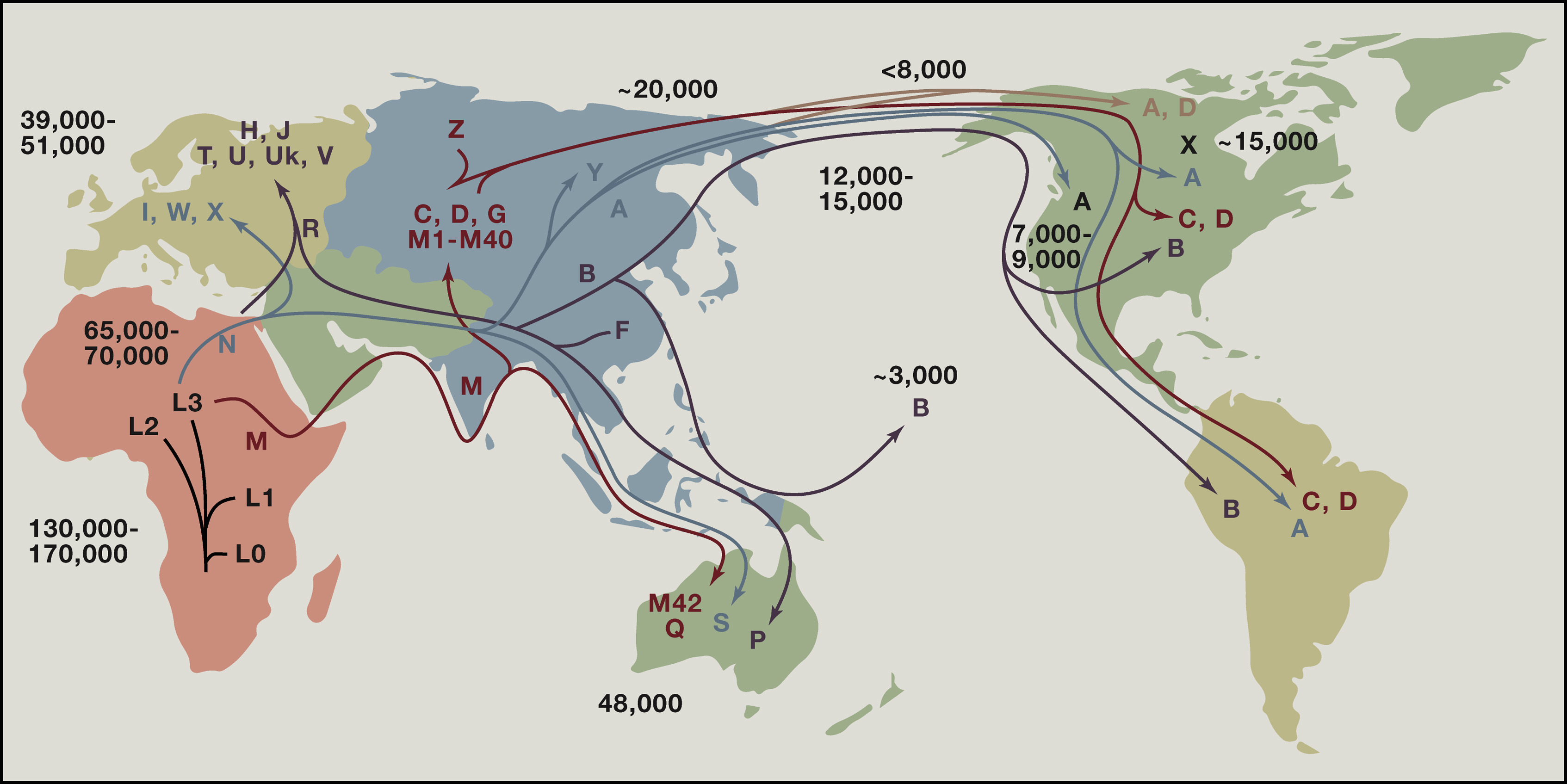
Haplogroups are not tribes or nations. They are genetic markers that developed as human populations spread across the world over tens of thousands of years. People with the same maternal haplogroup share a maternal lineage branch, not a specific named ancestor. That shared branch point may be recent, ancient, or separated by oceans and millennia.
Your haplogroup is part of shared human history. It connects you to migrations, to adaptations, to survival across changing climates and shifting landscapes.
The Common Maternal Ancestor
In eastern Africa, the woman we call "Mitochondrial Eve" lived. She was not the only woman of her time, but she is the one whose mitochondrial lineage survived in all living humans today. From her, all maternal haplogroups descend.
Migrations Out of Africa
Early human populations carrying distinct maternal lineages migrated from Africa into the Middle East, Asia, and eventually reached Europe and the far corners of the world.
Haplogroup Diversification
As populations settled in different environments—ice-age Europe, tropical Asia, the Americas—new maternal haplogroups emerged, each carrying the story of adaptation and endurance.
The Agricultural Age and Beyond
Farming spread from the Fertile Crescent, carrying maternal lineages across Europe and Asia. Migrations, conquests, and trade routes continued to spread and mix haplogroups—but each individual's maternal line remained unbroken.
Your Haplogroup
Your maternal haplogroup connects you to this ancient journey. It is not the whole story of your ancestry, but it is one that has traveled forward, unchanged in its essence, from mother to child, until it reached you.
What This Report Reveals
This is not a family tree. It is a line of descent.
Your Maternal Haplogroup
Precise identification of your maternal haplogroup using PhyloTree Build 17, a detailed mtDNA classification system.
Geographic Origins
Where your haplogroup emerged and where it spread. The lands your maternal ancestors traversed over thousands of years.
Historical Context
The migrations, adaptations, and historical events that shaped your maternal lineage's journey through time.
Modern Distribution
Where people with your maternal haplogroup live today, connecting you to populations across continents who share this ancient lineage.
Phylogenetic Placement
Your position on the maternal tree of human lineages, showing how your haplogroup relates to others across the world.
Plain-Language Narrative
Not just data—understanding. Your report is written clearly, designed for reflection rather than confusion.
Free basic preview before you buy
If your DNA file contains mitochondrial markers, your dashboard and the report page show a free basic preview: one broad, older branch of the maternal tree that your result falls within, a branch many people share. The full report names your exact haplogroup, its estimated age, where it is found, and the ancient individuals linked to it.
Reading Your Results Correctly
A calm perspective on what mtDNA tells you—and what it does not.
Your mtDNA ancestry report is one piece of a larger picture. Understanding its scope and limitations helps you appreciate what it reveals without overinterpreting what it means for your full ancestry.
One Lineage Among Many
mtDNA represents your direct maternal line only. It does not account for your father's ancestry, your maternal grandfather's line, or the many other ancestors who contributed to who you are.
Complements Other Analyses
mtDNA works alongside autosomal ancestry analysis (which reflects all ancestors) and Y-DNA analysis (for paternal lineage). Together, they provide a fuller picture.
No More, No Less
Your maternal haplogroup is not "more important" than your other ancestry. It is simply one line that can be traced with unusual clarity across deep time.
The Experience of the Report
Designed for understanding, not overwhelm.
Clearly Structured, Carefully Written
Your report is designed to be read and understood—not to impress with technical jargon or confuse with excessive data. Every section serves a purpose: to help you understand your maternal lineage.
Scientific Foundation
Exact methodology, transparent references.
PhyloTree Build 17
Your haplogroup is identified using PhyloTree Build 17, the gold standard for mitochondrial DNA classification, incorporating thousands of complete mtDNA sequences from around the world.
Mutation Rate Analysis
mtDNA accumulates mutations at a known rate, allowing scientists to estimate when haplogroups diverged. This molecular clock provides the timeline of your maternal lineage's journey.
Reference Population Data
Haplogroup distribution is mapped using extensive population studies from peer-reviewed literature, providing accurate geographic and historical context.
Validation and Confidence
Haplogroup predictions are validated against established marker databases, with confidence levels clearly reported when applicable.
"Mitochondrial DNA is one of the most stable markers in human genetics—
a quiet record of maternal descent across deep time."
Provider Compatibility Information
AncestryDNA is no longer providing MTDNA/YDNA data for tests taken since January 2026. Additionally, MyHeritage is no longer providing YDNA data for RAW files downloaded since January 2026 (note: MyHeritage never provided mtDNA data, only YDNA). YSEQ RAW files do not contain valid MTDNA information for MTDNA prediction, resulting in wrong and inconsistent predictions.
For accurate mtDNA analysis, consider using data from compatible providers such as 23andMe, LivingDNA, ADNtro, TellMeGen, or ordering a dedicated mtDNA test.
Frequently Asked Questions
Common questions about mtDNA analysis and compatibility.
- 23andMe - Provides good quality mtDNA data
- LivingDNA - Provides good quality mtDNA data
- ADNtro - Provides good quality mtDNA data
- TellMeGen - Provides good quality mtDNA data
- FamilyTreeDNA - Dedicated mtDNA tests available
Important limitations:
- AncestryDNA: No longer providing MTDNA/YDNA data for tests taken since January 2026
- MyHeritage: Never provided mtDNA data (only YDNA, which is no longer available since January 2026)
- YSEQ: RAW files generated by YSEQ do not contain valid MTDNA information for MTDNA prediction, resulting in wrong and inconsistent predictions
- FTDNA: Standard autosomal tests don't include mtDNA data (dedicated mtDNA test required)
If your DNA file doesn't contain sufficient mtDNA markers, consider uploading data from another provider or ordering a dedicated mtDNA test.
Testing providers have discontinued MTDNA/YDNA data provision:
As of January 2026, AncestryDNA is no longer providing MTDNA and YDNA haplogroup data in their raw DNA files for tests taken since this date. This means:
- AncestryDNA tests before January 2026: May still contain mtDNA/YDNA data if downloaded before the change
- AncestryDNA tests since January 2026: Will not contain mitochondrial or Y-chromosome DNA markers
- MyHeritage: Never provided mtDNA data (only YDNA, which is no longer available since January 2026)
- YSEQ: RAW files from YSEQ do not contain valid MTDNA markers needed for accurate haplogroup prediction, leading to incorrect and inconsistent results
- Alternative options: Consider using data from 23andMe, LivingDNA, ADNtro, TellMeGen, or ordering a dedicated mtDNA test from FamilyTreeDNA
Follow the Line That Endured
Many stories come together to make you.
This one never stopped.
"The line continues. Now you can trace it."