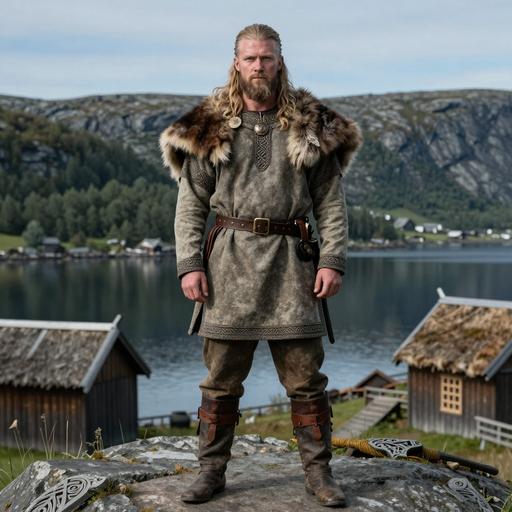
The Story
The journey of Y-DNA haplogroup I1A1B1A4A2
Origins and Evolution
Y-DNA haplogroup I1A1B1A4A2 is a deeply nested subclade of I1, one of the major paternal lineages of northern Europe. Because it sits several branches downstream from the broader I1 trunk, it is best interpreted as a recently differentiated founder lineage rather than an ancient, widespread macro-haplogroup. Its emergence is most plausibly placed in Scandinavia or adjacent northwest Europe during the late Neolithic to early Bronze Age time frame, when regional male lineages were increasingly structured by small population sizes, local drift, and social expansion of particular lineages.
The broader I1 haplogroup is strongly associated with northern European paternal ancestry and is especially common in Scandinavia. Subclades like I1A1B1A4A2 often represent branches that expanded within limited regions before appearing at low frequency in surrounding populations through migration, trade, warfare, and later historical mobility. Because of its position in the phylogenetic tree, this lineage is expected to be rare overall and more informative for tracing localized paternal descent than for describing broad continental patterns.
Subclades
As an intermediate downstream clade, I1A1B1A4A2 helps connect broader parent branches to more terminal lineages. Its immediate phylogenetic context suggests that it may have one or more very rare daughter branches, although public frequency data for such fine-level clades are often limited.
- Parent lineage: I1A1B1A4A
- Broader haplogroup: I1
- Phylogenetic implication: a localized northern European founder branch
Geographical Distribution
This haplogroup is expected to be concentrated in Scandinavia and northwest Europe, with low-frequency appearances in adjacent regions where northern European male ancestry has been historically present. Like other rare I1 subclades, it may also be observed in diaspora populations with recent ancestry from northern Europe.
Typical regions include:
- Scandinavia: likely highest concentration
- Northern Germany and the Low Countries: due to historical gene flow across the North Sea and Baltic zone
- British Isles: especially in populations with Norse, Anglo-Saxon, or later Scandinavian inputs
- Baltic region: through medieval and early modern northern European contacts
- Eastern Europe and the Balkans: usually low frequency, often reflecting historical mobility
- The Americas and Australia: in descendants of recent European emigrants
Historical and Cultural Significance
The cultural context of I1 and its subclades is complex. While the deepest roots of I1 likely precede the major cultural formations of the Neolithic and Bronze Age, the later expansion of northern European paternal lineages is often discussed in relation to Corded Ware, Nordic Bronze Age, and subsequent Iron Age and medieval Scandinavian population movements.
For a rare terminal branch such as I1A1B1A4A2, the most appropriate interpretation is not direct attribution to a single archaeological culture, but rather continuity within north European male lineages that were later amplified by demographic processes in the Bronze Age and historical era. In particular, Viking Age and medieval mobility may have helped disperse such lineages beyond their original local strongholds.
Population Genetics Context
Because this is a highly specific downstream haplogroup, its interpretation depends heavily on phylogenetic placement rather than on wide frequency studies. In population genetics, such clades often arise from:
- Founder effects in small regional populations
- Patrilineal social structure and differential male reproductive success
- Isolation-by-distance across northern Europe
- Historical migrations during the Viking Age, medieval trade, and modern diaspora formation
As with other rare Y-DNA subclades, the presence of I1A1B1A4A2 in multiple countries does not necessarily imply multiple origins; it may instead reflect a single regional origin followed by later dispersal of descendant males.
Conclusion
Y-DNA haplogroup I1A1B1A4A2 is a rare and likely localized branch of the broader I1 paternal lineage, rooted in northern Europe and probably centered in Scandinavia or nearby northwest Europe. Its distribution and age are most consistent with a regional founder lineage that expanded modestly through ancient northern European continuity and later historical movements.
Key Points
- Origins and Evolution
- Subclades
- Geographical Distribution
- Historical and Cultural Significance
- Population Genetics Context