Introduction
The Altai region sits at a crossroads between Europe and Asia, a corridor where cultures and peoples met, traded, and moved. By sequencing ancient genomes from the Altai and nearby Ob region, researchers built a ca. 1400-year time transect that reveals both continuity and change across the Iron Age to Medieval periods. This work adds a crucial chapter to the story of inner Eurasia, a zone long thought to host dynamic migrations and complex admixture.
Why does this matter? Understanding how populations in this region persisted, shifted, and interacted helps illuminate broader patterns of migration across the Asian steppes and informs how we interpret modern North Asian ancestry. The Altai data also refine our models of population genetics in a critical geographic node where ancient DNA, archaeology, and linguistic-cultural histories intersect.
Key Discoveries
- Finding 1: A ca. 1400-year Altai genome transect shows population continuity, with Iron Age genetic variety persisting into the Medieval era.
- Finding 2: A large-scale influx of East Asian genetic ancestry coincides with the rise and spread of Turkic cultural customs in the region.
- Finding 3: A unique Early Medieval Altai lineage exhibits elevated Ancient North Eurasian ancestry (ANE), suggesting a link between North Eurasian hunter-gatherers and modern North Asian groups.
- Finding 4: Distinct genetic patterns emerge between the Mountainous Altai and Forest-Steppe Altai populations in the 4th–8th centuries, indicating regional differentiation during this period.
Ancestry Insights: The study emphasizes continuous Iron Age diversity, admixture events tied to cultural shifts, and regional population structure that persisted into later centuries.
Historical Context: The Altai region served as a conduit for cultural and genetic exchange, with the 4th–8th centuries marking a period of regional differentiation that foreshadows later Turkic expansions.
AI Analysis Available: YES
What This Means for Your DNA
For people exploring their own ancestry, these findings highlight how regional studies can resolve questions about continuity versus replacement over long time spans. If your DNA shows components linked to East Asian ancestry, this work helps explain how such signatures can emerge and spread in tandem with cultural dynamics, such as the rise of Turkic influences in the region.
Autosomal DNA analyses that compare modern genomes to ancient reference panels can reveal admixture proportions and timing. The Altai transect demonstrates that ancestry components can persist for centuries even as new genetic influxes rise, shaping modern haplogroup and genome-wide patterns. Beginners can look for telltale shifts in East Asian-affiliated components and cross-check with historical migrations to understand how ancestry components accumulate over time.
For intermediate and advanced readers, the study underscores the importance of integrating time transects, population models, and regional differentiation when reconstructing family histories. The concept of a long, continuous Iron Age gene pool that persists into medieval times challenges simplistic narratives of wholesale population replacement.
Historical and Archaeological Context
The Altai and surrounding Mountainous Altai and Forest-Steppe landscapes form a strategic corridor where steppe, forest, and mountain communities connected across vast distances. The 4th–8th centuries, a formative period in inner Eurasia, saw cultural shifts and exchanges that culminated in large-scale exchanges with East Asian populations and the emergence of Turkic cultural practices. The discovery of an East Asian admixture signal aligning with Turkic-era dynamics aligns with archaeological indicators of material culture, trade networks, and settlement patterns that suggest sustained interaction across these regions. The 9th–12th centuries continued this trajectory, with admixture signals persisting alongside local continuity, painting a nuanced picture of population movements rather than abrupt replacements.
The distinct genetic patterns between Mountainous Altai and Forest-Steppe Altai during the 4th–8th centuries also reflect geography-driven differentiation. Mountains can foster isolated pockets of continuity, while forest-steppe zones may facilitate different contact networks. Together, these findings place Altai in a broader context of Inner Asian population history, linking hunter-gatherer lineages to later regional populations and providing a bridge to modern North Asian ancestry.
The Science Behind the Study
The study analyzes autosomal genome-wide data from 91 newly sequenced ancient individuals, forming a roughly 1400-year time transect in the Altai and Ob regions. Standard population-genomic methods were applied, including Principal Component Analysis (PCA), Runs of Homozygosity (ROH), Identity-by-Descent (IBD), and admixture modeling with qpAdm. These techniques enable researchers to quantify ancestry components, detect continuity versus admixture, and model the contribution of different source populations over time. The dataset provides a robust framework for testing hypotheses about population structure in inner Eurasia, while also acknowledging that the findings are preliminary until peer review completes.
In Simple Terms: This section explains the methods in plain language: PCA looks at how genomes cluster by ancestry, ROH measures how long stretches of DNA are identical within an individual (hinting at population size and mating patterns), IBD detects shared ancestry between individuals, and qpAdm estimates how much ancestry comes from different source populations. Together, these tools let researchers reconstruct who mixed with whom and when.
Infographic
The study provides an infographic that visualizes the Altai genome transect, illustrating population continuity, admixture events, and regional differences from the 4th to the 12th centuries. The graphic helps readers quickly grasp how Iron Age diversity persisted into Medieval times and where East Asian ancestry integrated with local lineages.
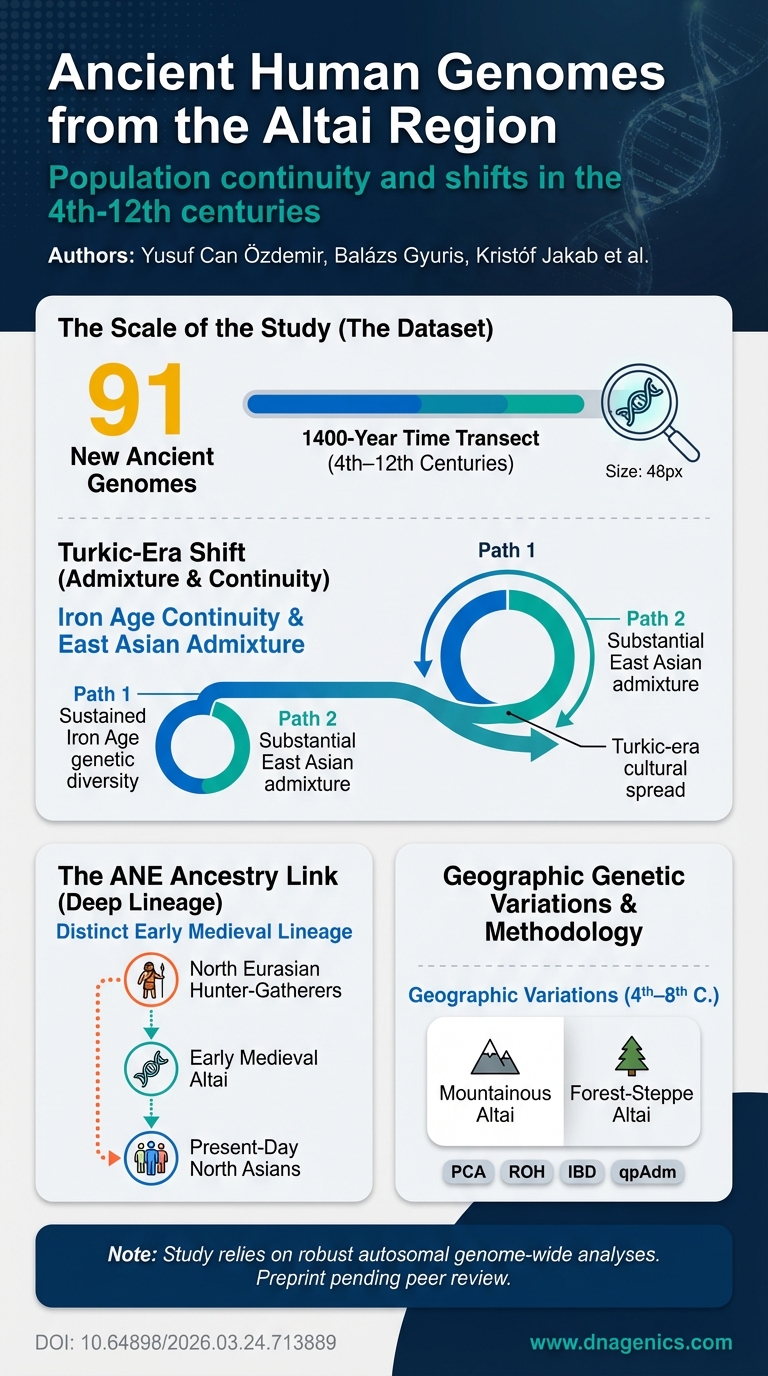
Description: The image shows sampling locations along the Altai transect, the proportions of ancestries over time, and the emergence of East Asian components coinciding with Turkic-era cultural changes. It synthesizes complex data into a visually accessible narrative about continuity and admixture.
Why It Matters
This work adds a refined narrative to our understanding of inner Eurasian population history by presenting a long, continuous genetic record in the Altai, with clear signals of East Asian admixture tied to cultural shifts. It highlights regional differentiation and long-term continuity that challenge simple models of population replacement. The implications extend to how we interpret modern North Asian genetics and how future ancient DNA studies can integrate archaeology, linguistics, and genome-wide data to build more precise population histories. Future research could expand sampling density across other nearby regions, test additional source populations, and incorporate ancient environmental data to understand how climate and subsistence strategies influenced migration and admixture.
References
- Ancient human genomes from the Altai region reveal population continuity and shifts in the 4th-12th centuries
- DOI