Introduction
Ibiza may be famous for sunlit coves, but a hidden archive lies in its medieval graves. A new study analyzes the genomes and metagenomes of 13 individuals buried in an Islamic-era cemetery on Ibiza, dated to 950–1150 CE. The result is a vivid, data-rich portrait of a frontier society where people carried mixed European, North African, and Sub-Saharan ancestries, along with pathogens that illuminate life and disease in the Balearics during a dynamic period of conquest and exchange.
Ibiza was a crossroads where Mediterranean, North African, and Saharan connections intersected under Islamic rule. By combining genome-wide analyses with ancient pathogen profiling, researchers can time migrations, trace movement routes, and glimpse health in a small island community that sat at the edge of multiple empires. This multidisciplinary approach, while powerful, also faces limitations from reference data and small sample size. Still, the securely dated genomes offer a rare, high-resolution view of medieval population dynamics in the Balearics and beyond.
Key Discoveries
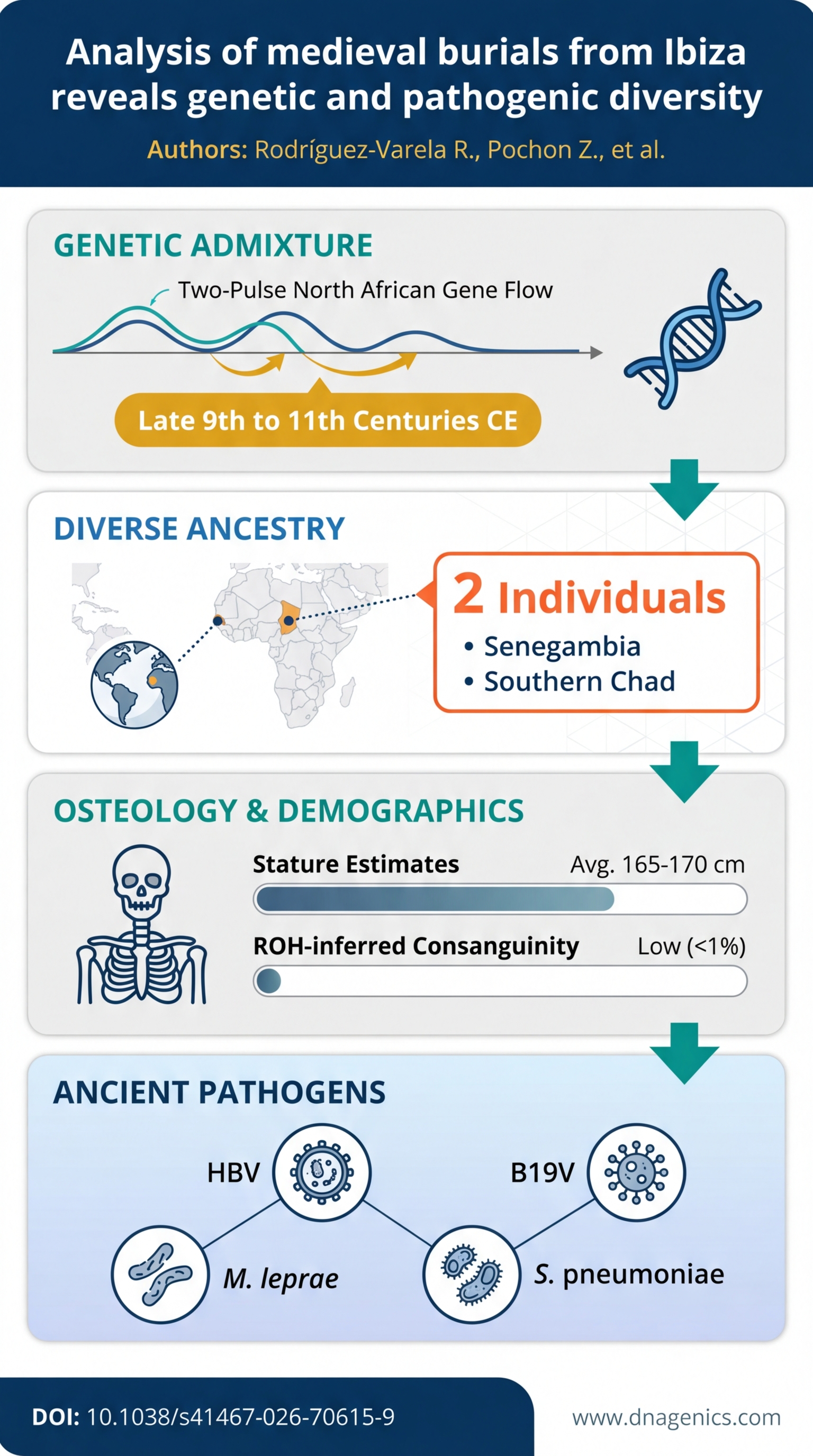
- Two-pulse model: Genome-wide data support two major North African gene flow events into Ibiza during the Islamic period, with an initial pulse around the late 9th to early 10th centuries CE and a second influx linked to Almoravid movements in the 11th century.
- Mosaic ancestry: All analyzed Ibiza individuals carry mixed Iberian European and North African ancestry; two individuals show Sub-Saharan ancestry with affinities to distinct regions.
- Long haplotype evidence: Analyses of haplotypes reveal extended European and North African segments, indicating admixture occurring within a few generations of the sampled individuals.
- Sub-Saharan lineages: One lineage aligns with southern Chad and another with Senegambia, providing direct evidence of long-distance trans-Saharan connections in medieval networks.
- Pathogens and health context: Metagenomic data detect pathogens such as HBV genotypes A and D and HBV/B19V, as well as Mycobacterium leprae genotype 2F, Streptococcus pneumoniae, and Parvimonas micra, painting a picture of health and disease within the community. Runs of Homozygosity in a subset of individuals also indicate localized consanguinity.
In Simple Terms: The researchers looked at 13 ancient genomes from Ibiza, finding that people there carried a mix of European and North African ancestry, with a couple of individuals showing Sub-Saharan connections. The DNA also lets us glimpse ancient diseases that affected the island, all within a framework of two historical waves of migration.
What This Means for Your DNA
For DNA enthusiasts and ancestry explorers, this study reinforces a core lesson: human history is a tapestry of multiple, overlapping migrations rather than a single lineage. The late antique and medieval Balearic context shows how population turnover can occur in bursts, leaving detectable traces in the genome as short- and long-range ancestry signals. In practical terms, it highlights why haplotype-based approaches (which track contiguous segments of ancestry) can reveal recent admixture more precisely than looking at allele frequencies alone.
If you analyze your own ancestry, remember that modern populations can conceal ancient movements. The Ibiza genomes illustrate how a person today could carry European, North African, and Sub-Saharan components in varying proportions, shaped by past conquests, trade, and slavery networks. When you interpret haplogroup data or ancestry estimates, consider the historical context and the possibility of multiple admixture events across generations.
Historical and Archaeological Context
The Ibiza study sits at a pivotal historical moment. Ibiza was conquered in 902 CE by the Umayyad Emirate of Córdoba and remained under Islamic rule through 1235 CE. The cemetery dated to 950–1150 CE captures a population during a time of early settlement following conquest and a later phase associated with broader regional dynamics, including Almoravid movements in the twelfth century. The two-pulse demographic model aligns with these historical inflections: an initial North African settlement after the early tenth century and a second influx tied to movements that expanded and reshaped Iberian and Balearic landscapes.
These genomic findings dovetail with archaeological and documentary sources that describe trade, military activity, and slave networks crossing the Mediterranean and Sahara. The presence of Sub-Saharan lineages in two individuals suggests far-reaching connections that extended into West and Central Africa, consistent with medieval accounts of trans-Saharan mobility and exchange. The integration of osteological data also adds context for health and demographics, such as stature estimates and indications of localized endogamy within subgroups.
The Science Behind the Study
This work relies on genome-wide analyses and metagenomic profiling of 13 individuals from Ibiza, dated to 950–1150 CE. The team used haplotype-based ancestry inference (notably RFMix) to deconvolute mixed ancestries and to estimate the timing of admixture events, revealing a two-pulse model with a first North African influx in the late 9th to early 10th centuries and a second influx in the 11th century linked to Almoravid movements. The study also employed uniparental markers and osteological data to complement genome-wide findings.
Metagenomic analyses recovered a variety of pathogens, including HBV genotypes A and D, HBV/B19V, and Mycobacterium leprae genotype 2F, along with other host-associated taxa like Streptococcus pneumoniae and Parvimonas micra. Runs of Homozygosity (ROH) analyses revealed evidence of consanguinity in a subset of individuals, indicating localized inbreeding within subgroups despite overall ancestry diversity. The authors acknowledge methodological limitations, including reference bias from North African surrogates (Mozabite/Bedouin) and limited representation of Sub-Saharan African populations, which may influence the partitioning of ancestry but not the overarching admixture narrative. Data are deposited in ENA, with controlled-access resources for modern African references.
In Simple Terms: In plain language, scientists compared the DNA of 13 medieval Ibiza burials to map where their ancestors came from, how they mixed, and what diseases affected them—while noting the limitations of reference data and the small sample size.
Infographic Section - Infographic is available
The infographic summarizes the study’s core concepts: the two-pulse North African admixture model, the mosaic ancestry across individuals including Sub-Saharan signals, and the pathogen findings in the metagenomic data. It visualizes how short and long chromosomal segments reveal the timing and sources of admixture, and how ancient pathogens help reconstruct life in medieval Ibiza.
Why It Matters
This study advances our understanding of population history in the western Mediterranean by providing securely dated genomes from the Balearics and demonstrating a nuanced two-pulse model of North African gene flow. It highlights how migration, conquest, and long-distance connections shaped island populations and health in a crossroads region. The integration of pathogen metagenomics with population genetics enriches our reconstruction of medieval daily life and disease landscapes. Future work could expand SSA representation in reference datasets, sample additional Balearic sites, and refine admixture dating with larger, more diverse cohorts to further illuminate migration routes and health dynamics in medieval Europe and North Africa.
References
DOI: 10.1038/s41467-026-70615-9