Introduction
In a field long dominated by dedicated clean-room facilities, new work from Slovenia shows that standard forensic genetic techniques can yield reliable ancient DNA data from archaeological remains. This narrative review surveys the Slovenian group's skeletal analyses across multiple sites, highlighting how careful contamination control and adapted workflows make forensic tools applicable to archaeogenetics.
Why this research matters is twofold. First, it broadens the toolkit for studying past populations by validating conventional forensic methods in ancient contexts, expanding options when petrous bones are unavailable or preservation is variable. Second, it informs best practices for sampling, storage, and interpretation—crucial as researchers continue to infer ancestry, kinship, and phenotypic traits from degraded DNA. Together, these findings help bridge forensic genetics and archaeogenetics, enabling more robust reconstructions of historical populations while prioritizing preservation and ethical sampling.
Key Discoveries
- Petrous bones provide the best endogenous DNA preservation, but alternative bones can be viable depending on context.
- Tooth cementum and patellae offer non-destructive or high-yield DNA sources, expanding options when petrous bones are unavailable.
- PowerQuant pre-screening improves efficiency by predicting STR success in degraded samples.
- Integrated STR, SNP, and MPS approaches enhance kinship analyses and case-specific resolution, including multi-method confirmation such as a 5th–6th century father–sons scenario with Y-haplogroup hints (E1b1b).
- HIrisPlex-based eye and hair color predictions are feasible in ancient DNA with consensus genotyping to mitigate damage artifacts, and Genetic sexing of subadult skeletons can outperform morphological methods.
What This Means for Your DNA
For enthusiasts exploring ancestry, these findings translate into practical guidance. If you’re analyzing ancient or degraded samples, prioritize DNA sources with higher preservation potential—petrous bones remain the gold standard, but the study shows that cementum and certain postcranial bones (like patellae) can yield usable data under favorable preservation. This expands the options for non-destructive or minimally destructive sampling, which is especially important when working with culturally sensitive remains.
The study also demonstrates the value of a tiered analytics approach. A pre-screen with PowerQuant helps predict whether downstream STR typing will be successful, saving time and resources on poor-quality material. When data are limited or damaged, combining STR and SNP data—and, where feasible, MPS-based identity SNPs—can improve kinship resolution and confidence in inferred relationships. Trait predictions, such as eye and hair color via HIrisPlex, are possible in ancient samples, provided robust consensus methods counteract damage artifacts. These insights can inform personal ancestry narratives while maintaining scientific rigor.
For hobbyists and professionals alike, the take-home message is clear: modern forensic techniques, when applied with stringent contamination controls and thoughtful sampling, can yield meaningful genetic information from archaeological remains and connect individual stories to broader population histories.
Historical and Archaeological Context
The Slovenian work situates ancient DNA recovery within real-world environmental and archaeological settings. Soil chemistry, temperature, and humidity influence DNA degradation, so preservation patterns observed in petrous bones and alternative sources reflect site-specific conditions. Across the studied contexts, patterns of preservation correlated with microenvironmental factors, underscoring the need for careful sample handling and storage in museums and labs alike.
From a historical perspective, the analyses tie genetic signals to known archaeological contexts in Slovenia and surrounding regions. Kinship in medieval to early medieval contexts, coupled with multi-marker approaches, provides a window into family structures and social organization. The use of non-destructive sampling methods also aligns with preservation ethics and curatorial requirements, enabling researchers to extract meaningful data while limiting damage to precious materials.
The Science Behind the Study
The researchers applied a practical fusion of forensic techniques to ancient material, detailing methods that balance contamination control with accessible workflows. Key methodological components included targeted sampling of skeletal elements (petrous bone, teeth, patella, femur, talus, calcaneus, patella), DNA extraction protocols optimized to minimize bone powder, and a combination of real-time PCR and sequencing approaches.
The lab implemented the PowerQuant system to pre-screen DNA quality and quantity, guiding downstream STR typing on degraded material. For kinship analyses, the study integrated STR, SNP, and MPS-based identity SNPs to maximize statistical power and resolve relatedness—evident in the demonstrated father–sons scenario from the 5th–6th centuries with supportive Y-haplogroup hints (E1b1b). Eye and hair color predictions used the HIrisPlex panel, with multi-sample consensus genotyping deployed to mitigate damage-induced artifacts.
In Simple Terms: This work shows that careful application of forensic genetics to ancient bones can recover meaningful genetic data even when the samples are old or degraded, provided contamination is controlled and multiple evidence lines are combined.
[Infographic Section - INCLUDES Infographic]
Infographic: Slovenian Ancient DNA Workflow and Key Findings
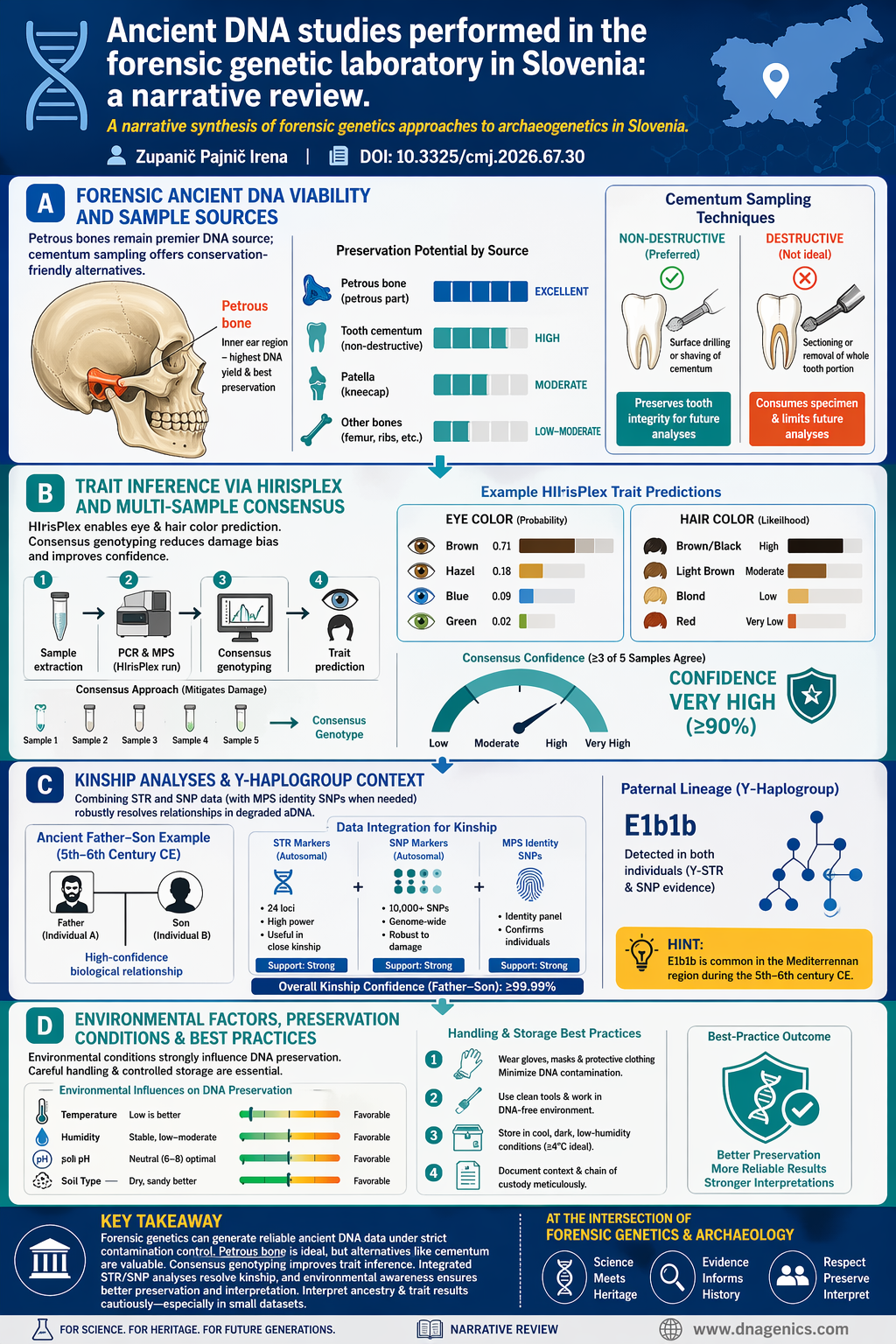
What the infographic shows:
- The sampling strategy across skeletal elements (petrous bone, teeth, patella, etc.).
- The workflow from DNA extraction to sequencing and data interpretation.
- The relationship between preservation conditions and data yield, plus the impact of pre-screening on efficiency.
- Examples of kinship hierarchical analyses combining STR, SNP, and MPS data, including a Y-haplogroup hint (E1b1b).
Why It Matters
This narrative reinforces that forensic genetics can meaningfully contribute to archaeogenetics without compromising conservation ethics. By validating conventional forensic tools under strict contamination controls for archaeological contexts, the work broadens access to ancient DNA data, supports more nuanced ancestry and kinship reconstructions, and informs best practices for sample handling and storage. The integrated approach—combining multiple genetic markers and non-destructive sampling—sets a pragmatic standard for future studies tackling degraded materials across diverse archaeological settings.
Looking ahead, further optimization of sampling strategies and consensus genotyping will refine trait predictions and ancestry inferences from ancient remains. Additional cross-site comparisons and standardized reporting will help harmonize methods across labs, enhancing reproducibility in population genetics and historical genetics research.
References
- View publication on DnaGenics
- Ancient DNA studies performed in the forensic genetic laboratory in Slovenia: a narrative review
- DOI