Introduction
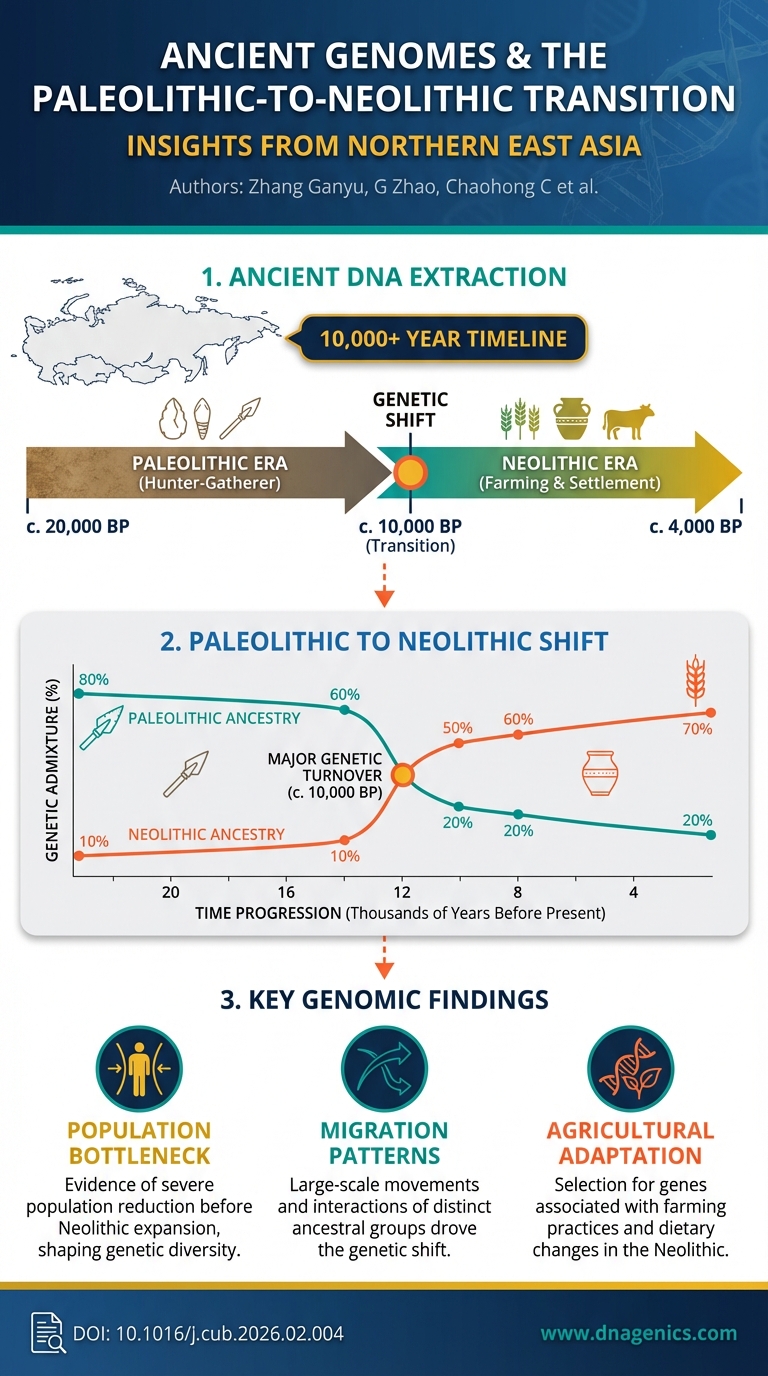
A tiny fragment from the deep past can unlock big questions about how people lived, moved, and adapted. The Paleolithic-to-Neolithic transition (PNT) marks a pivotal shift when hunter-gatherer groups gradually adopted farming and new technologies, reshaping societies worldwide. In northern East Asia, new ancient DNA from Donghulin, near modern Beijing, pushes this story back to roughly 11,000–9,000 years ago and shows a regional Neolithization with unique genetic dynamics.
Why this research matters goes beyond regional history. By tracing ancient genomes through a period of rapid climate change—the Holocene warming after the last Ice Age—scientists can test models of population continuity, migration, and admixture. These findings enrich our understanding of how early East Asian populations contributed to today’s genetic landscape and help refine how we interpret modern DNA data in light of deep-time events.
Key Discoveries
- DHL_M1 represents a newly discovered deep northern East Asian (nEA) lineage, diverging early in the Late Pleistocene. This lineage anchors a long, deep-rooted genetic history for northern East Asia.
- The study provides the earliest genetic evidence of Neolithization in northern East Asia, dating to roughly 11,000–9,000 years ago and tied to the Donghulin archaeological context.
- The Donghulin samples show genetic changes over ~2,000 years during the post-glacial warming period, revealing dynamic population turnover and potential admixture during the transition.
- Findings highlight genetic diversity and a complex population trajectory during the Neolithization process in northern East Asia, suggesting a regional PNT with its own distinctive tempo and pathways.
What This Means for Your DNA
For people exploring ancestry testing, these results underscore how regional histories can diverge even within a broad continent. The identification of a deep nEA lineage and evidence for early Neolithic gene flow in northern East Asia illustrate how ancient events can shape modern DNA in ways that aren’t always obvious from contemporary samples alone. In practical terms, a handful of ancient samples can illuminate lineage continuity or discontinuity, helping to contextualize current haplogroup patterns and regional variation.
If your family tree includes East Asian roots, you might encounter signals that reflect these deep-time dynamics—not every ancient lineage survives in modern populations in the same form, and regional histories can reveal pockets of diversity that standard datasets miss. This study also highlights the importance of integrating archaeology and genetics to interpret ancestry with nuance, rather than relying on single-marker stories.
Historical and Archaeological Context
Across many regions, the PNT coincides with a warming Holocene climate and the gradual emergence of farming technologies. In northern East Asia, the Donghulin site (western Beijing) provides a rare window into this transition, dating from approximately 11,000 to 9,000 years ago. The discovery of mitochondrial genomes from three individuals and genome-wide data from two individuals directly ties genetic signals to archaeological layers associated with early Neolithic lifeways, illustrating how culture and population history intertwined during a period of rapid environmental change.
This research situates northern East Asia within the broader narrative of PNT worldwide, while emphasizing regional distinctiveness. The presence of a deep nEA lineage prior to widespread Neolithic adoption points to long-standing population structure in East Asia, which later interacted with incoming cultural practices to produce the diverse genetic tapestry seen in contemporary East Asian populations. The ~2,000-year window captured at the site aligns with post-glacial warming, a time when landscapes and resources shifted and human groups likely restructured their communities through movement, contact, and sharing of technologies.
The Science Behind the Study
The study combines ancient DNA (aDNA) techniques with archaeological context to reconstruct population history during the PNT in northern East Asia. The researchers generated mitochondrial genomes from three individuals and genome-wide data from two individuals excavated at the Donghulin site, dated to roughly 11–9 thousand years ago. This dual data approach allows both maternal lineage tracking and broad genome-wide analyses to assess population structure and admixture signals.
Analytically, the work likely employed authentication checks common in ancient DNA research—damage pattern assessment, contamination estimates, and replication across independent extractions—to confirm the authenticity of the genetic material. The genome-wide data, albeit from a small sample, would enable ordination-based methods (e.g., PCA), clustering approaches, and formal tests for population splits and gene flow (such as D-statistics or f-statistics), helping to place the DHL_M1 lineage in the broader context of East Asian genetic diversity. The small sample size means interpretations emphasize cautious inferences about population-level processes but nonetheless offer crucial insights into the timing and nature of Neolithization in this region.
In Simple Terms: Ancient DNA lets scientists peek at an individual’s genetic code from thousands of years ago. By comparing multiple ancient genomes, researchers can see who related to whom, when lineages split, and how populations mix during big cultural shifts like adopting farming. In this study, a deep lineage (DHL_M1) and early Neolithic signals show that northern East Asia had its own unique path during the transition from hunting and gathering to farming.
Infographic Section
Before/after: Infographic highlights the timeline of the Paleolithic-to-Neolithic transition in northern East Asia, the Donghulin site context, and the key genetic findings (DHL_M1 lineage and Neolithization signals). The infographic visually links archaeological strata to genetic data and how climate change framed migration and admixture during ~11–9 thousand years ago.
Why It Matters
These findings illuminate a region-specific path through the PNT, illustrating how northern East Asia contributed to the broader story of early agriculture and population dynamics in East Asia. The identification of a deep nEA lineage and the documented genetic changes during post-glacial warming underscore the complexity of population structure and admixture during this critical period. Looking ahead, broader sampling across northern China and neighboring regions, higher-coverage ancient genomes, and integration with isotopic data and archaeological modeling will refine our understanding of how Neolithization unfolded across diverse landscapes and cultures.
References
Ancient genomes provide insight into the Paleolithic-to-Neolithic transition in northern East Asia
DOI: 10.1016/j.cub.2026.02.004