Introduction
What can ancient bones tell us about the making of a European kingdom? The Piast dynasty, foundational rulers of medieval Poland, are now being read through their DNA. An interdisciplinary study in archaeogenomics reconstructs kin networks from Piast necropolises spread across Poland, offering a genetic perspective on how state formation may have unfolded in East-Central Europe during the 9th–11th centuries. These findings add a crucial layer to the historical narrative, suggesting that dynastic politics involved not just local elites but broader European connections.
Why does this research matter? By linking paternal lineages, maternal lineages, and radiocarbon-dated remains, scientists are peeling back the curtain on origins, migration, and marriage patterns that shaped early Poland. The work also broadens our view of dynastic networks across Europe, showing how royal families—from Piasts to the Árpáds—may have participated in a shared medieval kinship landscape. This matters for ancestry enthusiasts because it highlights how ancient DNA can illuminate migration, kinship, and political alliances beyond traditional archives, while also reminding us of the uncertainties and limitations of working with small, ancient samples.
Set in Poland, the study provides a template for integrating archaeology, anthropology, and population genetics to understand how East-Central Europe emerged as a medieval polity. The researchers identify ten Piast individuals with high confidence and map cross-dynastic maternal and paternal links, inviting a reconsideration of how statehood and ethnicity formed in this dynamic region.
Key Discoveries
- Piasts studied show a predominant Y-haplogroup signature of R1b-BY3549, suggesting a shared paternal lineage across multiple generations and supporting a close male-line continuity within a single family network.
- Árpád dynasty connections and broader medieval European kinship networks point to non-local origins relative to central Poland, aligning with cross-continental dynastic exchange.
- Mitochondrial haplogroups illuminate diverse maternal lineages (e.g., T2b2b1, H7b1), enabling cross-dynastic comparisons with the Árpáds and highlighting dynastic unions shaping royal genealogies.
- The integration of radiocarbon dating, anthropological context, and kinship analyses allowed researchers to confidently identify ten Piast remains (PIAST01–PIAST17) and to map several kinship ties consistent with historical records.
- The study underscores the limitations of inferring phenotype from ancient DNA; no eye/hair/skin color data are reported, illustrating the broader point that genomic ancestry does not readily translate to visible traits in ancient individuals.
What This Means for Your DNA
For DNA enthusiasts, the Piast study offers a vivid reminder of how ancestry works across generations and continents. The predominance of a rare Y-haplogroup (R1b-BY3549) among Piast individuals underscores that paternal lineages can travel far beyond modern national borders through dynastic marriages and political alliances. Conversely, the diverse maternal lineages reflected in mitochondrial haplogroups demonstrate how royal networks connected women across dynasties, reinforcing the idea that lineage is a tapestry woven from many strands.
From a practical perspective, this research emphasizes three takeaways for personal DNA analysis:
- Y-DNA and mtDNA can reveal deep-past connections but are only part of the story; autosomal DNA captures a broader mosaic of ancestry affected by migrations, admixture, and admixture over many generations.
- Dynastic history can involve non-local origins and cross-border kin networks, so modern ancestry may reflect diverse geographic threads that converge in a single lineage.
- Caution is essential when inferring physical traits from ancient DNA; this study explicitly notes the absence of phenotype data, highlighting the limits of translating genotype to appearance.
If you’re exploring your own ancestry, consider how paternal and maternal lineages (Y-DNA and mtDNA) may connect to broad European dynastic histories. While a direct Piast connection for most readers is unlikely, understanding these patterns can enrich your interpretation of how migrations and alliances shape modern genetic diversity.
Historical and Archaeological Context
The Piast dynasty rose in a frontier region of East-Central Europe, playing a pivotal role in the political transformation of Poland from a collection of tribes into a medieval kingdom during the 10th century CE. The new study situates Piast necropolises across Poland within a broader tapestry of medieval Europe, where migration, intermarriage, and political alliance forged dynastic networks that extended beyond local borders. By combining radiocarbon dating with anthropological context and kinship analyses, researchers align genetic findings with historical records of dynastic power and territory.
The cross-dynastic links to the Árpád dynasty of Hungary reflect a period of intense interaction across Central Europe. These ties support a model of state formation in which foreign elites and their networks contributed to political consolidation in East-Central Europe. The timing—centuries spanning the 9th to 11th centuries—maps onto a dynamic migration frontier where cultures mingled and polities redefined themselves through marriage, alliance, and strategic burial practices. The geographic spread of samples in Poland provides a tangible framework to discuss how dynastic politics may have guided the emergence of a Polish realm that would later become a cornerstone of Central European history.
The Science Behind the Study
This interdisciplinary project rests on archaeogenomic techniques, combining genetics with archaeology and anthropology. Researchers surveyed eight necropolis sites in Poland, recovering skeletal remains likely belonging to Piast individuals. From these, they identified 33 sets of remains as Piasts, with genomic data confirming 10 identifications as Piasts. The analysis integrated radiocarbon dating to anchor chronology with kinship inferences based on genomic data, enabling the reconstruction of family networks across generations and between dynasties.
A key methodological pillar is the use of Y-chromosome and mitochondrial DNA (mtDNA) analyses to trace paternal and maternal lines, respectively, alongside autosomal data where available. The team also leveraged comparative data from historical figures across ten European royal dynasties to place Piast lineages in a broader dynastic context. Importantly, the researchers acknowledge limitations, including sample size and the cautious framing of conclusions about origins beyond the Piast subset studied. This balanced approach exemplifies population genetics in practice: combining multiple lines of evidence to illuminate complex demographic processes while acknowledging uncertainties.
In Simple Terms: Ancient DNA is like a time-stamped family tree. Scientists read the DNA from old bones to identify who was related to whom (through the Y-chromosome for fathers and mtDNA for mothers), estimate when individuals lived, and compare these lines across different royal families. The Piast results suggest connections beyond Poland and highlight how dynastic marriages tied together European elites, but they also remind us that one study of a few individuals can’t capture the whole story of a people.
Infographic Section
This study features an infographic that visualizes the Piast sampling sites, the Y-chromosome and mitochondrial lineages found among the remains, and the kinship links within and between dynasties, including ties to the Árpád dynasty. The image helps translate complex genetic relationships into an accessible map of medieval European dynastic networks.
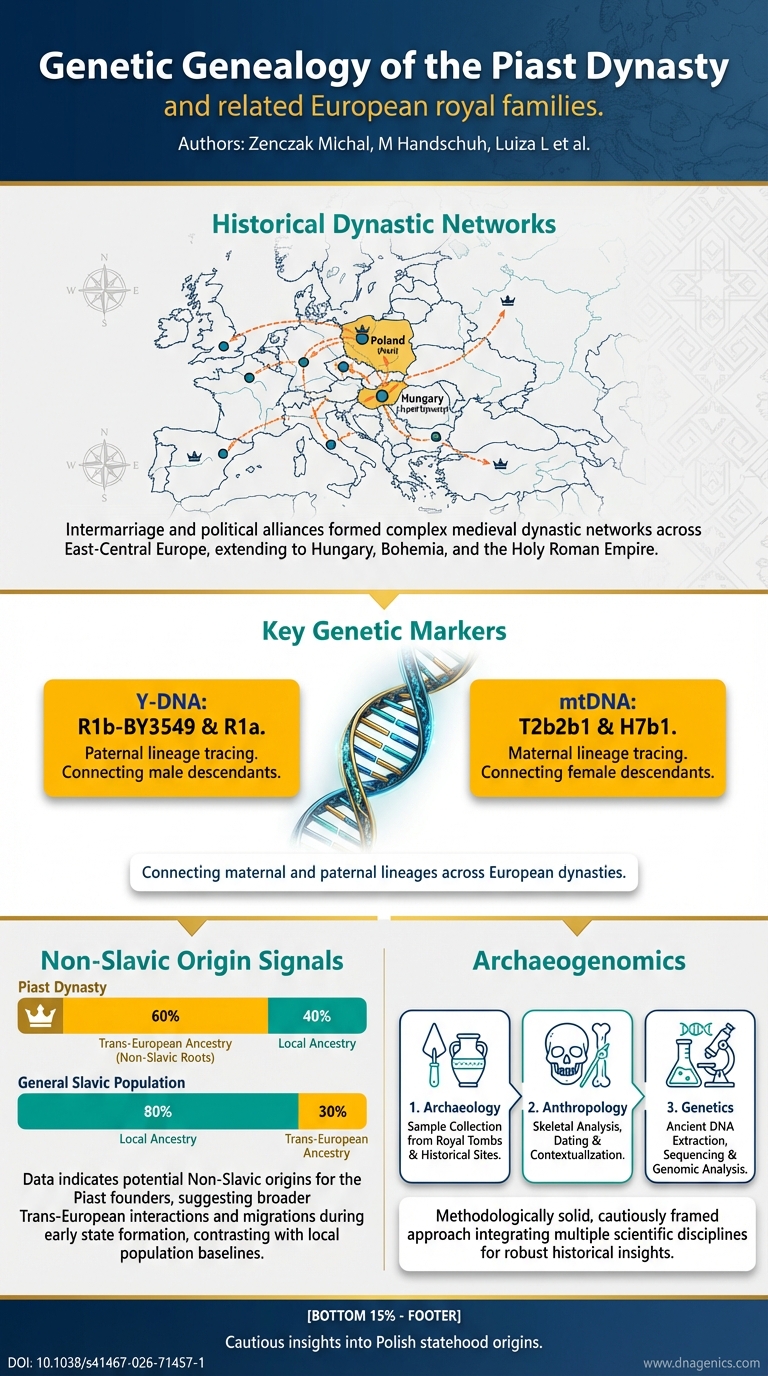
What the infographic shows: sampling locations across Polish necropolises, the distribution of Y-haplogroups (notably R1b-BY3549 and related lineages) and mtDNA haplogroups, and inferred kinships that align with historical narratives about cross-dynastic marriages and migrations.
Why It Matters
This research adds a valuable genetic dimension to the long-standing historical question of how Poland’s medieval state emerged. By demonstrating cross-European connections and suggesting non-local origins for the Piasts, the study reinforces the view that state formation was a trans-European process influenced by migrations, alliances, and kin networks. The integration of radiocarbon dating, anthropology, and kinship inference provides a robust framework for future work in population genetics and archaeology and offers a concrete model for how to study dynastic histories in other regions.
Looking ahead, expanding sample sizes, including additional necropolises, and integrating more comparative ancient DNA data across Central and Western Europe could refine our understanding of how dynastic politics intersected with population movements. This work lays the groundwork for exploring how modern genetic diversity in Poland and neighboring regions reflects centuries of dynastic interaction and migration.
References
Genetic genealogy of the Piast dynasty and related European royal families.
DOI: 10.1038/s41467-026-71457-1