Introduction
Across the Roman frontier, borderland sites like Praetorium Agrippinae offer a window into how communities formed, moved, and integrated people from diverse regions. This study combines strontium, oxygen, and carbon isotope analysis with ancient DNA from 33 inhumed and 44 cremated individuals buried at the site in Valkenburg, the Netherlands, to paint a biomolecular portrait of a major Lower Rhine border node with a long occupation history. The results show a community shaped by mobility, demographic diversity, and social differentiation, challenging the old view of border areas as uniformly organized military enclaves.
Why this research matters goes beyond cataloging origins. It demonstrates how borderland populations could be socially mixed, interconnected, and dynamic over centuries. By integrating isotope data with genome-wide analyses, researchers can distinguish local from non-local individuals, identify distant connections, and interpret burial practices in a broader social context. For practitioners of ancestry analysis, the study underscores the value and limitations of combining environmental and genetic proxies to reconstruct personal and population histories.
Key Discoveries
- Finding 1: Demographic heterogeneity and mobility – Valkenburg’s population is genetically and isotopically diverse, with mobility signatures across life stages and burial practices, supporting a borderland community rather than a closed military enclave.
- Finding 2: Outliers with distant affinities – Two individuals show clear genetic affinities to non-local populations (Greek-like and Estonian-like), illustrating occasional long-distance movement into the settlement.
- Finding 3: Isotopic mobility thresholds exceed baseline expectations – Nearly 40% of individuals exceed mobility thresholds in both Sr and O isotopes, indicating substantial cross-regional movement beyond local baselines.
- Finding 4: Burial practice heterogeneity and social interpretation – Cremation and inhumation signals suggest a more nuanced social structure; inhumations may reflect a specific subset rather than a strictly separate population, with kinship signals largely absent within the sampled group.
- Finding 5: Pigmentation predictions show Western European diversity – HIrisPlex-S inferences reveal a range of pigmentation traits consistent with Western European variation, though predictions carry uncertainty due to data quality and coverage.
What This Means for Your DNA
For individuals curious about their own ancestry, this study highlights how mobility and admixture across long arcs of time can shape genetic landscapes. The presence of non-local genetic signals and a broadly diverse isotope profile at Praetorium Agrippinae demonstrates that borderland populations often included people from multiple regions, not just a single recruiting district. In practical terms, a DNA test may reveal a mosaic of ancestries, and isotopic data from the same individuals could point to upbringing in places far from the burial site. It also emphasizes that absence of close kinship signals in ancient samples does not mean a lack of social ties; communities could be interconnected through movement and long-distance networks rather than tight kin groups.
For hobbyists and researchers, the study reinforces the importance of multi-proxy data when interpreting ancestry. You might see a diverse genetic background alongside non-local isotopic signatures, suggesting movement, exchange, and social integration across Great Distances and generations.
Historical and Archaeological Context
Praetorium Agrippinae sits at what was a major Northwestern borderland node along the Lower Rhine Limes, with a long occupation history and a substantial cemetery. The site’s cemetery composition—predominantly cremations with a significant inhumation component—offers a rare opportunity to compare burial practices within a single community over roughly three centuries. The combination of large-scale burial data and biomolecular analysis makes it possible to link demographic patterns to broader Roman frontier dynamics, including mobility, trade, military provisioning, and cultural exchange across diverse regions.
These findings fit into a growing archaeological narrative that Roman borderlands were not monolithic military outposts but socially mixed zones where people from different geographic origins interacted, moved, and settled. The gradient of migration signals, together with observed pigment diversity in the sample, points to a borderland population shaped by ongoing movement and interaction across Western Europe and beyond.
The Science Behind the Study
This study employs a multi-proxy approach to reconstruct mobility, ancestry, and phenotype within a single community. Researchers analyzed Sr-O-C isotopes from enamel and cremated bone to infer geographic origins and mobility, alongside ancient DNA (aDNA) to build heterogeneous ancestry profiles and assess kinship. The dataset comprises 33 inhumed and 44 cremated individuals, allowing direct comparisons between burial practices and biomolecular signatures. In addition, HIrisPlex-S phenotype predictions were used to explore pigmentation variation, providing a probabilistic view of skin, hair, and eye color across the population.
Methodologically, the team established local isotopic baselines and evaluated mobility against these baselines for both strontium and oxygen isotopes. aDNA analyses revealed a lack of close kinship ties within the sampled cohort, reinforcing the view of a diverse, mixed community. While HIrisPlex-S results align with Western European pigmentation diversity, researchers caution that predictions depend on data quality and coverage, particularly in ancient contexts where preservation varies.
In Simple Terms: Biomolecular data act like fingerprints. Strontium and oxygen in teeth tell where a person likely grew up, carbon isotopes inform about diet and environment, and ancient DNA reveals ancestral affinities. Put together, they help us understand who moved here, where they came from, and what their appearance might have looked like, even when written records are missing.
[Infographic Section - Infographic Included]
Before you read on, check out the infographic that visualizes the study’s multi-proxy approach and key findings.
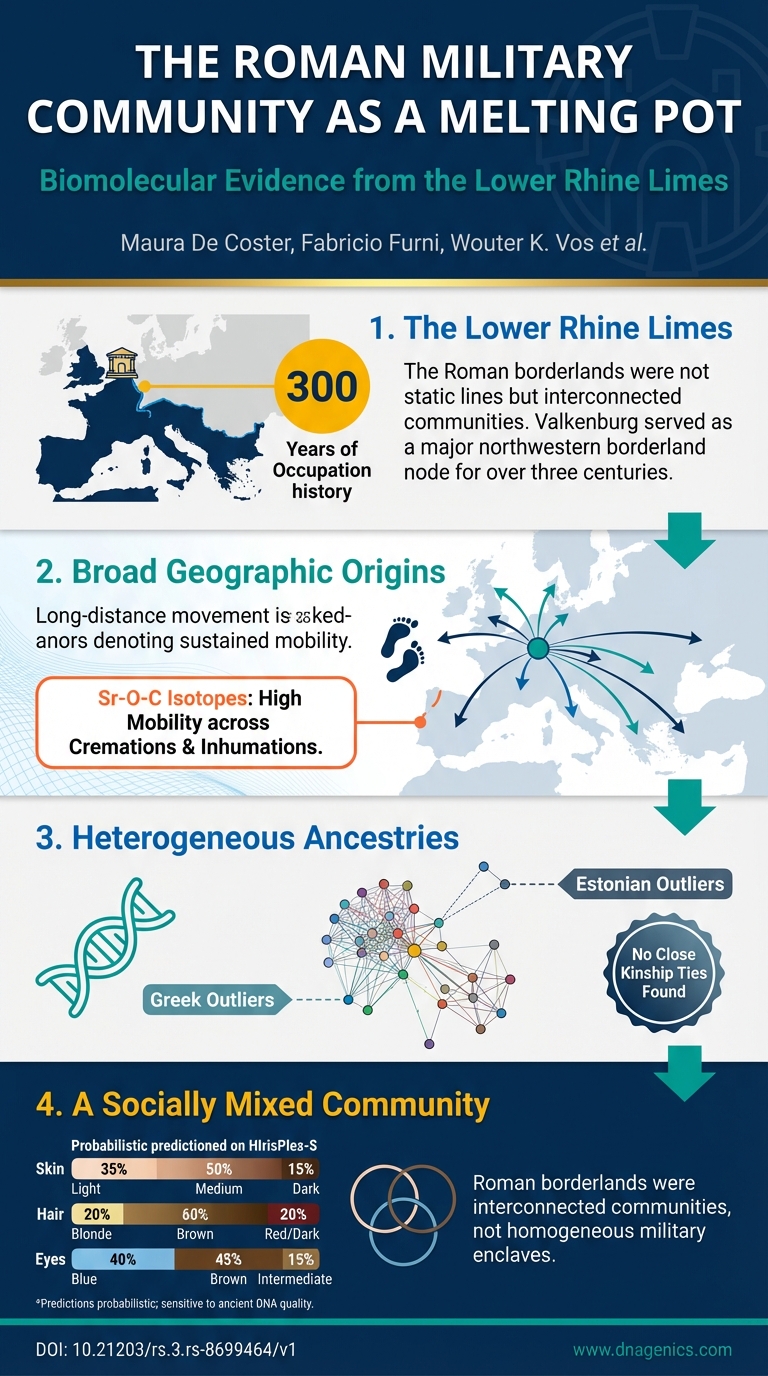
The infographic summarizes how isotope data (Sr-O-C) from enamel and cremated bone, combined with ancient DNA and pigmentation predictions, converge to portray a highly mobile and genetically diverse borderland community across 300 years.
Why It Matters
This research matters because it reframes how we understand Roman borderlands: from fixed garrisons to interconnected, demographically diverse communities shaped by movement and social differentiation. The evidence of long-distance connections and broad mobility challenges simplistic models of Roman frontier life and highlights the value of integrating archaeology with biomolecular techniques. Future work could expand sampling across other borderland sites to map broader migration networks and refine our interpretations of burial practices in relation to social status, identity, and mobility.
References
The Roman Military Community as a Melting Pot: Biomolecular Evidence from the Lower Rhine Limes
DOI: 10.21203/rs.3.rs-8699464/v1