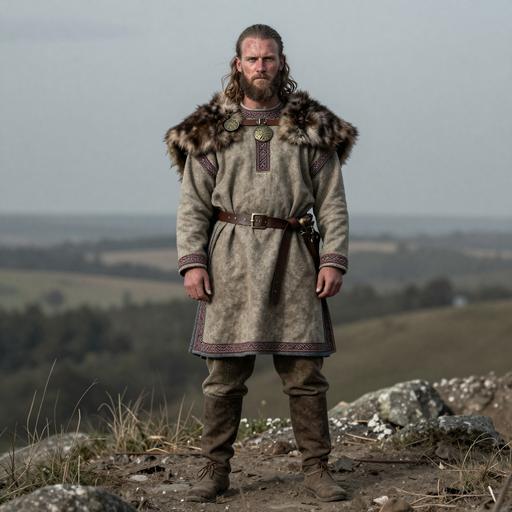
The Story
The journey of Y-DNA haplogroup I1A1B1
Origins and Evolution
Y-DNA haplogroup I1A1B1 is a subclade of I1A1B, which itself is nested within the broader I1 paternal lineage. The I1 branch is widely regarded as one of the characteristic Y-chromosome lineages of northern Europe, with roots traceable to post-glacial recolonization and subsequent founder effects in refugial and northern European populations.
Given its position in the phylogenetic tree, I1A1B1 is best understood as a relatively recent derivative of the northern European I1 expansion rather than an ancient deeply divergent lineage. Its likely formation around 10 thousand years ago aligns with the period after the Late Glacial Maximum, when human groups expanded into Scandinavia and adjacent regions and experienced repeated bottlenecks, drift, and local differentiation.
Subclades
As an intermediate or near-intermediate branch, I1A1B1 may contain additional downstream lineages not yet widely resolved in public datasets or may serve as a connector between parent and child branches in phylogenetic reconstructions. In Y-chromosome studies, such lineages often reflect regional founder events, small effective population sizes, and the accumulation of private mutations within localized male lines.
Geographical Distribution
This haplogroup is expected to show its highest frequencies in Scandinavia, especially in Sweden, Norway, Denmark, and historically linked areas of Finland and Iceland. It should also be present at lower to moderate levels in Germany, Austria, the British Isles, the Baltic region, Eastern Europe, and parts of Central and Southeastern Europe due to historical mobility, medieval expansion, trade, warfare, and later modern migration.
Outside Europe, I1A1B1 may be encountered in diaspora populations in the Americas, Australia, and New Zealand, reflecting relatively recent genealogical movements rather than ancient local origin.
Historical and Cultural Significance
Although no single archaeological culture can be assigned with certainty to I1A1B1 specifically, its broader parent lineages within I1 are frequently discussed in relation to post-glacial European population history and later northern European demographic expansions. More generally, I1 lineages are often associated with Mesolithic-to-Neolithic European continuity, followed by substantial growth during later prehistoric and historic periods in northern Europe.
Because this haplogroup is a sub-branch of a northern European lineage, it may be found among men descending from populations associated with Corded Ware, Bronze Age northern European societies, and later Germanic and Scandinavian population expansions. However, these associations should be treated as broad demographic context rather than direct cultural attribution.
Population Genetics Context
From a population-genetic perspective, I1A1B1 likely reflects low to moderate frequency distribution, with localized peaks caused by founder effects and drift. Such patterns are typical of Y-chromosome lineages in northern Europe, where paternal lines can become overrepresented within specific regions or surnames due to historical demographic processes.
The lineage's placement within I1 suggests affinity with populations in which I1 is common, including Scandinavian and northwestern European groups. Its finer structure may be informative in studies of regional paternal ancestry, surname history, and the phylogeography of northern European male lineages.
Conclusion
I1A1B1 is a northern European Y-DNA subclade shaped by post-glacial expansion, founder effects, and later regional demographic history. It is most strongly associated with Scandinavia and nearby European populations, while also appearing in diaspora communities worldwide through more recent migration.
Key Points
- Origins and Evolution
- Subclades
- Geographical Distribution
- Historical and Cultural Significance
- Population Genetics Context