


Population history and subsistence of farming communities in an agro-pastoral transition zone of northern China: ancient DNA and isotopic evidence from the Erdaojingzi site
Xiaohong Lv, Yao Yu, Lin Ban et al.
Visual Summary
A visual snapshot of this publication's key findings at a glance
Publication Details
Comprehensive information about this research publication
Abstract
Summary of the research findings
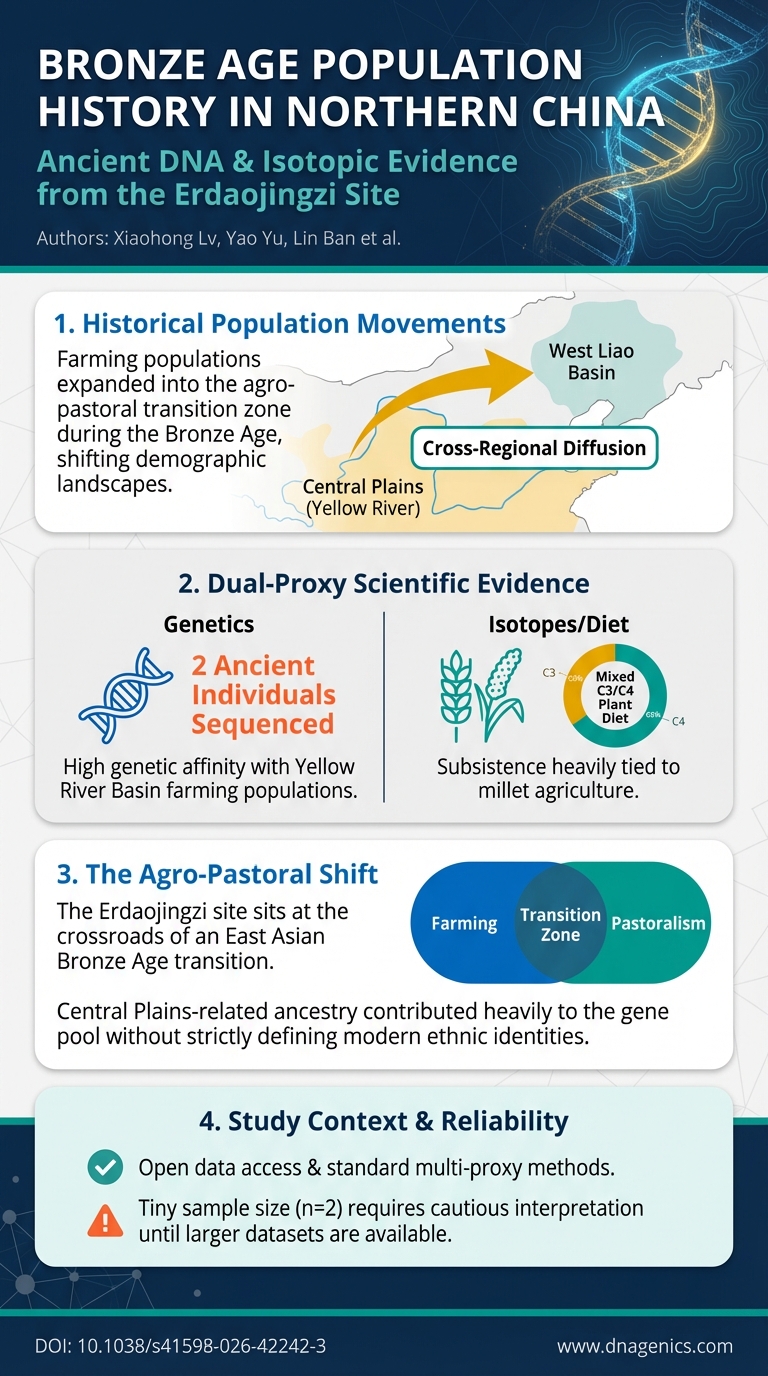
This study investigates the population history and subsistence of farming communities at the Erdaojingzi site (ca. 3700–3330 cal. BP), a well-preserved Bronze Age settlement located in the agro-pastoral transition zone of the West Liao River Basin in northern China. We apply a multidisciplinary approach, combining ancient DNA, carbon and nitrogen stable isotope analysis, zooarchaeological data and archaeobotanical evidence, to evaluate population affinities at the site and to characterise subsistence practices in relation to environmental and cultural conditions. Ancient DNA from two individuals shows ancestry profiles closely related to farming populations of the Yellow River Basin, rather than to previously published Neolithic groups from the western Liao region, indicating strong genetic connections with Central Plains related farming communities. Stable isotope results from 43 animal and two human bone samples demonstrate that millet and its by-products formed dietary staples for both humans and domestic animals. Humans, pigs and dogs primarily relied on C4 plants, whereas cattle and sheep consumed mixed diets of C3 and C4 plants. Nitrogen isotope values point to a diet rich in animal protein for humans. Combined age at death and isotopic data from pig remains further indicate that young pigs constituted an important component of meat consumption. Variation in nitrogen isotope values among sheep suggests differences in grazing and foddering regimes, and may also reflect localised soil enrichment by dung and other management practices. Taken together, these results provide new insight into how farming communities organised their subsistence and how population history and economic strategies were intertwined in an agro-pastoral transition zone of prehistoric East Asia.
Analysis
Comprehensive review of ancestry and genetic findings
Important Disclaimer: This review has been performed semi-automatically and is provided for informational purposes only. While we strive for accuracy, this analysis may contain errors, omissions, or misinterpretations of the original research. DNA Genics disclaims all liability for any inaccuracies, errors, or consequences arising from the use of this information. Users should independently verify all information and consult original research publications before making any decisions based on this content. This analysis is not intended as a substitute for professional scientific review or medical advice.