Introduction
The story of modern humans is not just a short chapter in history; it is a long, winding saga of migrations, mixtures, and hidden populations. A new method, called GhostBuster, uses genome-wide genealogies to detect admixture from unsampled, or “ghost,” populations and to infer accurate local ancestry across deep time. This opens a window into our most ancient exchanges, beyond what present-day diversity or ancient DNA alone can reveal.
Why this research matters is twofold. First, it challenges the idea that deep ancestry can be read only from a few well-characterized populations or recent ancient samples. Second, it provides a framework to connect deep historical events with present-day genetics, including how ancient mixing shapes polygenic traits and the portability of DNA-based predictions across African populations and beyond. The study situates modern human ancestry as a tapestry woven from multiple, time-spread admixture events, not a single lineage meeting another.
In this context, the study offers a cohesive narrative that links ancient population structure to today’s genetic diversity, migration patterns, and the genomic architecture of recombination. By modeling ghost admixture and local ancestry, the authors map out deep events that help explain why different populations carry different risk and trait profiles, and why some regionally tuned DNA tests can miss historical nuances. The result is a more nuanced view of human history that integrates genetics, archaeology, and population history.
Key Discoveries
- Three waves of back-to-Africa admixture identified around ~14,000 years ago, highlighting a complex, bidirectional history of human movement.
- A ~50,000-year-ago lineage expansion that contributed to present-day non-Africans while also expanding within Africa and mixing with local African groups.
- Two deeply diverged ancestral lineages (300k–1M years ago) with distinct recombination landscapes, tied to different PRDM9-A and PRDM9-C alleles.
- Neanderthals and ancestral modern humans formed through mixtures of these two lineages, with no evidence of gene flow from the PRDM9-A lineage into Denisovans.
- Deep population structure in Africa may influence polygenic score portability and cross-population trait associations.
- GhostBuster provides a framework to detect admixture from ghost populations and to infer local ancestry using genome-wide genealogies, expanding how we study deep human history.
What This Means for Your DNA
For DNA enthusiasts, this research translates into a more dynamic view of ancestry testing. Traditional analyses often focus on a limited set of reference populations and relatively recent events. The GhostBuster approach, by incorporating unsampled ghost populations and deep-time genealogies, suggests that your personal DNA carries signatures from lineages that no modern population perfectly represents. In practice, this means:
- Ancestry inferences may reflect complex mixtures that occurred long before recent migrations, not just the last few thousand years.
- Local ancestry assignments can become more nuanced, revealing how ancient recombination landscapes and lineage-specific hotspots shaped segments of your genome.
- Polygenic trait predictions could vary across populations within Africa and beyond, informed by ancient admixture and recombination history that influence how many trait-associated variants you inherit.
For beginners, think of GhostBuster as a method to read the deep past written into your DNA, going beyond present-day population signals to understand how ancient lineages contributed to who you are today.
Historical and Archaeological Context
The study places deep ancestry in a broad historical frame. The proposed back-to-Africa waves around 14k years ago align with well-documented periods of climate shifts and renewed human mobility in Africa and adjacent regions, suggesting repeated bidirectional interactions between African populations. The ~50k-year lineage expansion corresponds to a critical window when modern humans diversified outside Africa and partially recirculated within Africa, mixing with local groups in complex patterns.
On a deeper timescale, the researchers propose two deeply diverged ancestral lineages active between 300k and 1M years ago, each with distinct recombination landscapes and different PRDM9 alleles. By showing that Neanderthals and ancestral modern humans derive from mixtures of these lineages, the work links deep genomic structure to migration, interbreeding, and the shaping of recombination hotspots. The finding that no gene flow from the PRDM9-A lineage entered Denisovans provides a concrete boundary on ancient admixture routes and helps explain differences in how recombination operates across hominin lineages.
These connections knit together genetic signals with archaeological timelines of human presence, migration routes, and population interactions. The frame supports a narrative where Africa remained a hub of genetic exchange and diversification long after modern humans emerged, influencing both global dispersals and regional genetic landscapes.
The Science Behind the Study
At the core of this work is the GhostBuster method, which leverages inferred genome-wide genealogies to detect admixture from unsampled ghost populations while simultaneously inferring accurate local ancestry. This dual approach allows researchers to identify ancestry-specific genomic segments that corroborate deep admixture events, even when one or more source populations are not directly observed in the dataset.
The researchers combine genome-wide genealogies with local ancestry inference to reconstruct the timing and sources of admixture across deep time. The analysis spans broad timescales, from hundreds of thousands of years ago to the late Pleistocene and Holocene, and integrates recombination landscape differences linked to distinct PRDM9 alleles. Key methodological components include coalescent-based modelling of genealogy across the genome, probabilistic inference of ancestry along chromosomes, and cross-validation with ancient DNA when available. Although the preprint has not yet undergone peer review, the framework offers a principled way to interpret deep ancestry and its effects on modern genomes.
In Simple Terms: GhostBuster tries to read the hidden chapters of our DNA by imagining ghost populations that left genetic traces, then using those traces to map where in the genome different ancient lineages contributed and how recombination shaped those regions.
The study also highlights the role of ancient population structure in Africa in shaping modern genetic diversity and trait associations. By incorporating deep-time admixture, the work provides a richer context for understanding regional variation and the portability of DNA-based predictions across diverse populations.
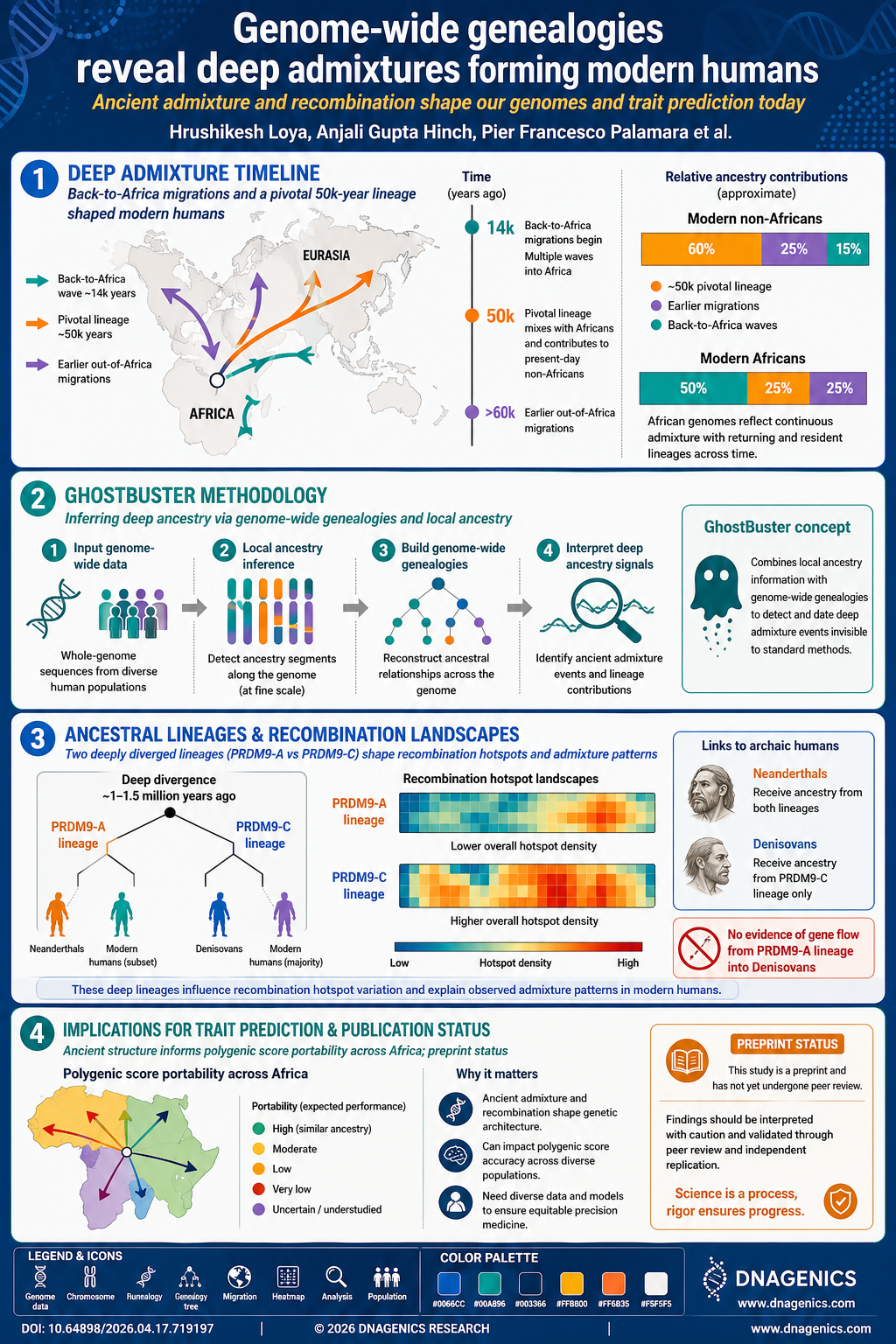
[Infographic Section - Infographic Provided]
Descriptive text: The infographic illustrates the GhostBuster framework, the three back-to-Africa admixture waves around 14k years ago, the pivotal ~50k-year lineage, and the two deeply diverged ancestral lineages (PRDM9-A and PRDM9-C). It also shows how Neanderthal and Denisovan-related ancestries emerge from mixtures of these lineages and highlights recombination landscape differences.
Why It Matters
This work advances our understanding of human history by formalizing a framework to detect and interpret deep admixture events, including ghost populations that left genomic signatures long before present-day reference panels existed. The implications span evolutionary biology, anthropology, and the practical use of DNA in ancestry testing. The approach helps explain why populations carry different sets of ancestry tracts and how ancient recombination processes can shape current trait associations and polygenic predictions. Looking ahead, the GhostBuster framework could be extended with more ancient DNA data, refined recombination maps, and larger diverse samples to further resolve the deep history of humanity and improve cross-population genomic interpretations.
References
- View publication on DnaGenics
- Genome-wide genealogies reveal deep admixtures forming modern humans
- DOI: 10.64898/2026.04.17.719197