Introduction
A mass grave from Gomolava in the Carpathian Basin has yielded a striking and unsettling pattern: far more women and children among the deceased than would be expected from a random burial. This ninth-century BCE event sits at a crossroads of cultural traditions, mobility, and competing ideologies about landscape use in Southeast Europe. By combining bioarchaeology, ancient DNA, and biomolecular analyses, researchers have begun to untangle a complex story of cross-regional interaction and deliberate violence.
Why this matters goes beyond a single site. The findings illuminate how violence can be organized across regional networks and how gender and age dynamics shape social power in prehistoric Europe. They also showcase how modern techniques—genetics, isotopes, and archaeology—can reconstruct social processes that left little direct documentary trace but lasting material footprints in bones and burial assemblages. Gomolava thus contributes a crucial piece to the broader puzzle of how early European societies navigated conflict, mobility, and identity.
Set in the transitional era between the Late Bronze Age and Early Iron Age, the Gomolava project situates a unique, multinational-like burial in a landscape defined by cultural exchange and demographic flux. The site’s position at the interface of diverse traditions makes it an especially informative case for studying how communities managed power, violence, and social differentiation in a changing Europe.
Key Discoveries
- Three-component ancestry: Gomolava individuals show a mixed ancestry combining sources from the Serbia Iron Gates Mesolithic, Anatolia Neolithic, and Samara Yamnaya Early Bronze Age, with affinity to Bronze Age Balkan groups.
- Low kinship majority: Despite a large grave, genetic relatedness is generally low; only a single mother–daughter cluster is evident, suggesting a cross-settlement, translocal burial population rather than a single kin group.
- Isotope-informed mobility: Enamel strontium isotope data reveal both local and non-local origins; several individuals lie outside local baselines, with one individual (Sk53) fully nonlocal, indicating broad geographic origins within a regional network.
- Gendered violence and social implications: The grave shows targeted violence against women and children, implying complex social and political dynamics, including displacement and power across regional networks.
- Trait signals in ancient DNA: SNP-based markers hint at health-related alleles (e.g., lactase non-persistence, celiac disease susceptibility, malaria resistance), but interpretations remain cautious due to sample size and ancient-DNA limitations.
Ancestry Insights:
- Three-component admixture signals reflect multiple source populations contributing to the Gomolava group.
- Non-local origins indicate deliberate cross-regional integration or exogamy within a broader network.
- The combination of ancestry and mobility data supports a scenario of regional interaction rather than a single familial burial unit.
- Gendered violence points to political-strategic factors shaping demographic targeting and social power.
What This Means for Your DNA
For individuals exploring ancestry through DNA testing, the Gomolava findings underscore a key truth: genetic heritage is often multi-layered and geographically distributed. A single burial or a single community may bring together lineages from far-flung regions, reflecting long-distance mobility, marriage networks, and exchange across cultural boundaries. The study’s three-component ancestry demonstrates how your own DNA could carry signals from multiple regions that interacted in the distant past.
Practically, this work highlights the importance of contextualizing DNA results with archaeology and isotopic data. An individual’s genetic makeup may align with several ancestral streams, even within a relatively small geographic area. It also emphasizes that social and demographic dynamics—such as exogamy or population turnover—shape who passes on DNA to future generations, just as they shaped who was buried together in Gomolava.
In short, your DNA carries stories of movement, alliance, and shifting power across regions, not just linear lineages tied to a single location.
Historical and Archaeological Context
The Carpathian Basin during the transition from the Late Bronze Age to the Early Iron Age was a dynamic crossroads for cultural traditions, migrations, and economic networks. Gomolava’s mass grave sits at a nexus where different identities, landscapes, and values intersected, creating a setting ripe for cross-regional interaction and competition. The burial assemblage suggests a broader social field in which mobility—across regional boundaries—played a central role in shaping communities and their conflicts.
The mass grave’s demographic pattern—an overrepresentation of women and children—offers tangible evidence for a targeted, possibly strategic form of violence. This pattern aligns with broader archaeological theories that early European societies could mobilize populations and resources across regions during periods of social pressure, resource constraint, or political realignment. In this context, Gomolava illuminates how gendered power relations, displacement, and inter-regional networks manifested in material culture and human remains.
Chronologically, the site anchors an important moment in early European prehistory when long-distance connections intensified and local groups negotiated new social orders as population dynamics shifted and trade routes expanded. The findings contribute to a growing understanding of how violence, migration, and family structure interacted in shaping the region’s trajectory toward later European Prehistory.
The Science Behind the Study
This study employs a robust, multi-method framework to reconstruct ancestry, mobility, and social structure. It combines bioarchaeological analysis of 77 individuals with biomolecular analyses on a subset of 25 individuals to illuminate genetic relationships, ancestry components, and mobility signals from tooth enamel. Ancient DNA data are integrated with isotope analyses (notably enamel strontium isotopes) to infer geographic origins and movement patterns, all within the archaeological context of Gomolava.
Methodologically, researchers applied population genetic modelling to detect admixture among disparate source populations, while isotopic data provided geographic granularity that genetics alone cannot resolve. The triangulation of these data streams—genetics, isotopes, and archaeology—strengthens interpretations but remains tempered by limitations inherent to ancient DNA, such as sample size and variable genome coverage. These caveats are essential to acknowledge when inferring kinship networks or precise migration routes.
In Simple Terms: In this study, scientists mixed three kinds of clues—DNA fingerprints, tooth chemistry that records where someone ate and drank, and the bones and grave context—to piece together who these people were, where they came from, and why they were buried together in a way that reveals social and political dynamics of their time.
Infographic Section - Infographic: Gomolava Mass Grave Overview
The infographic below summarizes the study’s cross-disciplinary findings, illustrating ancestry components, mobility signals, and the gendered violence pattern seen in the Gomolava mass grave.
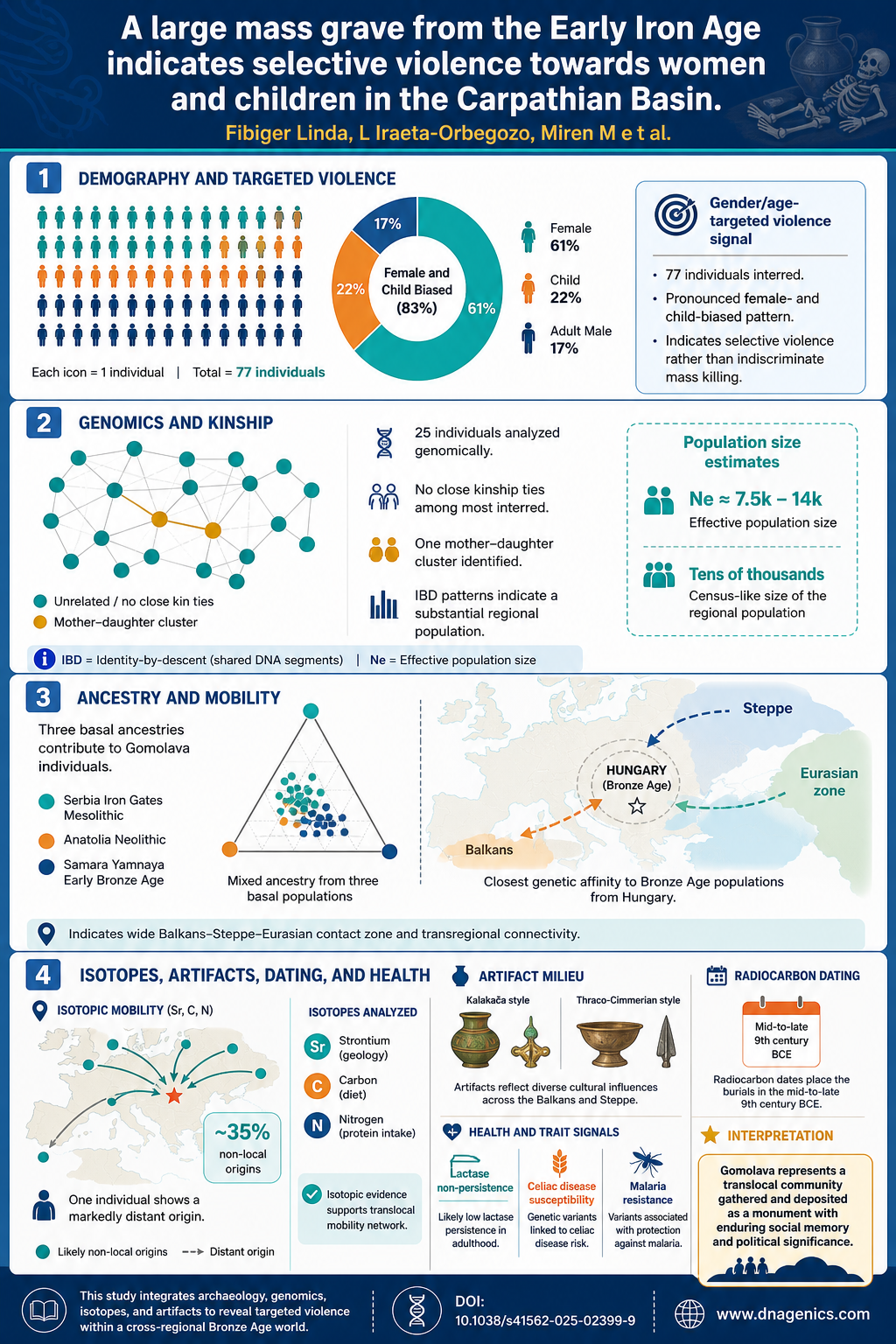
This visual synthesizes: three-source ancestry, local vs. non-local enamel Sr isotopes, the demographic skew toward women and children, and how these threads fit into wider cross-regional networks in the Carpathian Basin during the Early Iron Age.
Why It Matters
The Gomolava findings reframe assumptions about prehistoric violence and social organization in Europe. They show that lethal violence could be targeted and regionally coordinated, rather than purely the outcome of local intergroup skirmishes. The evidence for diverse origins within a single burial population highlights the permeability of regional borders and the prominence of mobility in shaping early European societies. The study also foregrounds the role of women and youths in socio-political dynamics, inviting more nuanced discussions about gender, agency, and power in prehistoric contexts.
Looking ahead, expanding comparative analyses with additional sites, increasing sample sizes for genetic and isotopic data, and integrating newer palaeogenetic methods will refine our understanding of these processes. Such work will help clarify how widespread cross-regional violence was, how networks of exchange and alliance operated, and how demographic shifts influenced the cultural landscape of Bronze to Iron Age Europe.