Introduction
The Islamic influence on the Iberian Peninsula left lasting cultural and linguistic legacies, but its demographic impact has been harder to pin down. This study uses ancient DNA from eastern Iberia to track gene flow and population structure from the early to late medieval period, offering a genome-wide window into migrations, slavery, and mass displacement. By combining radiocarbon dating, archaeology, and robust genetics, the researchers illuminate how historical events translated into lasting genetic patterns.
Why this matters goes beyond curiosity about the past. Understanding how populations mixed, separated, and moved helps explain the contemporary genetic landscape of Iberia and its connections to the broader Mediterranean world. It also demonstrates how political events—such as conquests, slavery, and expulsions—can leave measurable traces in our DNA across centuries.
Key Discoveries
- Pan‑Mediterranean mixing during Roman times is evident in an eastern Mediterranean/Italian affinity in the Roman-era genome and an unexpected mtDNA lineage (D4e1), signaling early cross‑regional connections.
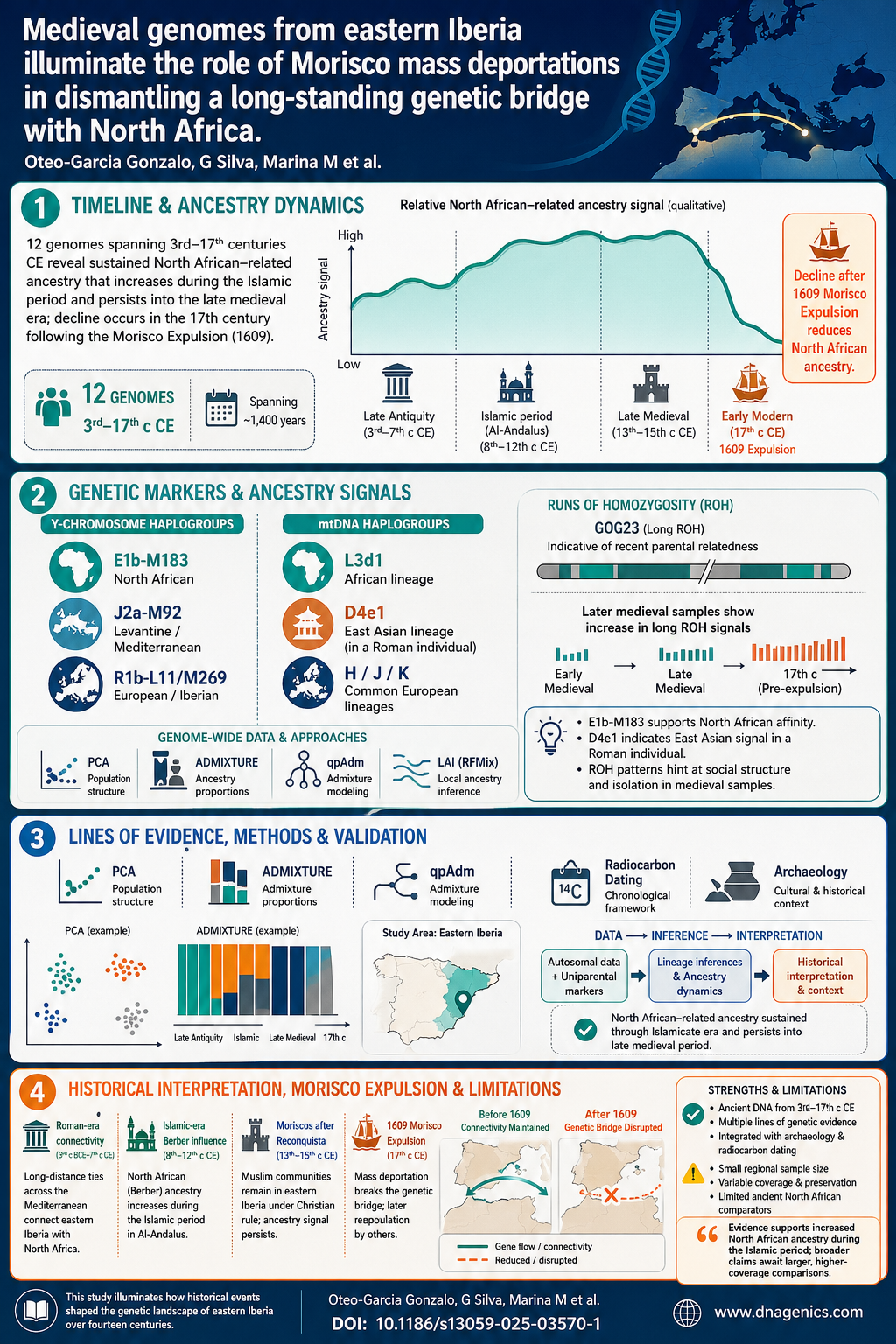
- North African ancestry was present before the Islamic conquest and became more consolidated during the Al‑Andalus period, forming a notable Berber‑related cluster with roughly 14–31% North African ancestry in some individuals.
- Uniparental markers corroborate autosomal signals: Y‑chromosome E1b‑M183 and mtDNA L3d1 support Maghrebi connections; R1b lineages attest to European continuity.
- Genomic evidence for slavery is seen in the GOG59 individual, who clusters with modern Moroccan/Algerian Berbers and carries an iron shackle, aligning with documentary records of North African slave trafficking.
- Runs of homozygosity (ROH) reveal social structure: one early Islamic individual (GOG23) shows long ROH consistent with close‑kin relatedness; later medieval samples show ROH patterns suggesting increasing isolation in some groups.
In Simple Terms: This study paints a picture of a long‑standing genetic bridge between Iberia and North Africa that ebbed and flowed with history—through conquest, slavery, and, ultimately, expulsions.
What This Means for Your DNA
For modern DNA enthusiasts, the work emphasizes that Iberian ancestry is not a simple blend from a single source. The findings show periods when North African signals were visibly stronger in eastern Iberia, especially during Islamic rule, and periods when those signals faded due to population replacements after the Morisco Expulsion. Uniparental markers (Y‑chromosome and mtDNA) provide context for ancestry beyond autosomal averages, but autosomal DNA remains crucial for reconstructing population history across many generations.
If you have Iberian ancestry, you might see regional signals that reflect ancient Mediterranean connectivity, Berber influences, and later demographic shifts. This study highlights the importance of considering historical timelines when interpreting DNA results, especially for regions with complex immigration, displacement, and conversion histories. It also underscores why high‑quality, context‑rich reference datasets—complemented by archaeology and radiocarbon dating—improve the accuracy of ancestry inferences for medieval populations.
Historical and Archaeological Context
Eastern Iberia sits at a crossroads of the Roman, Visigothic, and Islamic eras, a region where Mediterranean connectivity persisted despite political upheavals. The genomic data align with Roman‑era trade and mobility, then show a measurable Maghrebi influence during the Islamic period, likely reflecting Berber and North African integration into the population. The continuity of North African ancestry into late medieval times parallels historical narratives of Morisco communities living under Christian rule after 1492 and continuing to influence the region’s cultural fabric.
The study also engages with the darker aspects of the medieval and early modern period, providing genetic corroboration for slavery and transport from North Africa. A seventeenth‑century individual lacking strong North African signals around the time of the 1609 Morisco Expulsion illustrates how mass displacement and repopulation reshaped local genetic landscapes. Taken together, the genetic findings trace a timeline from pan‑Mediterranean exchange through period‑specific demographic events to the modern gene pool of eastern Iberia.
The Science Behind the Study
The authors analyzed 12 newly sequenced medieval genomes from eastern Iberia, spanning roughly from the 3rd to the 17th century CE, using genome‑wide methods complemented by uniparental markers and radiocarbon dating. They integrated multiple approaches to reconstruct ancestry and population structure:
- Principal component analysis (PCA) and model‑based clustering (ADMIXTURE) to visualize broad ancestry components.
- Formal admixture tests (qpAdm) to quantify ancestry proportions from neighboring regions, including North Africa and the Mediterranean basin.
- Local ancestry inference (LAI) with RFMix to localize African vs. European/Mediterranean segments along the genome.
- Runs of homozygosity (ROH) to infer social structure and potential consanguinity, supported by uniparental data (mtDNA and Y‑chromosome haplogroups).
- Radiocarbon dating and archaeological context to anchor genetic signals in precise historical periods.
This multi‑layered approach strengthens inferences about population movements and admixture, though the authors caution that conclusions about large‑scale demographic replacement remain tentative due to sampling limitations and the need for more North African comparisons.
In Simple Terms: Think of the study as a genetic time machine, combining broad DNA patterns with fine‑grained ancestry blocks to see where people came from and how groups mixed over centuries.
Infographic
The infographic provides a visual summary of the study’s major findings, illustrating how North African ancestry rose during the Islamic period, persisted into the late medieval era, and declined after the Morisco Expulsion. It also highlights key individuals and markers identified in the data, along with the geographic and temporal context.
Why It Matters
This research deepens our understanding of how political events shaped the genetic landscape of a major European region. It demonstrates that population structure can be tightly linked to historical episodes, such as migration flows, slavery, and mass expulsions, with detectable signatures lasting for centuries. The findings encourage broader sampling and cross‑regional comparisons to validate and refine models of population dynamics in the Mediterranean and to interpret medieval DNA in a robust historical framework.
Future work could expand North African comparative datasets and increase geographic coverage within Iberia to map the granularity of ancestry shifts more precisely. Such efforts will enhance our ability to translate ancient genomes into nuanced narratives about migration, cultural exchange, and demographic change in the medieval world.
References
- View publication on DnaGenics
- Medieval genomes from eastern Iberia illuminate the role of Morisco mass deportations in dismantling a long‑standing genetic bridge with North Africa
- DOI 10.1186/s13059-025-03570-1