Introduction
A new chapter in human history is unfolding through the genomes of Indigenous Americans. By sequencing 128 high-coverage genomes across 45 populations and 28 language families, researchers illuminate a complex tapestry of migration, adaptation, and long term continuity on the American continents. This study reframes what we know about how the Americas were peopled and how Indigenous populations built genetic diversity over thousands of years.
Why this research matters goes beyond cataloging variants. It demonstrates that the peopling of the Americas was not a single wave but a dynamic process with multiple dispersals, regional differentiation, and deep ancestry signals that persist to this day. The findings also highlight the importance of representing diverse populations in genomic research, and they raise intriguing questions about ancient gene flow, selection, and how environments shaped human biology.
Key Discoveries
- Three dispersals into South America with distinct, lasting regional contributions and continuity into present-day populations.
- Australasian affinity (Ypykuéra ancestry) detected across multiple Indigenous groups, implying an ancient, unsampled ancestry component separate from classical archaic introgression.
- Archaic introgression signals (Neanderthal and Denisovan) enriched for immune and epidermal genes, suggesting adaptive contributions alongside neutral ancestry patterns.
- Geography-driven population structure robustly aligns with four South American genetic clusters and a North American Aridoamerica vs Mesoamerica pattern, indicating deep historical differentiation shaped by landscape and culture.
- Extensive genetic diversity in Indigenous American genomes, with many novel SNVs per individual, underscoring underrepresentation in global genomic resources.
What This Means for Your DNA
For people exploring their ancestry, these findings translate into several practical takeaways. First, the idea of a single, clean lineage into the Americas is supplanted by a mosaic of waves and regions. Modern DNA tests that rely on broad continental categories may miss deep, regionally specific signals such as Australasian affinity or localized selection in immune and metabolic genes. Second, the presence of ancient admixture and long term regional continuity means that your own genetic story could reflect ancestry components that are thousands of years old and distributed unevenly across populations.
If you are curious about how your DNA might connect to these patterns, look for results that report deep ancestry components or ancestry fractions beyond the familiar European, African, and East Asian categories. Advanced analyses that model multiple dispersals, local migration, and adaptive introgression are more likely to capture the full spectrum of Indigenous American diversity. Remember that ethical engagement and consent with source communities remains essential in interpreting and sharing such findings.
Historical and Archaeological Context
The Indigenous American genome study supports a model in which the peopling of the Americas involved multiple rapid movements followed by long term regional differentiation. Rather than a single migratory event, the data suggest at least three major dispersals into South America, each contributing to lasting regional genetic structure that persists into contemporary populations. These patterns align with known geography and cultural landscapes, where physical barriers like the Andes, Amazon basin, and Arctic shores, as well as diverse ecological zones, shaped movement, settlement, and gene flow.
The discovery of Australasian affinity components across several Indigenous groups points to deep, unsampled ancestry linked to ancient Asian-related lineages. This signal appears largely independent from Neanderthal or Denisovan introgression, indicating a separate evolutionary origin that persisted for millennia. The integration of ancient DNA data with modern genomes helps place these signals in a broader timeline of migration and interaction across the hemisphere.
Geographically, the results reveal four South American genetic clusters in addition to distinct North American patterns such as Aridoamerica versus Mesoamerica. This geography-driven structure emphasizes how landscape, climate, and cultural practices shaped population differentiation long before modern borders arose.
The Science Behind the Study
The study builds a robust, multi-method reconstruction of Indigenous American ancestry by combining 128 high-coverage modern genomes with ancient DNA data. Sampling spans 45 populations and 28 language families, enabling a fine-grained view of regional diversity and historical connectivity. The researchers used multiple ancestry-inference methods to cross-validate findings and reduce method-specific biases, alongside transversions-focused analyses in ancient DNA to mitigate damage typical of degraded samples.
Key methodological pillars include high-coverage sequencing to capture rare variants, comprehensive population structure analyses, and admixture modeling that accommodates multiple dispersals. By integrating modern and ancient data, the study achieves a nuanced view of haplogroup trajectories, allele sharing, and selection signals across broad timescales. The approach highlights how careful sampling, ethical engagement with Indigenous communities, and methodological transparency are essential for credible population genomics.
In Simple Terms: This study sequences many genomes at great depth and uses several independent methods to reconstruct shared ancestry. It combines recent DNA from living people with ancient DNA to map where different ancestral signals come from, how they moved, and how natural selection shaped genes important for survival in diverse environments.
[Infographic Section - ONLY if infographic is available]
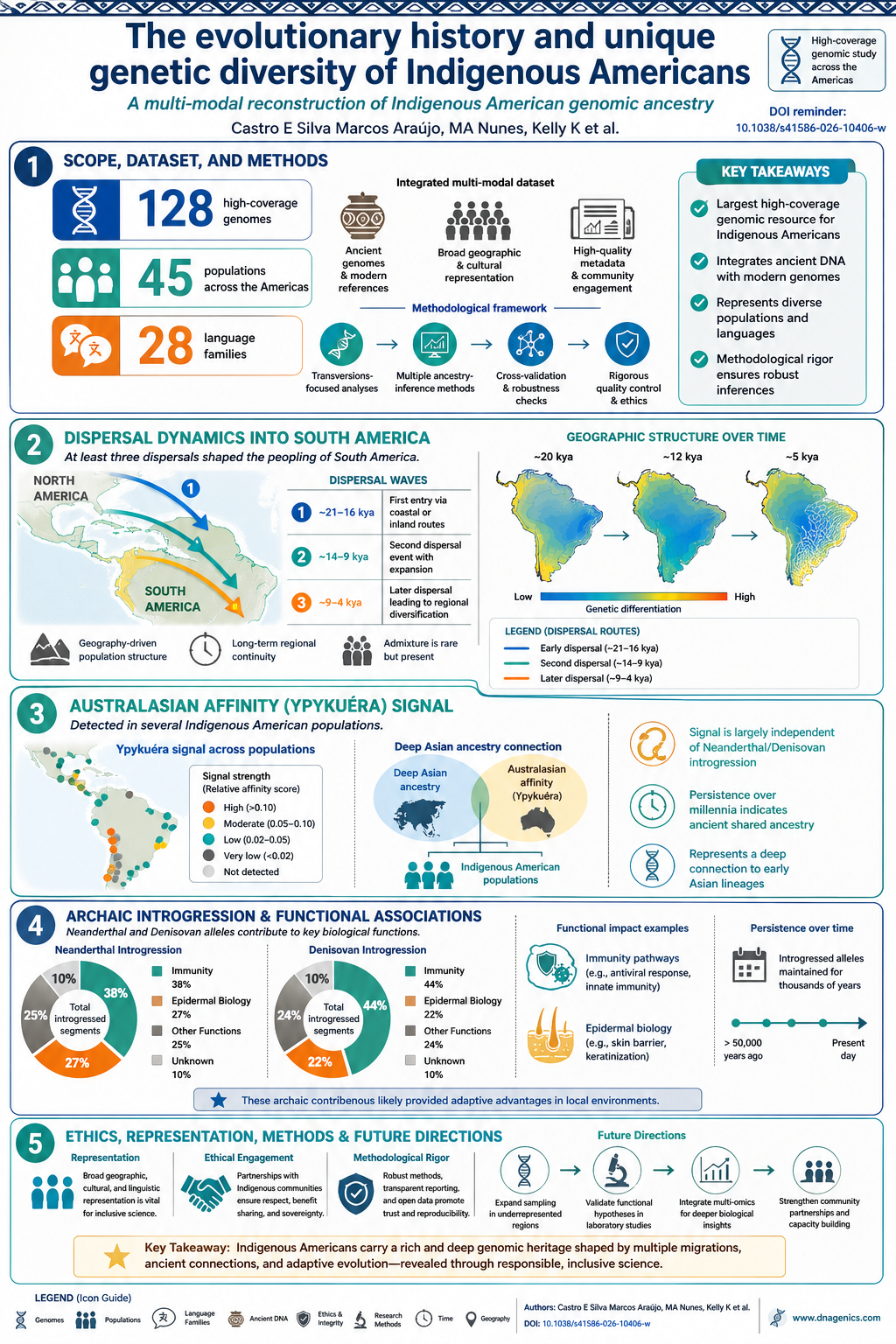
The infographic visually summarizes the study, showing the three major dispersals into South America, the Australasian affinity component, and the layers of archaic introgression in relation to geography and selection. It provides a quick-read map of population clusters, allele-sharing patterns, and functional gene categories under selection.
Why It Matters
These findings reshape our understanding of human expansion into the Americas, showing a more dynamic and intricate history than previously appreciated. The discovery of multiple dispersals, deep regional continuity, and novel ancestry components underscores the importance of broad population representation in genomic research. The observed adaptive signals in immunity, metabolism, and skin biology also open avenues for exploring how environmental pressures shaped health and development in Indigenous populations.
Future work will aim to validate functional hypotheses, expand geographic and temporal sampling, and integrate more ancient data. This will help refine models of migration, admixture, and selection, with potential implications for health research and the interpretation of ancestry tests in Indigenous territories.
References
The evolutionary history and unique genetic diversity of Indigenous Americans
DOI: 10.1038/s41586-026-10406-w