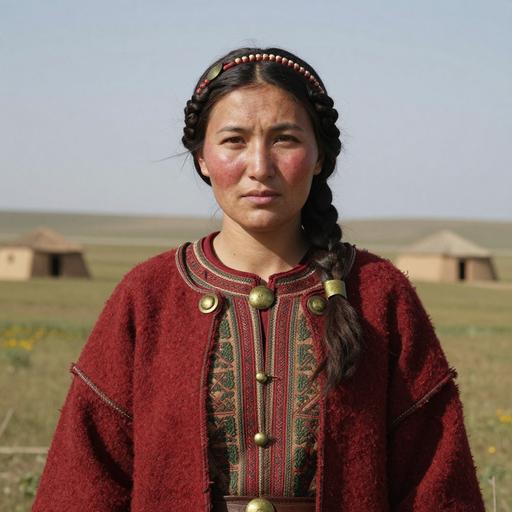
The Story
The journey of mtDNA haplogroup F2
Origins and Evolution
mtDNA haplogroup F2 is a branch of the broader haplogroup F, which itself arose in East/Southeast Asia during the Late Pleistocene. Based on phylogenetic position within F and comparative coalescence estimates for sibling clades, F2 most likely diversified after the Last Glacial Maximum as regional populations expanded and restructured within East and Southeast Asia. The estimated age for the F2 node (approximately ~18 kya) places its origin in a period when climatic amelioration and human demographic increases set the stage for later Holocene expansions.
F2 inherits diagnostic mutations from its parent F lineage but carries its own subclade-defining substitutions that allow researchers to distinguish it in modern and ancient mitogenomes. Though less ubiquitous than some other F subclades, F2 contributes to the maternal genetic landscape of multiple East and Southeast Asian populations and is a useful marker for tracing regional continuity and migration.
Subclades
F2 is divided into internal branches (often reported as F2a, F2b, etc., in the literature), each with geographically skewed distributions. Some subclades appear concentrated in mainland East Asia (including Han and Tibeto-Burman speakers), while others show stronger representation among Southeast Asian and Austronesian-speaking groups. High-resolution sequencing and larger ancient DNA datasets continue to refine the internal phylogeny and the geographic patterning of these sub-branches.
Geographical Distribution
F2 is primarily found across East Asia and Mainland and Island Southeast Asia, with lower-frequency occurrences in nearby regions of Near Oceania and parts of Central Asia and southern Siberia. Modern populations with detectable F2 lineages include Han Chinese, Japanese (including some Jomon-descended lineages), Koreans, Vietnamese, Thai and other Tai-Kadai groups (e.g., Zhuang), various Austronesian-speaking communities (Formosan, Filipino, Indonesian, Malay), and some Tibeto-Burman and mainland Southeast Asian groups (Lao, Khmer). Low-frequency occurrences in Near Oceania and select Central Asian / southern Siberian groups likely reflect long-distance contact, secondary dispersals, or ancient shared ancestry.
Two ancient DNA samples in current databases have been assigned to haplogroup F (including F2-level resolution in some cases), providing direct archaeological evidence that at least some branches of F2 were present in prehistoric contexts and reinforcing inferences from modern population distributions.
Historical and Cultural Significance
While mtDNA haplogroups do not track cultural identities directly, the distribution and chronology of F2 make it relevant to several major prehistoric events in East and Southeast Asia. The timing and spread of F2 are compatible with post-glacial recolonization and subsequent Neolithic expansions associated with rice cultivation in the Yangtze basin and with later Austronesian maritime dispersals out of Taiwan and into Island Southeast Asia and Near Oceania. In places like Japan, low-frequency F2 lineages appearing among Jomon and later populations may document local continuity or admixture during the Jomon–Yayoi transition.
F2 therefore helps illuminate maternal contributions to the peopling of island Southeast Asia and the genetic substrate into which later farming and seafaring expansions inserted themselves. Co-occurrence patterns with other East and Southeast Asian maternal lineages (for example, B4, M7, and D4) and with regional Y-DNA signatures (such as haplogroup O sublineages) reflect the complex demographic processes—local survival, migration, and admixture—that shaped Holocene population structure.
Conclusion
mtDNA haplogroup F2 is a regionally informative maternal lineage that originated in East/Southeast Asia in the Late Pleistocene and later participated in Holocene demographic events including Neolithic and Austronesian-associated dispersals. Although not as widespread as some sibling clades, F2's presence in both modern and a small number of ancient samples makes it a useful marker for reconstructing maternal population history in East and Southeast Asia and their connections to Near Oceania and adjacent regions. Continued sampling and ancient DNA recovery will refine the timing and routes of F2 subclade expansions.
Key Points
- Origins and Evolution
- Subclades
- Geographical Distribution
- Historical and Cultural Significance
- Conclusion