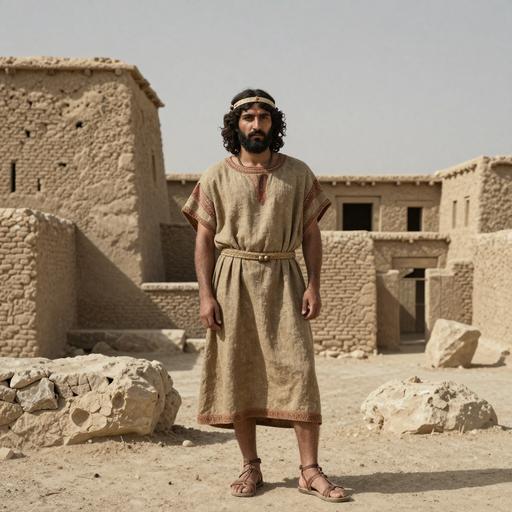
The Story
The journey of Y-DNA haplogroup J2A1A
Origins and Evolution
Y-DNA J2A1A is a downstream branch of J2a, itself one of the major subclades of haplogroup J2. The broader J2 radiation is generally linked to the Near East, where it likely diversified during the late Upper Paleolithic to early Holocene, with much of its later expansion tied to the emergence of Neolithic farming societies and subsequent population movements across West Asia and the eastern Mediterranean.
As an intermediate subclade, J2A1A likely represents a lineage that formed after the initial diversification of J2a, but before many of the regionally specific branches that are observed today. While the precise phylogenetic age of J2A1A depends on the current resolution of sequencing datasets, a reasonable estimate places its formation in the early to middle Holocene, roughly around 10 kya, within the broader demographic context of post-glacial expansions and the spread of food-producing populations.
Subclades
Because J2A1A is an intermediate branch, its internal structure may include additional downstream lines that are not always uniformly sampled in public datasets. In practical population-genetic terms, it serves as a bridge between J2A1 and more localized descendant lineages, some of which may be enriched in specific populations or historical communities.
Typical downstream diversification patterns for J2a-related lineages include:
- Regional founder effects in the Levant, Anatolia, and the Caucasus
- Mediterranean dispersals into Greece, Italy, and the Balkans
- Near Eastern and Jewish diaspora lineages preserved through later historical migrations
- Secondary spread into South Asia through ancient and historic connectivity
Geographical Distribution
J2A1A is expected to show its strongest representation in West Asia and the eastern Mediterranean, with a distribution pattern consistent with other J2a-derived paternal lineages. It is likely to be found at variable frequencies in:
- Levantine populations, especially in the eastern Mediterranean corridor
- Anatolian populations, where J2 diversity is often elevated
- Caucasus populations, reflecting long-term regional continuity and population structure
- Mesopotamian populations, where Near Eastern paternal lineages are common
- Greek, Aegean, and southern Italian populations, consistent with ancient Mediterranean gene flow
- Balkan populations, where Neolithic and later historic movements introduced many J2 lineages
- Arabian Peninsula populations, typically at lower but notable frequencies in some groups
- North African populations, often mediated through Mediterranean and Near Eastern contacts
- Jewish populations, where several J2 subclades are found at appreciable frequencies due to shared Near Eastern ancestry and founder effects
- Some South Asian populations, likely reflecting a mix of ancient and historic west-to-east gene flow
Historical and Cultural Significance
Haplogroup J2A1A belongs to a paternal lineage family that is frequently discussed in relation to the Neolithic transition, Bronze Age interregional exchange, and the development of complex societies in the Near East and Mediterranean basin. Although no single archaeological culture can be assigned exclusively to this subclade, J2a lineages broadly are often associated with:
- Early agricultural dispersals from the Near East
- Chalcolithic and Bronze Age mobility across Anatolia, the Levant, and the Aegean
- Maritime and inland trade networks linking the eastern Mediterranean to southeastern Europe
- Later historical expansions associated with urban civilizations, imperial systems, and diaspora movements
In modern population genetics, J2A1A is best understood not as a marker of one culture, but as part of a deeply rooted Near Eastern paternal continuum that experienced repeated regional expansions and demographic bottlenecks over thousands of years.
Conclusion
Y-DNA J2A1A is a Near Eastern-derived subclade of J2a with likely early Holocene origins and a distribution shaped by Neolithic, Bronze Age, and later historical migrations. Its presence across the Levant, Anatolia, the Caucasus, the Balkans, and the Mediterranean underscores the long-term connectivity of these regions and the important role of J2a lineages in the paternal history of West Eurasia.
Key Points
- Origins and Evolution
- Subclades
- Geographical Distribution
- Historical and Cultural Significance
- Conclusion