


Ancient genomes reveal an extensive kinship network and endogamy in a Three-Kingdoms period society in Korea
Genevieve Susca, Jong Bhak, Kazuyoshi Hosoki et al.
Visual Summary
A visual snapshot of this publication's key findings at a glance
Publication Details
Comprehensive information about this research publication
Abstract
Summary of the research findings
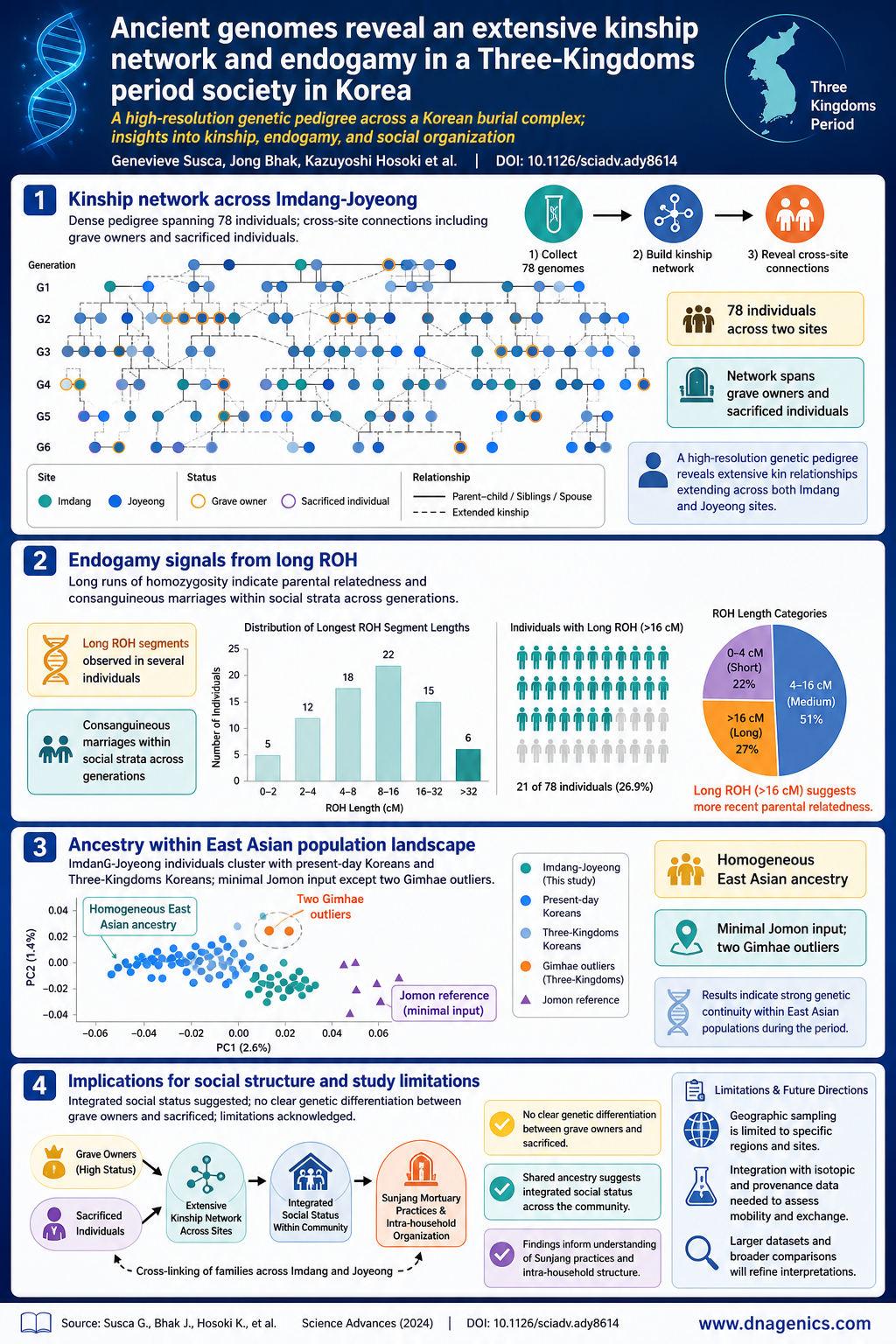
Ancient DNA studies have provided insights into past human societies, but kinship analysis at the community level remains challenging. We analyzed genome-wide ancient DNA from 41 individuals from Deokcheon-ri, a Three Kingdoms period (300–668 CE) site in Korea. We identified extensive biological relationships spanning multiple generations, including parent-offspring, siblings, and more distant relatives. The community practiced endogamy, with most marriages occurring within the local group. Social stratification was evident, with higher-status individuals buried with more grave goods and showing distinct kinship patterns. Our results reveal a complex social organization characterized by patrilocal residence patterns, multigenerational family units, and restricted gene flow, providing unprecedented insights into ancient Korean society during a critical period of state formation.
Listen to This Research
A two-host conversation exploring the key findings of this publication
Ancient genomes reveal an extensive kinship network and endogamy in a Three-Kingdoms period society in Korea
Two-Host ConversationAnalysis
Comprehensive review of ancestry and genetic findings
Important Disclaimer: This review has been performed semi-automatically and is provided for informational purposes only. While we strive for accuracy, this analysis may contain errors, omissions, or misinterpretations of the original research. DNA Genics disclaims all liability for any inaccuracies, errors, or consequences arising from the use of this information. Users should independently verify all information and consult original research publications before making any decisions based on this content. This analysis is not intended as a substitute for professional scientific review or medical advice.