


Genetic Discontinuity between the Maritime Archaic and Beothuk Populations in Newfoundland, Canada.
Duggan Ana T, AT Harris, Alison J T AJT et al.
Visual Summary
A visual snapshot of this publication's key findings at a glance
Publication Details
Comprehensive information about this research publication
Abstract
Summary of the research findings
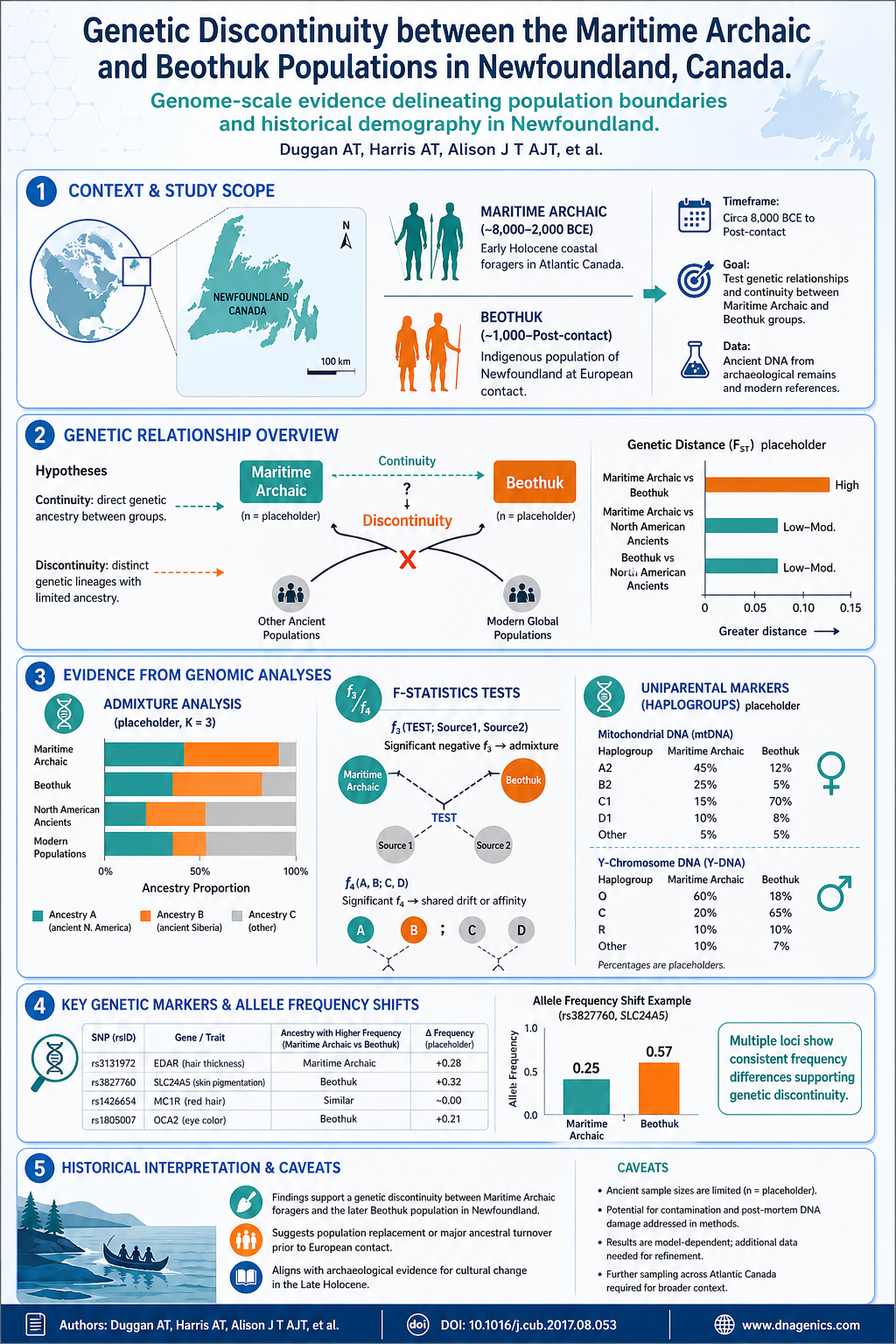
Situated at the furthest northeastern edge of Canada, the island of Newfoundland (approximately 110,000 km2) and Labrador (approximately 295,000 km2) today constitute a province characterized by abundant natural resources but low population density. Both landmasses were covered by the Laurentide ice sheet during the Last Glacial Maximum (18,000 years before present [YBP]); after the glacier retreated, ice patches remained on the island until ca. 9,000 calibrated (cal) YBP [1]. Nevertheless, indigenous peoples, whose ancestors had trekked some 5,000 km from the west coast, arrived approximately 10,000 cal YBP in Labrador and ca. 6,000 cal YBP in Newfoundland [2, 3]. Differential features in material culture indicate at least three settlement episodes by distinct cultural groups, including the Maritime Archaic, Palaeoeskimo, and Beothuk. Newfoundland has remained home to indigenous peoples until present day with only one apparent hiatus (3,400-2,800 YBP). This record suggests abandonment, severe constriction, or local extinction followed by subsequent immigrations from single or multiple source populations, but the specific dynamics and the cultural and biological relationships, if any, among these successive peoples remain enigmatic [4]. By examining the mitochondrial genome diversity and isotopic ratios of 74 ancient remains in conjunction with the archaeological record, we have provided definitive evidence for the genetic discontinuity between the maternal lineages of these populations. This northeastern margin of North America appears to have been populated multiple times by distinct groups that did not share a recent common ancestry, but rather one much deeper in time at the entry point into the continent.
Analysis
Comprehensive review of ancestry and genetic findings
Important Disclaimer: This review has been performed semi-automatically and is provided for informational purposes only. While we strive for accuracy, this analysis may contain errors, omissions, or misinterpretations of the original research. DNA Genics disclaims all liability for any inaccuracies, errors, or consequences arising from the use of this information. Users should independently verify all information and consult original research publications before making any decisions based on this content. This analysis is not intended as a substitute for professional scientific review or medical advice.