


Ancient DNA reveals pervasive directional selection across West Eurasia
Ali Akbari, Annabel Perry, Alison R. Barton et al.
Visual Summary
A visual snapshot of this publication's key findings at a glance
Publication Details
Comprehensive information about this research publication
Abstract
Summary of the research findings
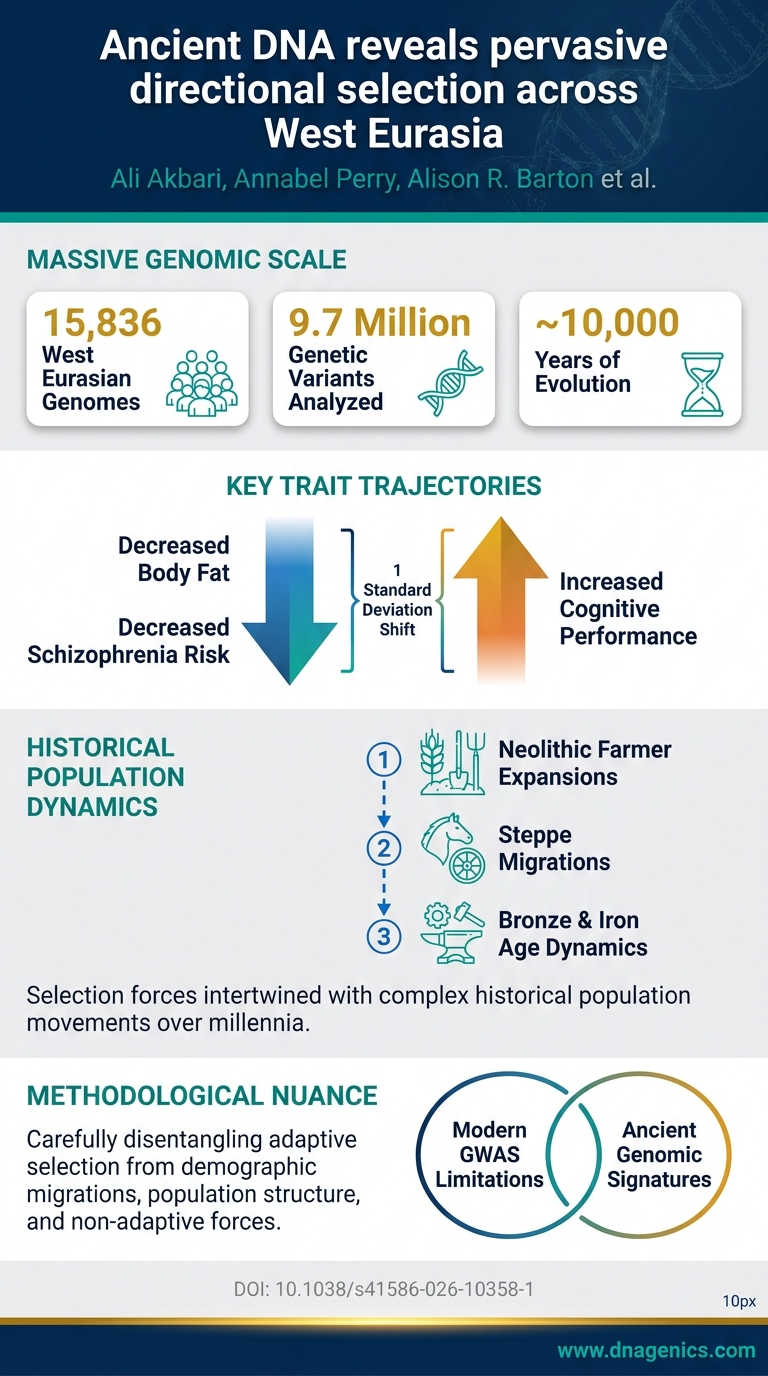
Ancient DNA has transformed our understanding of population history, but its potential to reveal as much about human evolutionary biology has not been realized because of limited sample sizes and the difficulty of distinguishing sustained rises in allele frequency increasing fitness—directional selection—from shifts due to migrations, population structure, or non-adaptive purifying or stabilizing selection. Here we present a method for detecting directional selection in ancient DNA time-series data that tests for consistent trends in allele frequency change over time, and apply it to 15,836 West Eurasians (10,016 with new data). Previous work has shown that classic hard sweeps driving advantageous mutations to fixation have been rare over the broad span of human evolution. By contrast, in the past ten millennia, we find that many hundreds of alleles have been affected by strong directional selection. We also document one-standard-deviation changes on the scale of modern variation in combinations of alleles that today predict complex traits. This includes decreases in predicted body fat and schizophrenia, and increases in measures of cognitive performance. These effects were measured in industrialized societies, and it remains unclear how these relate to phenotypes that were adaptive in the past. We estimate selection coefficients at 9.7 million variants, enabling study of how Darwinian forces couple to allelic effects and shape the genetic architecture of complex traits. Analysis of 15,836 ancient West Eurasian genomes reveals hundreds of instances of directional selection, showing that sustained changes in allele frequency were widespread, rather than being rare over this period as previously assumed.
Listen to This Research
A two-host conversation exploring the key findings of this publication
Ancient DNA reveals pervasive directional selection across West Eurasia
Two-Host ConversationAnalysis
Comprehensive review of ancestry and genetic findings
Important Disclaimer: This review has been performed semi-automatically and is provided for informational purposes only. While we strive for accuracy, this analysis may contain errors, omissions, or misinterpretations of the original research. DNA Genics disclaims all liability for any inaccuracies, errors, or consequences arising from the use of this information. Users should independently verify all information and consult original research publications before making any decisions based on this content. This analysis is not intended as a substitute for professional scientific review or medical advice.