Introduction
The Caribbean’s earliest inhabitants left few remains, making it hard to reconstruct their population history. A new study analyzes genome-wide data from 19 individuals buried in Hispaniola’s Samaná Peninsula, focusing on four who lived during the Lithic Age pre-Ceramic period. This approach extends the Caribbean genetic record by more than a millennium to around 4,400 calBP and reveals a remarkable pattern of continuity across islands.
Why this matters: understanding the origin and trajectories of the region's first inhabitants informs broader questions in DNA and population genetics, including how maritime cultures moved, interacted, and persisted across the archipelago. The work suggests a shared pre-Ceramic Caribbean ancestry that endured across Hispaniola and Cuba, with subtle internal structure and limited mainland proxies for direct source matching. Set against archaeological contexts, the findings illuminate how early Caribbean groups organized themselves and how later Ceramic Age admixture reshaped the gene pool.
Key Discoveries
- Pre-Ceramic Caribbean ancestry derives from a single source with subtle intra-Samaná structure
- Caribbean_PreCeramic shares excess drift with Isthmo-Colombian and northern South American lineages, not a single proximate mainland proxy
- Ne ≈ 114–163 indicates extremely small, structured communities with notable short-to-intermediate ROH (runs of homozygosity)
- Ceramic Age admixture from pre-Ceramic Caribbean lineages into the island gene pool is evident, but specific mainland sources remain unresolved due to sampling gaps
- qpGraph analyses reveal multiple well-fitting yet non-unique topologies, underscoring ancestry complexity and unsampled lineages
What This Means for Your DNA
For individuals exploring their own ancestry, these findings highlight several practical takeaways. First, the earliest Caribbean populations show a deep, shared pre-Ceramic signal that predates many later cultural transitions. This reinforces the idea that some Caribbean genetic variation originates from a broad Southern Native American-related source rather than a single, nearby mainland population. Second, the small, structured population patterns described by the study imply that Caribbean lineages can be disproportionately represented in local gene pools, especially in island contexts where endogamy within small communities could amplify certain signals.
For DNA testing and interpretation, this study suggests that modern Caribbean ancestry may retain enduring traces of an ancient, geographically broad source. However, pinpointing exact mainland origins remains challenging due to gaps in ancient and modern sampling from the Isthmo-Colombian region and northern South America. When you see signals of mixed ancestry in test results, they may reflect both long-term continuity on islands and later Ceramic Age admixture events that introduced new lineages into the Caribbean.
Historical and Archaeological Context
The Samaná Peninsula evidence links the Lithic Age to Casimiroid occupational patterns, emphasizing long-distance maritime connections in a region known for sea faring and island interactions. The pre-Ceramic populations appear to trace back to a single ancestral source that maintained continuity across Hispaniola and Cuba for many generations, even as local structure formed within Hispaniola.
Around 4,400 calBP, Ceramic Age shifts coincide with agricultural adoption and broader cultural changes, accompanied by admixture from pre-Ceramic lineages in some populations, such as those in Haiti’s Ceramic contexts. These archaeological signals align with genetic findings, painting a picture of deep Caribbean roots punctuated by later episodes of admixture and cultural transformation. The timeline situates the Lithic Age as the region’s initial occupation phase, with genetic continuity serving as a backbone for subsequent demographic and cultural evolution.
The Science Behind the Study
The researchers generated genome-wide data for roughly 1.4 million SNPs from 19 individuals excavated from Hispaniola, focusing on four Lithic Age pre-Ceramic individuals. This depth allowed they to pursue population-genetic analyses such as admixture graphs and drift modelling to trace ancestry relationships across the Caribbean and adjacent regions.
Key methodological points:
- Genome-wide data enable differentiating a shared Caribbean ancestry from proximate mainland proxies, revealing a drift pattern that aligns with the Isthmo-Colombian region and northern South America rather than a single nearby source.
- Demographic inferences show very small effective community sizes (Ne ≈ 114–163) and enriched short-to-intermediate ROH, indicating small, localized mating pools with limited gene flow.
- The authors used qpGraph and related graph-based methods to test competing ancestral topologies. They stress that multiple well-fitting, non-unique solutions exist, underscoring the complexity of Caribbean ancestry and the need for broader sampling of mainland lineages.
- Admixture events are detected in the Ceramic Age, but precise mainland contributors remain unresolved due to sampling gaps in the Isthmo-Colombian and northern South American regions.
In Simple Terms: The study reads ancient DNA like a family tree puzzle. Researchers compared the genomes of 19 people to find a shared Caribbean origin that remained stable across islands, then traced how later groups mixed in during the Ceramic Age. They used specialized graph methods to model ancestry, but the exact mainland sources are still a mystery because some regions were not sampled enough.
Infographic
Infographic: Early Caribbean Lithic Age ancestry and population dynamics
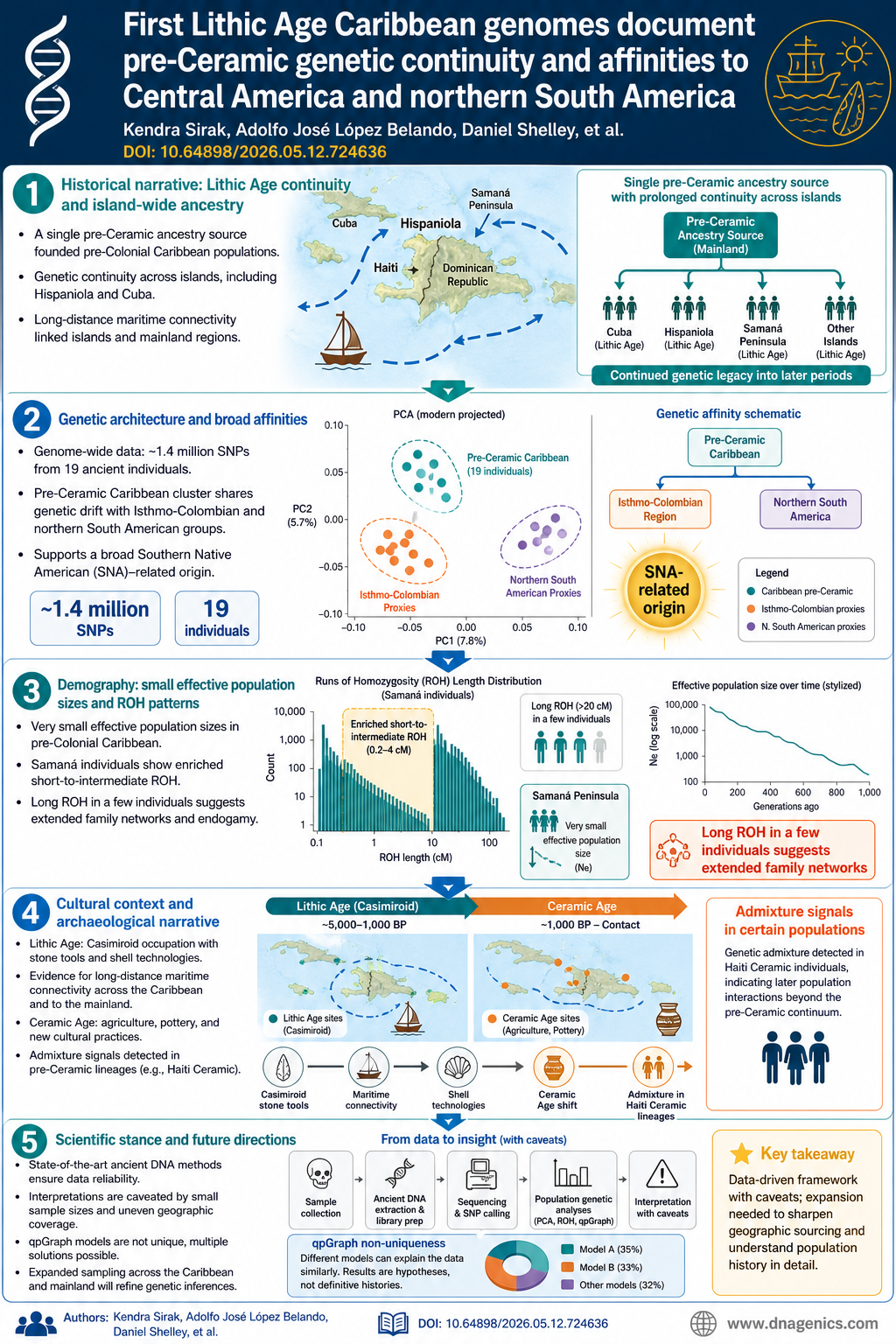
The infographic visually summarises the major findings: a single pre-Ceramic Caribbean ancestry with cross-island continuity, subtle intra-Samaná structure, drift ties to Isthmo-Colombian and northern South American lineages, small Ne values, ROH patterns, and the timing of Ceramic Age admixture. It helps readers grasp the geographic and temporal scale of the study and connect genetic signals to archaeological contexts.
Why It Matters
This work provides a data-driven framework for understanding the Caribbean’s earliest population history, emphasizing genetic continuity across islands and the complexities introduced by later admixture events. It informs broader debates in ancient DNA and population genetics about how island populations form, maintain structure, and integrate new lineages over time. The study also highlights the need for expanded sampling in the Isthmo-Colombian region and northern South America to sharpen geographic sourcing and resolve non-uniqueness in ancestry models. Future research with larger datasets and broader geographic coverage will help clarify the mainland sources that contributed to pre-Ceramic Caribbean ancestry and refine temporal dynamics of migration and admixture in the Caribbean archipelago.
References
- View publication on DnaGenics
- First Lithic Age Caribbean genomes document pre-Ceramic genetic continuity and affinities to Central America and northern South America
- DOI