Introduction
The peopling of the American continents is a story written in DNA as well as in artifacts and languages. This narrative-science review centers Indigenous perspectives and uses a four-signature framework—witness, introduced, transplanted, and new genetic signatures—to describe how ancestry components entered and reshaped populations across the Americas, with a Brazil-focused lens. The goal is to move beyond broad continental generalizations and toward ancestry-aware analyses that respect Indigenous contexts and diverse regional histories.
Why this research matters goes beyond academic curiosity. For communities and individuals tracing their roots, understanding how ancient lineages persist, mix, and influence modern genomes can illuminate health, adaptation, and cultural heritage. By clarifying terminology and foregrounding Indigenous participation, the study aims to reduce neocolonial bias and provide a framework that better reflects the continent-wide diversity—from the Amazon to the Andes and beyond.
Set in this context, the review synthesizes evidence on the initial peopling of the Americas, post-contact demography, and natural selection, with a brazilian-centric emphasis. It also highlights ethical dimensions and the importance of Indigenous contribution to science, while illustrating how modern AI-assisted analyses can enhance ancestry interpretation without erasing historical nuance.
Key Discoveries
- The peopling of the American continent involved multiple waves and complex admixture patterns, including a Beringian phase and subsequent migrations that produced Northern Native American and Southern Native American lineages.
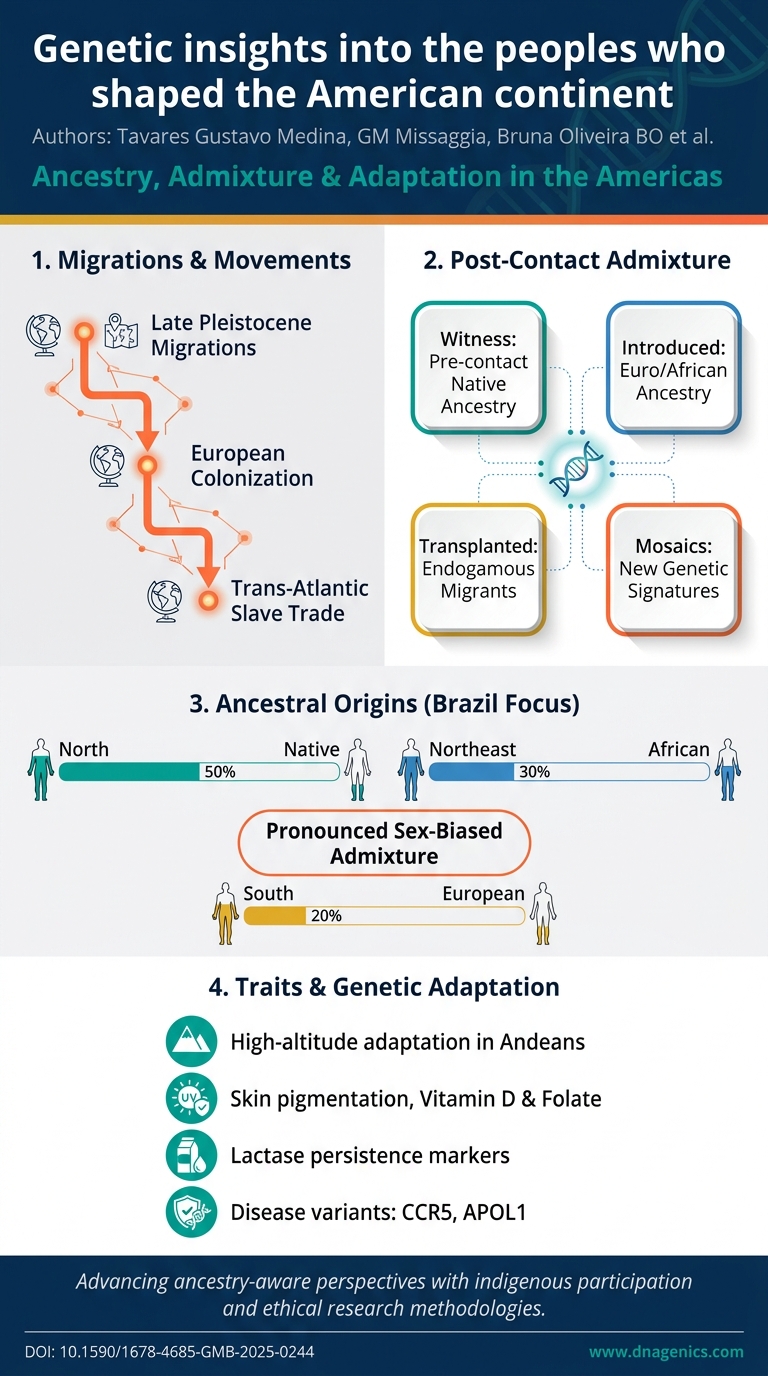
- Brazil exemplifies a highly admixed landscape with pronounced sex-biased admixture, regional ancestry variation, and detectable Indigenous genetic signatures in modern populations.
- A novel framework for ancestry interpretation—witness, transplanted, introduced, and new genetic signatures—offers a structured way to conceptualize how ancestry components entered and evolved in the Americas, particularly in Brazil.
- High-altitude adaptation in Andeans involves multi-gene, pathway-level changes (e.g., EGLN1, EPAS1, a TP53 network) with polygenic and epistatic effects; signals show both convergence and population-specific trajectories.
- Pigmentation and UV-related adaptation in Native Americans may involve distinct allele architectures from other continents, with evidence for co-adaptation involving vitamin D and folate metabolism.
- Introduced genetic signatures (European/African) in admixed populations carry implications for disease susceptibility and pharmacogenomics (CCR5-Δ32, APOL1, LCT-13910).
- The study underscores the importance of diverse representation in genetic research and cautions against overgeneralizing continental patterns to all Indigenous or admixed groups.
What This Means for Your DNA
For those exploring their own ancestry, the Brazil-centered perspective highlights how modern genomes can carry a mosaic of components shaped by centuries of migration, conquest, and cultural exchange. In practical terms, you may find evidence of ancient Native American ancestry layered with European and African lineages, with regional variation reflecting historical settlement patterns and sex-biased admixture. The four-signature framework helps translate complex results into meaningful narratives: some segments reflect deep-time witness lineages, others reflect introduced or new genomic material that became part of the population over generations.
This approach also has implications for personal DNA analyses and health research. Recognizing admixed backgrounds and lineage-specific adaptations can improve the interpretation of polygenic traits, disease risk, and pharmacogenomics. The Brazil lens reinforces that ancestry models designed for one region may not map cleanly onto another, underscoring the value of population-specific reference panels and careful communication of results to individuals.
Historical and Archaeological Context
The story begins in the Late Pleistocene, when migratory movements into the Americas laid the foundation for distinct Native American lineages. Subsequent shifts—driven by climate change, sea-level fluctuations, and cultural innovations—produced diverse regional trajectories across North, Central, and South America. Post-contact history—encompassing European colonization, the trans-Atlantic slave trade, and large-scale internal migrations—further reshaped genetic landscapes, particularly in Brazil, where Indigenous, European, and African contributions merged in complex, regionally nuanced patterns.
Archaeological and genetic evidence together reveal migration corridors, trade networks, and demographic turnovers that align with (and occasionally challenge) traditional historical narratives. In Brazil, regional differences in admixture reflect a mosaic of Indigenous communities, colonial demographic histories, and later population movements, reinforcing the need to interpret genetic data within a culturally informed timeline.
The Science Behind the Study
This work is a comprehensive narrative review that synthesizes ancient DNA results, modern population genomics, and case studies from Indigenous and admixed groups, with a Brazil-centered emphasis. Methodologically, the literature draws on genome-wide association data, haplotype-based analyses, f-statistics, and principal components to resolve ancestral components, admixture timing, and geographic affinities. The authors explicitly discuss the limitations of extrapolating continental patterns to diverse Indigenous populations and advocate for inclusive sampling and context-aware interpretations.
A key methodological innovation in the review is the adoption of the four-signature framework to categorize genetic components: witness (pre-contact Native American ancestry), introduced (European/African lineages entering populations), transplanted (lineages from endogamous migrant communities), and new (post-admixture mosaics formed through successive generations). This framework helps disentangle historical processes and clarifies how different genomic segments contribute to present-day ancestry profiles. The study also touches on ongoing work using genome editing to probe adaptive alleles in high-altitude contexts, illustrating how experimental approaches can complement population-genetic inferences.
In Simple Terms: Think of a genome as a layered mural. The witness layer is the ancient Native American artwork preserved in some regions. The introduced layer adds European and African colors from contact periods. Transplanted pieces come from communities who moved or were moved, bringing their own patterns. The new layer is the mosaic formed after many generations of mixing. Together, these layers tell the full history of a population.
Infographic
Infographic Section The visual summary below illustrates how the four genetic signature concepts—witness, introduced, transplanted, and new—interact with migration routes, regional Brazilian diversity, and key adaptive genes in the Americas. It also showcases how admixture shapes modern health associations across populations.
Why It Matters
This continent-wide, Brazil-anchored perspective emphasizes that ancestry research must be contextual, ethically grounded, and scientifically rigorous. By highlighting diverse representation and region-specific patterns, the review advocates for tailored reference panels and careful interpretation to avoid one-size-fits-all conclusions. Beyond historical interest, the findings have practical implications for precision public health, including better understanding of mitonuclear interactions, dietary adaptations, and pathogen exposure that shape disease susceptibility across Native American and admixed populations.
Future research should prioritize Indigenous leadership and collaboration, expand ancient DNA sampling in underrepresented regions, and refine models that capture the complexity of post-contact demography. Such efforts will enhance our ability to translate genetic history into meaningful health insights while honoring Indigenous knowledge and sovereignty.
References
Genetic insights into Native American ancestry across America
DOI 10.1590/1678-4685-GMB-2025-0244