Introduction
The shift from foraging to farming was a watershed moment in human history, reshaping diets, settlements, and social life. In the Southern Andes, farming arrived later than in many other regions, offering a natural laboratory to study how communities adapted to ecological and social stress. This study analyzes 46 ancient genomes and combines stable isotope data and pathogen genomics to reconstruct a nuanced picture of the Uspallata Valley frontier at the southern edge of Andean agriculture.
Why this research matters is twofold: it reveals how agricultural adoption can proceed through local continuity rather than wholesale replacement, and it shows how regional migration and social organization can act as resilience strategies during crises. By placing genetic signals alongside diet, mobility, and disease markers, the work helps disentangle population history, farming pathways, and health in a frontier zone just before the Inka expansion. This integrative approach advances our understanding of population genetics, migration, and the complex mosaic of ancestry in the Southern Andes.
Key Discoveries
- Late agricultural adoption with genetic continuity: Agriculture was adopted by local hunter-gatherers with deep genetic continuity from pre-farming populations in the Uspallata Valley. This challenges a simple model of replacement and underscores regional continuity in Indigenous American diversity.
- Distinct regional Indigenous ancestry: The Southern Andes groups harbor a unique Indigenous American genetic component, indicative of a region-specific population history and complex meta-population structure.
- Migration within a regional metapopulation: 87Sr/86Sr data reveal migrant influx from nearby regions around 810–700 cal BP, joining the same regional metapopulation rather than displacing locals.
- Maize emphasis and dietary flexibility: Palaeodietary isotopes show maize intake fluctuating over time, signaling flexible, maize-focused subsistence strategies rather than a uniform transition.
- Matrilineal organization and resilience strategies: Migrants likely moved in matrilineally organized family groups; pathogen genomics point to health stress (e.g., tuberculosis) within the community, suggesting social mobility and organization as key resilience responses to multidimensional crises.
What This Means for Your DNA
For ancestry enthusiasts, this study highlights that population history in the Andes can be more nuanced than simple splits and replacements. You can think in terms of regional metapopulations and admixture events that may leave subtle but detectable genomic signatures in modern descendants. The evidence for local genetic continuity even as maize-based farming expanded shows that genetic continuity and change can coexist: farming practices may spread through cultural exchange and migration without wiping out established lineages. In practical terms, this means researchers and hobbyists should consider both local ancestry components and regional population history when interpreting haplogroup distributions and Indigenous American genetic diversity.
The inclusion of isotopic and pathogen data also reminds us that DNA is only one layer of a multi-dimensional history. Personal ancestry reports that focus solely on genomic variants may miss the broader social and health dynamics that shaped population trajectories. For those using DNA to explore lineage, this study underscores the value of integrating multiple data streams—genomics, isotopes, and pathogen evidence—to build a richer narrative about ancestral origins and migrations.
Historical and Archaeological Context
The Uspallata Valley sits at the southern frontier of Andean farming, offering a window into late adoption and frontier dynamics. The study places the adoption of agriculture around a corridor that predates the Inka expansion, with migrant influx occurring circa 810–700 cal BP (roughly 11th–13th centuries CE). This timing corresponds to a period of regional connectivity and environmental pressures that may have driven people to combine hunter-gatherer and cropping practices.
Archaeological and isotopic data situate the local communities within a broader Indigenous American diversity, suggesting a regional metapopulation rather than isolated groups. The maize-centric diet reflects the diffusion of maize agriculture into the Southern Andes and the flexibility of subsistence strategies in a frontier zone. The evidence for matrilineal family movement and health stress adds a social and health dimension to the archaeological narrative, linking social organization with population dynamics in times of crisis. Taken together, these findings illuminate migration routes, crop adoption pathways, and the interplay between genetics, diet, and disease in a highland frontier.
The Science Behind the Study
This work integrates genomic, isotopic, and pathogen analyses to reconstruct population history and subsistence strategies. The dataset comprises 46 ancient genomes sequenced from individuals in the Southern Andes, enabling population-genetic analyses that identify regional ancestry components and continuity. Stable isotopes (δ13C and δ15N) provide a palaeodietary record, revealing maize contribution to the diet and its temporal fluctuations. Strontium isotopes (87Sr/86Sr) track mobility and provenance, revealing migrant influx from nearby regions within a shared metapopulation. Pathogen genomics adds health context by identifying diseases such as tuberculosis, indicating stress and disease burden in the migrating groups.
Methodologically, the study leverages high-coverage ancient DNA sequencing, population-genetics tools to assess ancestry components and continuity, isotope geochemistry for diet and mobility, and metagenomic/pathogen analysis to detect infectious disease signals. The multi-proxy approach strengthens interpretations about population structure, migration, and social organization, though some inferences—such as matrilineal social patterns—remain model-based given sample sizes and the fragmentary nature of ancient records. Overall, the convergence of independent data streams increases confidence in the proposed scenario of late farming, regional continuity, and resilience strategies.
In Simple Terms: This study uses DNA from ancient bones, chemical clues from bones to read what people ate and where they moved, and pathogen DNA to see what diseases were present. By putting all these clues together, researchers can tell a more complete story about how farming spread, who moved where, and how communities coped with stress before the Inka arrived.
Infographic Section
The illustrated infographic summarizes the study’s multi-proxy approach and key findings. It highlights the 46 ancient genomes, isotopic data for diet and mobility, the 87Sr/86Sr migration signal, and the presence of pathogen DNA, all woven into a narrative of late agricultural adoption, regional continuity, and social resilience in the Southern Andes. The visual also shows the inferred migration flow within the regional metapopulation and the maize-focused subsistence pattern inferred from isotopic shifts.
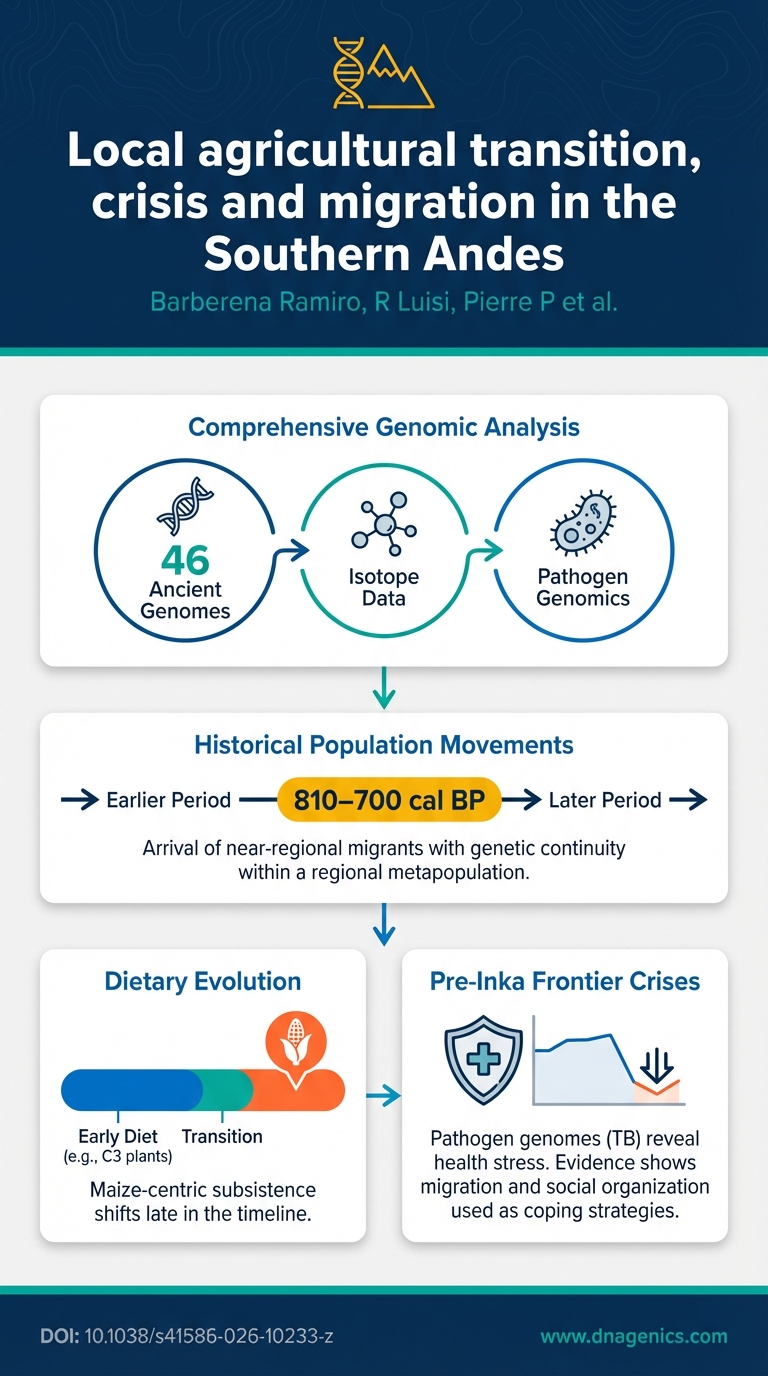
This graphic complements the text by offering a concise, at-a-glance synthesis of how genetics, diet, mobility, and health intersect in this frontier zone prior to the Inka expansion.
Why It Matters
This research advances our grasp of how agricultural adoption unfolds at regional frontiers, showing that demographic change can be gradual and mediated by mobility, social organization, and health pressures. It challenges a simplistic model of rapid replacement and demonstrates the value of a multi-proxy framework for understanding population history. The findings also inform contemporary discussions about Indigenous diversity and governance, especially in relation to how communities engage with genetic data and how modern communities are represented in research. Looking ahead, expanding sample sizes, expanding geographic coverage, and integrating additional environmental proxies could further refine models of migration, subsistence change, and health in the Andes and other frontier regions.
References
Local agricultural transition, crisis and migration in the Southern Andes