Introduction
Ancient monuments often outlive their builders, but the Menga dolmen in Antequera shows how historical layers accumulate over time. This Neolithic masterpiece, now a UNESCO World Heritage site, was repurposed in later centuries, turning a prehistoric tomb into a stage for new acts in medieval Iberia. The study of two individuals radiocarbon dated to the 8th–11th centuries CE situates the Menga site within a broader story of mobility, exchange, and cultural contact across the Western Mediterranean.
Why does this matter? Genetics, archaeology, and history converge here to illuminate how populations moved and interacted in a frontier region of Europe. Even when ancient DNA is highly degraded, targeted sequencing (SNP-enrichment) can reveal telltale ancestry signals that help reconstruct historical processes like the al-Andalus era’s North African gene flow into southern Iberia. This research demonstrates the value of integrating genetic data with archaeological context to interpret the medieval reuse of prehistoric monuments.
The study centers on one individual, Menga1, analyzed after SNP-enrichment, with dating firmly placed in the early medieval centuries. The authors acknowledge the limitations of working with low-coverage DNA from a single subject, yet the findings add a meaningful genetic snapshot to the wider archaeological narrative of the region. The data are openly available (PRJEB88790), underscoring a cautious, transparent approach to interpreting ancient DNA in Mediterranean contexts.
Key Discoveries
- Menga1 dates to the 8th–11th c. CE and was interred in the atrium of the Neolithic Menga dolmen, aligned with the monument’s axis.
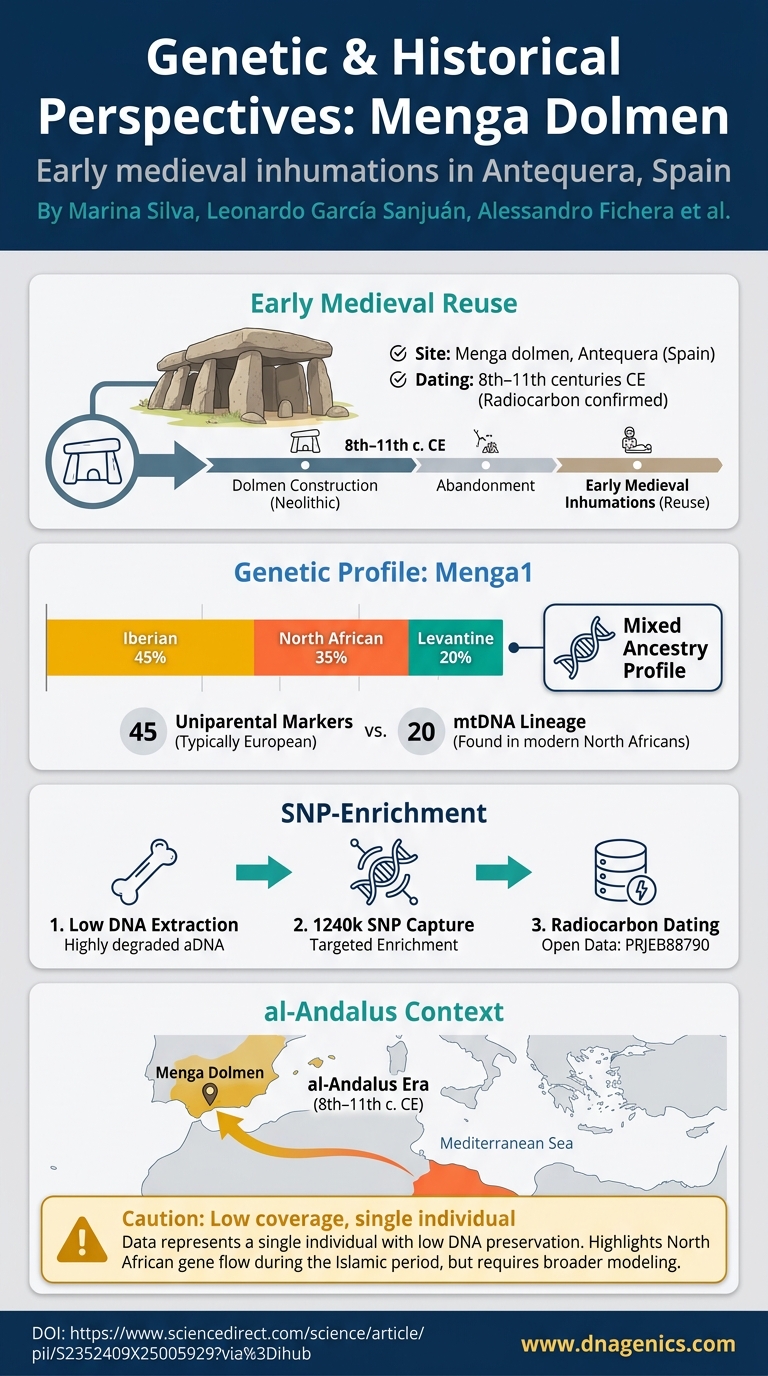
- Autosomal DNA shows an Iberian background with North African– and Levantine–related components, indicating a complex, mixed ancestry in medieval southern Iberia.
- Uniparental markers are described as "typically European", yet the mtDNA lineage is also found among modern North Africans, highlighting discordance between uniparental and autosomal signals.
- The findings are consistent with al-Andalus–era mobility and broader Western Mediterranean gene flow, aligning genetic signals with historical accounts of movement during this period.
- DNA preservation was poor, necessitating SNP-enrichment; the authors present cautious conclusions and make the data openly accessible (PRJEB88790).
What This Means for Your DNA
For ancestry enthusiasts, the Menga study offers a concrete example of how medieval migrations can shape a regional gene pool in ways not always visible in modern populations. The autosomal signal showing a mix of Iberian and North African–Levantine ancestry demonstrates that southern Iberia was a crossroads where local lineages interacted with incoming groups from the broader Mediterranean world. Importantly, the study underscores the difference between uniparental markers (the Y chromosome and mtDNA) and autosomal DNA: the former can reflect deeper, lineage-specific histories, while the latter captures an integrated picture of recent population structure and admixture.
For people analyzing their own DNA, this work highlights key concepts: (1) ancestry is layered across time, (2) local populations can harbor distant signals from neighboring regions due to historical migrations, and (3) ancient DNA interpretations require caution when data are sparse. Modern DNA analyses often rely on reference panels built from past and present populations; ancient DNA studies like this one remind us that regional histories (e.g., al-Andalus mobility) can produce mosaic genetic patterns that depart from expectations based on geography alone.
Historical and Archaeological Context
The Menga dolmen sits at the crossroads of Neolithic monumentality and medieval reuse. The broader context in southern Iberia includes documented North African gene flow during the medieval period and ongoing exchange across the Western Mediterranean. The discovery of North African– and Levantine–related ancestry within a burial dating to the 8th–11th centuries CE aligns with historical narratives of al-Andalus, when peoples from North Africa and the broader Islamic world moved into the Iberian Peninsula. This genetic signal complements archaeological evidence of continued interaction among Iberian populations and their Mediterranean neighbors.
From an archaeological perspective, the study emphasizes the phenomenon of reusing prehistoric monuments in medieval Iberia—an act that speaks to cultural memory, religious and social dynamics, and the pragmatic reuse of sacred or monumental spaces. The Menga case thus links a long architectural biography—from its Neolithic origin to its medieval function—through a genetic lens that records how people moved through and inhabited these spaces across centuries.
The Science Behind the Study
The researchers analyzed two individuals radiocarbon dated to the 8th–11th centuries CE, with a focus on one subject, Menga1, following SNP-enrichment to recover genetic information from highly degraded DNA. Given the poor DNA preservation typical of Mediterranean aDNA, a targeted SNP capture approach (approximately a broad set of informative SNPs, such as the common 1240k panel) was employed to maximize informative genetic signals while working with limited endogenous DNA. The study confirms the feasibility of extracting meaningful ancestry data from challenging samples when combined with a robust archaeological framework.
The analysis yields a nuanced ancestry profile: autosomal data show an Iberian genetic background with detectable North African– and Levantine–related components, consistent with historical mobility into southern Iberia. Uniparental markers are described as "typically European", underscoring a potential mismatch between maternal/paternal lineages and the broader autosomal ancestry. The mtDNA lineage in Menga1 is shared with modern North Africans, highlighting how maternal lineages can reflect long-standing regional connections even when autosomal admixture signals differ.
The authors are appropriately cautious: the low coverage and focus on a single individual limit the granularity of population modeling, and broader conclusions will require additional samples. The data are openly accessible (PRJEB88790), enabling independent verification and future meta-analyses as more Iberian medieval genomes become available.
In Simple Terms: Ancient DNA from these medieval burials was fragile. Scientists used a curated set of genetic markers to read ancestry signals, giving a snapshot of past population structure rather than a full genome. The results point to a mixed ancestry shaped by medieval movements, but with clear limits due to degraded DNA.
[Infographic Section - Infographic is available]
The infographic accompanying this study visualizes how the Menga findings fit into a broader map of medieval migrations in the Western Mediterranean. It highlights the autosomal signal of Iberian plus North African–Levantine ancestry, contrasts uniparental markers with autosomal patterns, and situates the Menga burials within al-Andalus-era mobility. The graphic also notes data limitations from low-coverage ancient DNA and the open data availability (PRJEB88790).
Why It Matters
This study contributes a concrete genetic dimension to the historical understanding of medieval Iberia, illustrating how North African gene flow intersected with local Iberian populations during al-Andalus. It reinforces the value of integrating ancient DNA with archaeology and historical scholarship to reconstruct population histories that are geographically nuanced and temporally layered. As more samples from medieval Iberia become available, researchers can refine admixture models, clarify regional variation, and explore how monument reuse intersected with population dynamics across the Western Mediterranean.
Future work should aim to increase sample sizes, apply formal admixture modeling, and compare multiple necropolises from Andalusia and neighboring regions. Such efforts will deepen our understanding of how migrations, trade networks, and cultural exchanges shaped the genetics of modern populations in southern Europe and beyond.