Introduction
Wildlife forensics increasingly relies on molecular tools to distinguish elephant and mammoth materials in the public trade and legal substitutes. Traditional morphology or chemical methods can struggle when samples are degraded or processed, making enforcement slow and costly. This study evaluates a near point-of-need workflow that combines rapid screening with sequencing to improve accuracy and speed for detecting elephant and mammoth DNA in calcified tissues such as ivory, bone, and teeth.
Why this research matters is twofold: it enhances capacity to enforce wildlife protection laws and informs policy discussions around mammoth ivory as a substitute. By benchmarking a colorimetric LAMP approach against short-amplicon qPCR and Nanopore sequencing, the authors show how field-ready methods can be paired with robust taxonomic resolution. The result is a practical pipeline that preserves sample integrity where possible, triages cases before destructive sampling, and yields court-defensible identifications when needed.
Key Discoveries
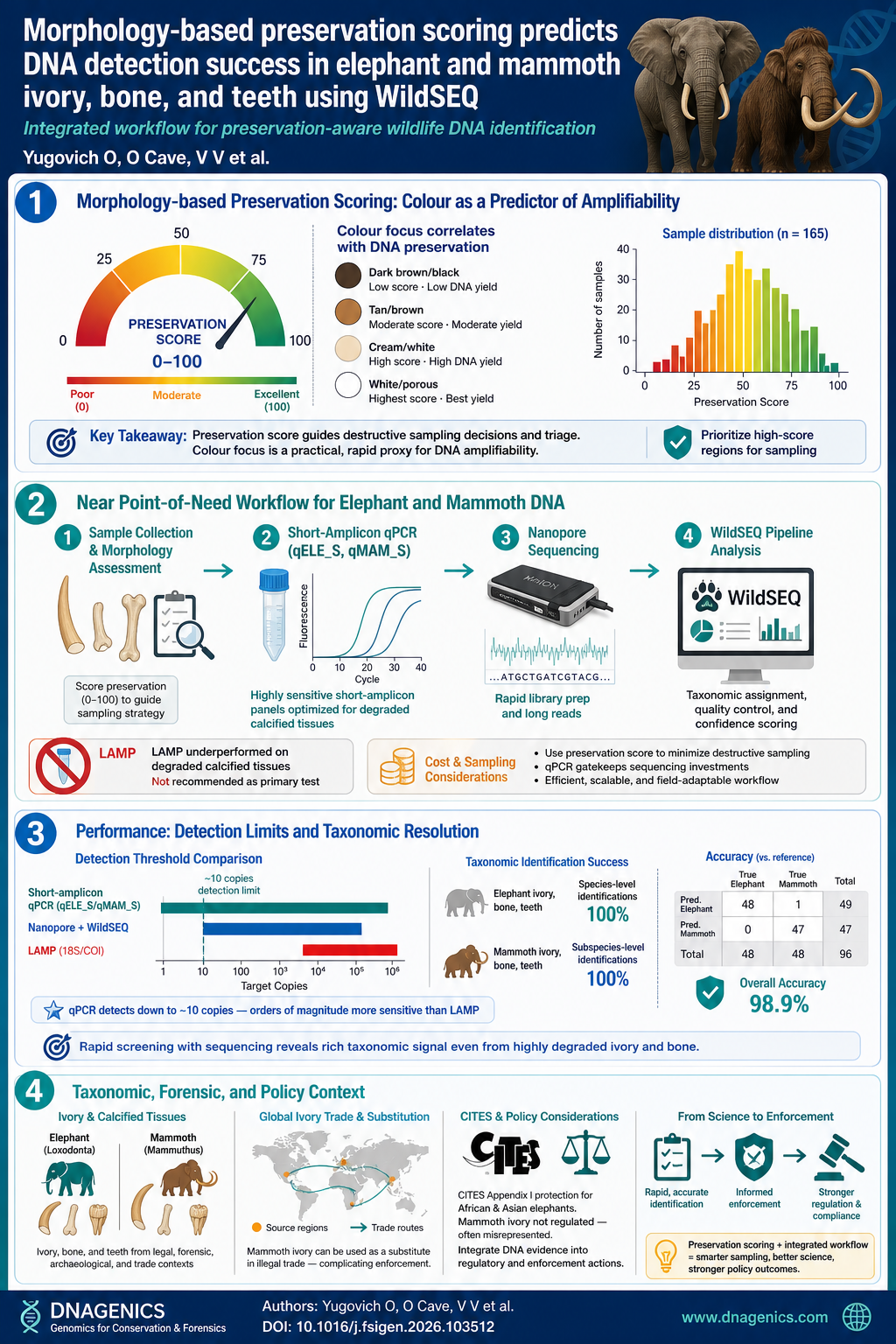
- Short-amplicon qPCR succeeds where LAMP struggles on degraded calcified tissues, achieving detection down to about 10 copies of elephant or mammoth DNA.
- Species discrimination with CytB markers enables clear identification among E. maximus, L. africana, L. cyclotis, and mammoth lineages, with sequencing providing subspecies resolution.
- Color is the simplest predictor of DNA preservation; a calculated preservation score (0–6) correlates with detection probability and can triage sampling decisions.
- Quantitative sampling matters: about 50 mg input improves detection across preservation states, supporting a practical sampling threshold for challenging specimens.
- WildSEQ enhances interpretability by delivering mapping-based identifications from qPCR amplicons, reducing reliance on BLAST-like workflows and supporting court-defensible reporting.
- Caution with museum-derived data: 34% undetected samples and single-assessor preservation scoring highlight the need for broader validation and inter-rater reliability studies.
What This Means for Your DNA
For researchers and practitioners, the study emphasizes that degraded DNA benefits from short targets and robust verification. The short-amplicon qPCR approach, when paired with nanopore sequencing, can yield rapid species and subspecies identifications even from tough materials like ivory or fossilized bone. The inclusion of a simple morphology-based preservation score helps triage destructive sampling, potentially conserving valuable specimens while still delivering reliable results.
For those analyzing personal or ancient DNA, the takeaway is intuitive: when DNA quality is compromised, targeting shorter regions improves assay success, and integrating sequencing can resolve ambiguous results. The WildSEQ pipeline demonstrates how streamlined, user-friendly reporting can accompany molecular identifications while maintaining rigour expected in forensic contexts.
In Simple Terms: When DNA is damaged, shorter DNA pieces are easier to copy and read. A quick color check on the sample tells you how likely you are to get usable DNA, guiding whether to sample more deeply. Combining a fast screening test with sequencing gives you reliable species answers without overcomplicating the process.
Historical and Archaeological Context
These findings intersect with ongoing discussions about ivory trade, CITES regulations, and the use of mammoth ivory as substitutes in enforcement and commerce. By reliably distinguishing the DNA of elephants from mammoths, law enforcement and policymakers can better trace the origins of materials and assess compliance with wildlife protections. The approach also aligns with broader efforts to integrate morphology, chemistry, and genetics in forensics, offering a practical template for real-world enforcement.
From an archaeological perspective, the ability to assign specimens to specific elephant lineages or mammoth lineages provides a window into past distributions and migrations. CytB-based identifications, coupled with sequencing, enable finer resolution than morphology alone and can help map historical range shifts during the Pleistocene. The geographic implications, ranging from African and Asian elephant lineages to mammoth populations across North America and Eurasia, support a nuanced view of how ancient populations interacted with changing climates and landscapes.
The Science Behind the Study
The researchers tested a colorimetric LAMP assay against two qPCR assays. The longer amplicon qPCR targeted the same region as LAMP, while a shorter, degraded-DNA-optimized qPCR was designed to maximize detection in compromised samples. Although LAMP successfully amplified synthetic DNA, it performed poorly on calcified tissues, underscoring the limitations of some field-friendly assays with degraded forensic materials. In contrast, the short-amplicon qPCR workflow detected as few as ~10 DNA copies and enabled clear species and subspecies identifications when paired with Nanopore sequencing.
Nanopore sequencing of the qPCR amplicons provided high-resolution taxonomic attribution, including subspecies resolution, which is crucial for both enforcement and population genetics perspectives. The integrated WildSEQ analysis pipeline offered rapid, interpretable results with reduced computational requirements compared to standard BLAST workflows, supporting timely decision-making in field or court settings. The study also evaluated practical factors influencing detection, including preservation state and sampling quantity, and proposed a simple, morphology-based preservation scoring system to guide sampling decisions. A key finding is that sample quantity (mg) strongly influences detection probability across preservation states, with 50 mg recommended as a practical threshold for challenging specimens.
In Simple Terms: When DNA is damaged, shorter DNA pieces are easier to copy and read, and a color score from the sample helps decide if it should be sampled further. Sequencing the amplified DNA adds a reliable layer of species detail, which is essential for enforcement and historical interpretation.
Infographic Section - Infographic: Preservation scoring and DNA detection workflow
The infographic illustrates how a color-based preservation score guides sampling decisions, contrasts LAMP with short-amplicon qPCR, and shows how Nanopore sequencing adds taxonomic detail within the WildSEQ workflow. It also highlights the practical sampling threshold (50 mg) and the relative performance of the methods across preservation states.
Why It Matters
This study offers a practical, integrated approach that bridges rapid field screening with high-resolution sequencing to improve wildlife forensic workflows. By combining a simple preservation-based triage with a sensitive short-amplicon qPCR and Nanopore sequencing, laboratories can deliver faster, more reliable identifications while controlling costs and minimizing tissue destruction. The approach has direct implications for ivory trade enforcement, CITES-compliant documentation, and broader population genetics inquiries into elephant and mammoth lineages.
Future work should focus on inter-laboratory validation of the preservation scoring system, refinement of sampling guidelines across preservation states, and broader application of the WildSEQ pipeline to other wildlife taxa. Expanding museum specimen validation and expanding runtimes for field-deployable equipment will further strengthen the robustness and courtroom readiness of this workflow.