Introduction
Corded Ware culture, a defining Final Eneolithic phenomenon, swept across much of central Europe and is closely linked with population movements from the Pontic steppe. A new study focusing on the heartland of this complex in south-eastern Poland sequenced genomes from 19 individuals and combined whole genome data with strontium isotope analysis to investigate ancestry, kinship, and mobility. The findings reveal a nuanced picture: a population with deep maternal roots in Neolithic lineages but strong paternal input from Steppe groups, illustrating a sex-biased admixture pattern during Corded Ware expansion.
Why this matters goes beyond academia. Understanding how Corded Ware communities formed, moved, and organized socially helps illuminate broader processes of population replacement, cultural change, and long distance interactions in Bronze Age Europe. This study adds a regional lens to a pan-European story, showing how local dynamics could diverge from nearby regions yet still connect through shared migration routes and cultural practices.
Key Discoveries
- SE Poland Corded Ware shows maternal Neolithic continuity and paternal Steppe ancestry, indicating a mixed-origin population with sex-biased admixture.
- Y-chromosome diversity includes R1b-M269/R-L11 lineages, characteristic of Yamnaya and Beaker-associated lineages in some contexts, but less common among published Corded Ware samples elsewhere.
- ** mtDNA lineages (H, HV, I2, J1, K1, T1, T2, U4, U5) reflect European Neolithic ancestry rather than exclusive Yamnaya-related mtDNA**.
- Autosomal ancestry includes WHG, NEN, and SEA/SA/NEA components, with SE Poland CWC showing admixture patterns not identical to other Polish CWC groups.
- Kinship networks reveal close relationships within graves and non-local connections suggesting mobility and interregional exchange.
What This Means for Your DNA
For anyone exploring ancestry, this study emphasizes that population history is often a mosaic rather than a straight line of replacement. In Corded Ware contexts, maternal lineages can trace back to long established Neolithic communities, while paternal lineages reveal rapid influx from Steppe populations. In practical terms, this means:
- Your mitochondrial DNA (mtDNA) lineage may reflect deep local continuity, even in populations with substantial paternal influx from distant sources.
- Y-chromosome results can show strong regional signatures that echo migrations, but they may not align perfectly with autosomal ancestry due to sex-biased admixture.
- Autosomal DNA often captures a blend of hunter-gatherer (WHG), Neolithic farmer (NEN), and steppe-like (SEA/SA/NEA) components, underscoring regional variation within Corded Ware groups.
For hobbyists and professionals alike, this work reinforces the importance of integrating autosomal data with uniparental markers (mtDNA and Y-DNA) and, when possible, isotopic data to interpret mobility and ancestry. It also highlights that consumer DNA tests may reflect broad continental signals, while regionally specific admixture patterns can require archaeological context to interpret accurately.
Historical and Archaeological Context
The Corded Ware Complex emerged in the late Neolithic and spread across Central Europe, often in parallel with Beaker-related networks and prior Neolithic communities. The southeast Polish region studied here sits at a crossroads where steppe-derived inputs could mingle with established Neolithic populations, offering a laboratory to observe how large-scale migrations intersect with local continuity.
The findings align with a broader picture of Corded Ware as a mosaic culture shaped by migrations from the steppe and interactions with local farmers. The presence of paternal Steppe ancestry amid maternal Neolithic continuity supports a model where male-mediated gene flow and cultural exchanges contributed to the genetic and cultural landscape of third millennium BCE Central Europe. The discovery of non-local individuals within localized burial contexts also points to mobility and social networks that crossed regional boundaries, contributing to a dynamic and interconnected Corded Ware horizon.
The study also engages with Beaker period dynamics by noting divergent affinities in Beaker samples from nearby regions, suggesting that Central Europe hosted multiple, overlapping population streams with regional heterogeneity in ancestry and cultural practice. Taken together, these insights depict a regionally structured Corded Ware landscape where migrations, local continuity, and cross-cultural exchanges shaped population history.
The Science Behind the Study
The research integrates genomics and isotope geochemistry to dissect ancestry, kinship, and mobility in a Southeast Poland Corded Ware sample set. Researchers sequenced whole genomes from 19 individuals and combined these data with strontium isotope ratios extracted from tooth enamel to infer childhood origins and mobility patterns. Kinship was assessed through genetic relatedness analyses, revealing first- and second-degree relationships and supporting social organization hypotheses based on burials.
Methodologically, the study relies on standard population genetics tools to parse ancestry: uniparental markers (Y-chromosome haplogroups such as R1b-M269 and R-L11; mtDNA haplogroups like H, HV, I2, J1, K1, T1, T2, U4, U5) and autosomal admixture components described as WHG (Western Hunter-Gatherer), NEN (Neolithic Europe-related component), and SEA/SA/NEA (steppe and related spectra). The combination of genomic and isotopic data allows cross-validation of mobility signals and ancestry inferences. The authors acknowledge limitations including small sample size and potential biases from uneven genome coverage, urging cautious generalization to broader Corded Ware populations.
In Simple Terms: Genomes are like a mixed bag from many ancestral populations. In these Corded Ware individuals, the maternal lineages come from long-standing Neolithic farmers, while the paternal lineages reflect Steppe migrations. Strontium isotopes show where people grew up, confirming some moved long distances. Kinship patterns tell us families buried together, while some non-locals in local graves reveal mobility and wider connections across regions.
Infographic
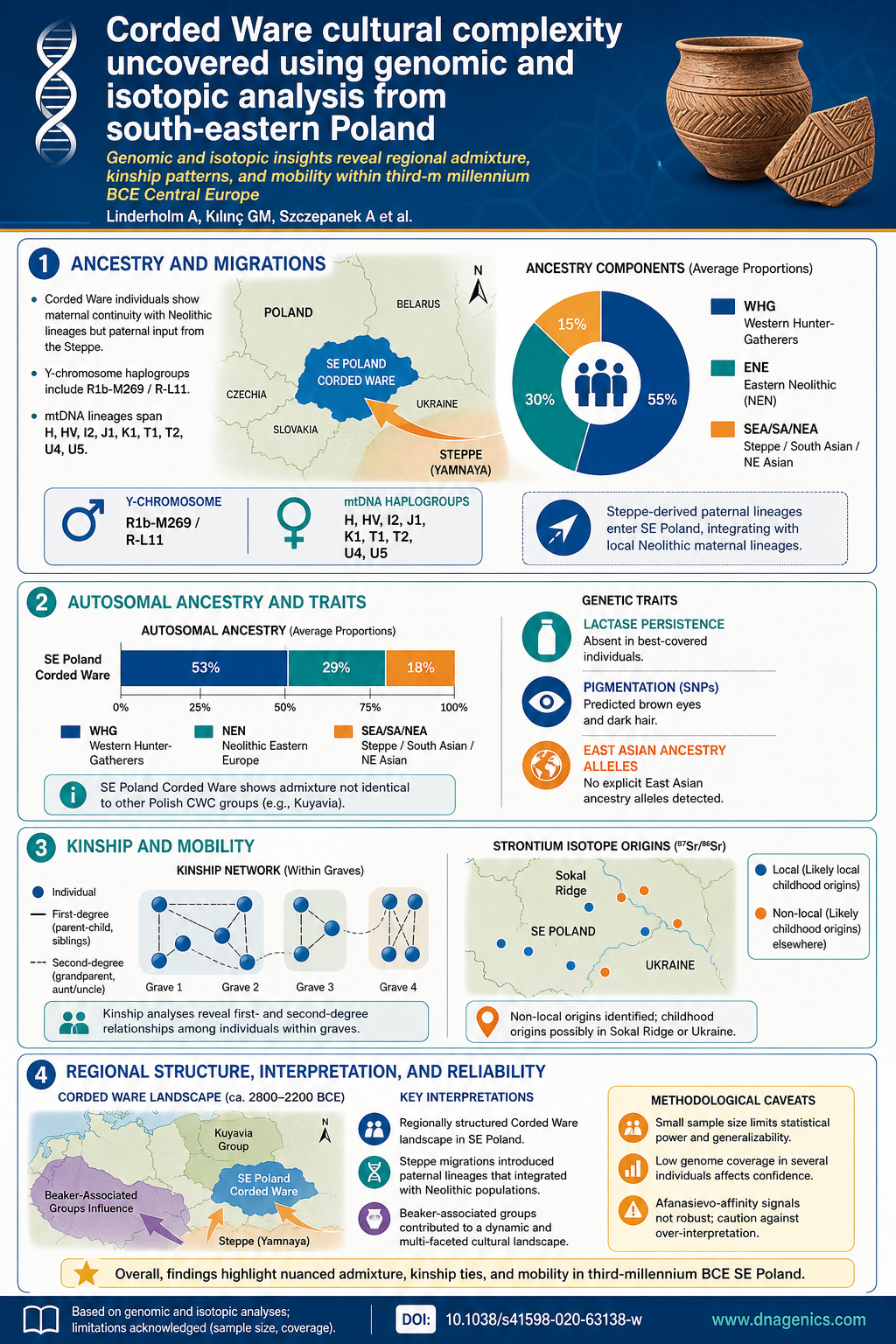
The study provides an infographic that visualizes the Corded Ware dynamics in south-eastern Poland, highlighting maternal continuity, paternal Steppe input, and mobility networks. The infographic helps readers quickly grasp how genetic ancestry and isotope data converge to illuminate kinship and migration during the Corded Ware period.
Descriptive overview of the infographic: it contrasts SE Poland Corded Ware findings with regional Beaker contexts, marks key uniparental lineages, and illustrates the mix of WHG, NEN, and SEA/SA/NEA autosomal components. It also highlights kinship ties within graves and the presence of non-local individuals inferred from Sr isotope data.
Why It Matters
This research underscores the complex, regional nature of Corded Ware population dynamics in Central Europe. Rather than a single, uniform migration, the SE Poland data reveal deep maternal continuity alongside strong paternal stepspe input, illustrating sex-biased admixture and nuanced population structure. Such findings refine our understanding of how demographic processes, kinship organization, and mobility interacted to shape the genetic landscape seen across Europe in the third millennium BCE.
Looking forward, larger sample sizes across diverse regions will help determine the extent of Afanasievo-like affinities and other nuanced regional patterns suggested by this study. Integrating genomic data with more extensive isotopic and archaeological datasets will further illuminate the social and demographic fabric of Corded Ware communities and their connections to neighboring cultures.
References
- View publication on DnaGenics
- Corded Ware cultural complexity uncovered using genomic and isotopic analysis from south-eastern Poland
- DOI