Introduction
The Thar Desert, a harsh but enduring landscape in Northwestern India, hides a story written not only in sand but in genes. A genome wide study of eight craft based communities, set against a broad panel of global and ancient genomes, reveals how migration, ecology, and culture leave a lasting imprint on human DNA. This work offers a fresh genomic baseline for the Thar, a region where pastoralism, crafts, and social structure intersect in surprising ways.
Why this research matters is twofold. First, it helps explain how populations adapt to extreme environments while keeping cultural identities intact. Second, it provides a framework for understanding how endogamy, guild based organization, and historic trade networks shape population genetics in a region that sits at a nexus between West Eurasian and South Asian ancestry. Together these insights inform broader questions about ancestry, migration, and the genetic architecture of traits that interact with culture, such as lactase persistence and pigmentation.
Key Discoveries
- Thar craft populations lie along the north–south Indian genetic cline with West Eurasian affinities in several groups. This places Thar communities within a broader Indian genetic landscape while highlighting regional diversity.
- Three Thar artisan subgroups (TH-IJE-4-R, TH-IJE-1-PR, TH-IJE-1-MU) show elevated West Eurasian ancestry and Central Steppe MLBA components. These signals point to substantial external inputs at specific historical periods.
- A subset of groups (e.g., TH-IJE-1-SN, TH-IJE-2-R) cluster toward Indo-European– and Dravidian-associated ancestry within South Asia. This reflects heterogeneous population histories across guilds.
- Admixture dating points to West Eurasian/Steppe inputs beginning 60–80 generations ago, with more recent events (~30 generations) in TH-IJE-2U. This time framing aligns with known periods of regional connectivity and exchange.
- Elevated runs of homozygosity and founder intensities indicate strong endogamy and bottlenecks, especially in certain artisan guilds (~400–500 years ago). A signature of guild based social structure and restricted mating pools.
- Uniparental DNA reveals a mosaic of South Asian maternal lineages with West Eurasian inputs; paternal lineages include R1a, L1a, and other West Eurasian associated haplogroups. A clear demonstration of sex biased admixture and deep lineage layering.
- Lactase persistence shows local heterogeneity; pastoralist groups harbor higher rs4988235 T allele frequencies, suggesting dairy adaptation alongside West Eurasian ancestry. A gene culture co evolution signal with dietary practices.
- SLC24A5 rs1426654 A allele frequency is relatively high in NW Thar populations, consistent with West Eurasian influence and pigmentation adaptation. This mirrors regional pigmentation patterns across Eurasia.
- Ancient DNA proxies indicate continuity with Indus Periphery and related sites, situating Thar populations within a long history of regional connectivity across Eurasia. The Thar emerges as a genetic crossroads rather than a distant outpost.
What This Means for Your DNA
For DNA enthusiasts, the Thar study underscores how ancestry is layered and region specific. If your results show a mix of South Asian components with West Eurasian input, you are witnessing a mirror of a real world pattern seen in the Thar eight communities. The finding that some groups carry Central Steppe MLBA like signals demonstrates how distant migrations can blend with local lineages to shape present day diversity.
A key takeaway is gene culture co evolution. The lactase persistence allele is more frequent in pastoralist groups, aligning with dairy practices, while other groups share ancestry with different South Asian lineages. The relatively high frequency of the SLC24A5 pigmentation allele in NW Thar reflects West Eurasian influence and adaptation in skin pigmentation. In practical terms, your DNA analysis can interpret such patterns as legacies of historical movements, ecological constraints, and social structure that guided mating and mobility.
For beginners, think of the Thar as a layered archive: ancient migrations layer over long standing local populations, with culture acting as a catalyst for certain genetic adaptations. When you analyze DNA data, you are tracing these layers to understand your own ancestral connections in a landscape that blends desert ecology with centuries of craft, trade, and settlement.
Historical and Archaeological Context
The Thar sits at a crossroads where the Indian subcontinent meets Central Asia and the Indo-European speaking world. The study places Thar communities within a north–south genetic cline across India, yet it highlights substantial substructure driven by endogamy and guild based settlement. The continuity signals with the Indus Periphery and related sites position the Thar as a living archive of ancient connectivity across the Eurasian landscape.
Archaeological narratives of the Indus Valley and surrounding trade networks help explain the West Eurasian and Central Steppe components found in several Thar groups. The timing of admixture events, estimated at tens of generations ago, aligns with known periods of long distance exchange and regional population movements. The desert environment itself likely shaped migration routes, settlement choices, and craft specialization, contributing to the enduring social and genetic stratification observed today.
The Science Behind the Study
This genome wide analysis used SNP data from 176 individuals across eight occupational communities, set in a comprehensive comparative framework with global, Indian, and ancient genomes. Population genetics methods included analyses of population structure, demographic modeling, admixture tests, and the detection of founder effects and bottlenecks. The combination of modern and ancient DNA data enabled assessments of continuity with Indus Periphery proxies and broader South Asian lineages.
The study also examined uniparental markers (mitochondrial DNA and Y haplogroups), revealing a mosaic of maternal lineages with West Eurasian inputs and paternal lineages that include R1a, L1a, and other West Eurasian associated haplogroups. Functional allele frequencies, such as rs4988235 for lactase persistence and rs1426654 for SLC24A5, were analyzed to illustrate gene culture co evolution in the context of ecology and occupation. These methods together create a robust, though early, genomic baseline for the Thar desert and its craft based communities.
In Simple Terms: This study examines thousands of genetic markers across many people to map where their ancestors came from, how groups mixed or stayed separate, and how culture drove genetic changes like dairy digestion and skin color.
[Infographic Section - Infographic available]
Infographic: Thar Desert genetic landscape across eight craft communities illustrates how different guilds show West Eurasian inputs, Steppe signals, and local South Asian ancestry. It also highlights the timing of admixture events and the strength of founder effects in select groups. The image helps readers visualize how ecology, migration, and culture combined to shape the Thar genetic landscape.
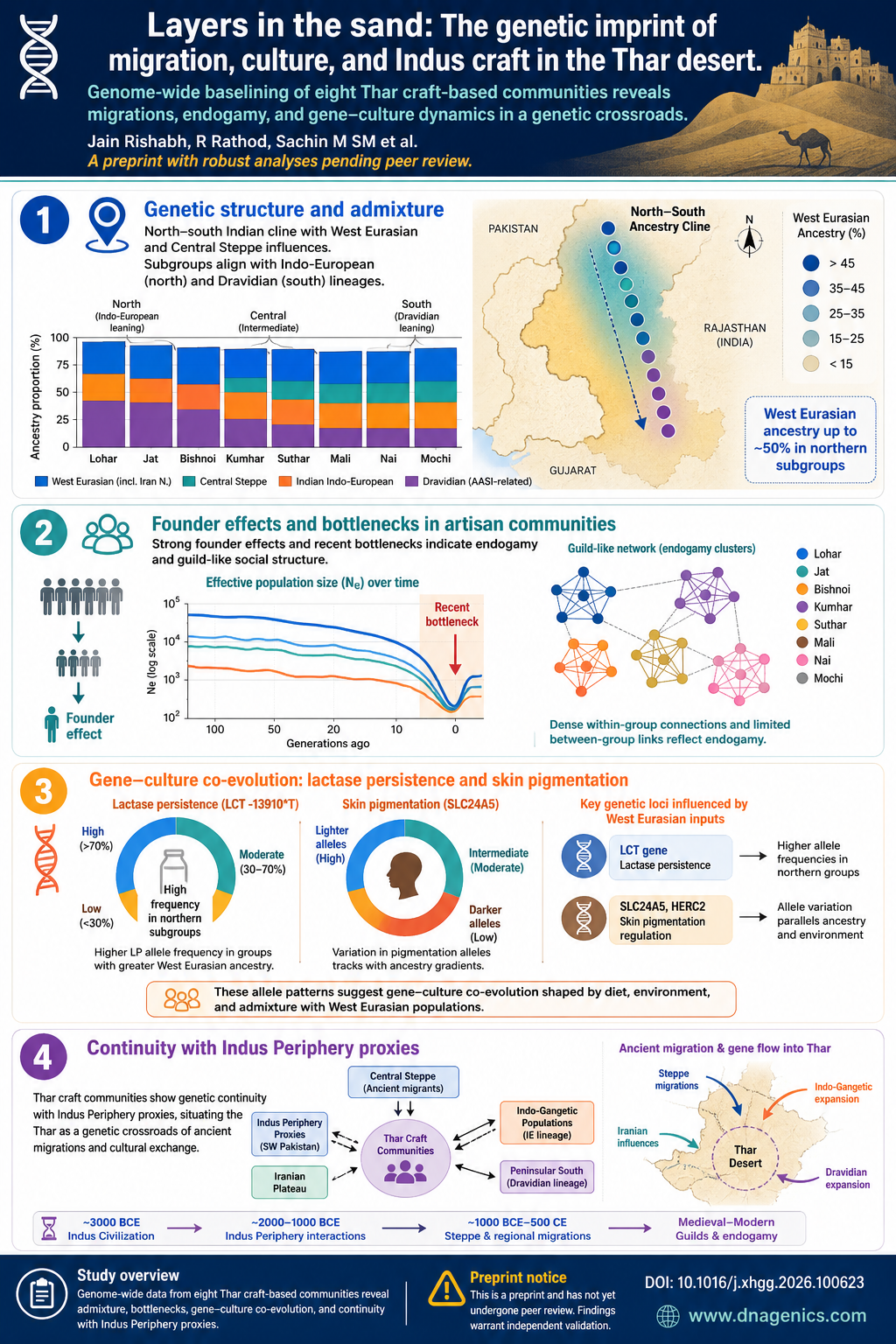
What the infographic shows:
- The genetic affinities of eight Thar communities along the Indian north–south cline
- West Eurasian and Central Steppe inputs in several artisan groups
- Variations in ancestry across guilds consistent with trade links and endogamy
- Dates of admixture consistent with historical periods of mobility and guild formation
Why It Matters
This work establishes a genomic baseline for the Thar desert, a region previously underrepresented in population genetics research. It demonstrates how ecology, social structure, and historical migrations shape genetic diversity and adaptation in extreme environments. The findings highlight the complexity of ancestry in South Asia, with regional substructure and multiple layers of gene flow that challenge simplistic models of population history.
Looking ahead, expanding sampling to more communities and integrating additional ancient DNA will refine admixture timing and migration pathways. These efforts will improve our understanding of genetic risk, adaptation, and resilience in desert populations, with direct relevance to ancestry based health research and personalized interpretation of DNA data.
References
- View publication on DnaGenics
- Layers in the sand: The genetic imprint of migration, culture, and Indus craft in the Thar desert
- DOI: 10.1016/j.xhgg.2026.100623