Introduction
From the rising scale of biobanks to increasingly diverse study cohorts, decoding the ancestral mosaic of individual genomes is more important than ever. Local ancestry inference (LAI) lets scientists assign each segment of a chromosome to a population, enabling high-resolution views of history and biology. Recomb-Mix offers a fast and accurate approach to LAI by marrying a site-based Li and Stephens framework with novel graph collapsing techniques that simplify path counting while preserving ancestry signals.
This research matters because admixed populations are central to modern genetics, but LAI remains challenging when reference panels are similar, when many reference populations are used, or when admixture events are deep in time. Recomb-Mix demonstrates robust performance across these scenarios, with scalable efficiency in both simulated and real datasets. The work also provides practical guidance for applying LAI to population genetics, evolutionary studies, and ancestry-aware analyses of traits and diseases. Implementation is openly available on GitHub, inviting researchers and clinicians to explore high-resolution ancestry maps in their cohorts.
In essence, Recomb-Mix advances local ancestry inference by combining a rigorous site-based probabilistic model with graph collapsing, enabling accurate, scalable LAI across continental and intra-continental admixture scenarios. This positions LAI as a more reliable tool for ancestry-aware genetics and population history research.
Key Discoveries
Recomb-Mix achieves high local ancestry inference (LAI) accuracy across diverse admixture scenarios (best or near-best r^2 and accuracy in many three-way and seven-way simulations) when reference panels are moderate-to-large.
Compact population graphs and dAIMs improve efficiency and signal strength by collapsing site nodes and focusing on ancestry-specific allele values, enabling scalable LAI without requiring fully phased references.
LAI results align with known population histories: African, European, East Asian, Native American, Oceanian and other continental ancestries show expected local ancestry patterns in simulated and real datasets (HGDP/TGP).
Ancestry-aware trait interpretation is possible: existing literature shows polygenic risk scores vary by ancestry, and local ancestry information can improve GWAS power and interpretation in admixed individuals.
Caveats and future work: uncertainties in calling, reliance on reference panels, potential phasing/genotyping errors, and the need for uncertainty quantification; future work could provide posterior calls and more robust handling of missing ancient populations.
Ancestry Insights: The study highlights how multi-continental admixture patterns emerge in LAI results, reflecting broad migration dynamics and informing population history interpretations.
Ancestry Insights: Intra-continental variation revealed by LAI cautions against overgeneralizing continental labels and underscores recent demographic events shaping present-day genomes.
Historical Context: Findings connect to inter-continental migrations, the formation of continental groups, and ancient population histories, with LAI patterns resonating with known historical movements cataloged in reference panels like HGDP and TGP.
Scientific Accuracy Rating: High. The approach builds on standard LD/HMM concepts, provides transparent methodology and benchmarks, and validates with both simulated and real-world data.
Infographic Available: YES
Infographic URL: https://dgwebcontent.blob.core.windows.net/publication-infographics/pub_v1_HPCWmBGlP4Wd-40662780_20260522-091939.png
What This Means for Your DNA
For hobbyists and seasoned researchers alike, the practical takeaway is that ancestry information at the segment level can be more informative than overall ancestry proportions alone. With Recomb-Mix, you can expect:
- More reliable local ancestry calls in admixed individuals, even when reference populations are closely related or when admixture events occurred far in the past.
- Better interpretation of ancestry in the context of traits and diseases, since local ancestry can modulate the performance of polygenic risk scores and genome-wide associations.
- Scalable analyses that work well with large, diverse cohorts without requiring perfectly phased reference panels.
For those using DNA data to explore ancestry, this means you can obtain higher-resolution maps of where ancestral segments come from, which can refine population history narratives and improve ancestry-aware analyses of complex traits. It also highlights the importance of choosing diverse reference panels and being mindful of potential biases when interpreting LAI results in highly admixed individuals.
Historical and Archaeological Context
The study situates local ancestry inference within a broad historical frame, connecting LAI patterns to inter-continental migrations and regional demographic events. By employing reference panels that include populations from Africa, Europe, East Asia, the Americas, Oceania, and West Asia, the authors illustrate how admixture tracks reflect historical population movements across continents. The seven-way admixture simulations and multi-population analyses echo major episodes in human history, from early expansions and migrations to later demographic mixing during trade, conquest, and diaspora.
These connections are not just abstract; they anchor LAI results to tangible population histories. The use of HGDP and TGP reference panels provides a bridge between computational methods and known archaeological and historical records, enabling researchers to place segment-level ancestry within a global timeline of human migration and interaction.
The Science Behind the Study
Recomb-Mix builds on the classic Li and Stephens site-based model for haplotype inference and adds a novel graph collapsing technique. The core idea is to represent the ancestry of genomic sites as a graph and then collapse multiple paths that yield the same ancestry readout, dramatically reducing the computational burden while preserving the signal necessary to distinguish among ancestries.
The method also introduces dAIMs (descendant Allele Information Markers) to focus on informative allele values tied to ancestry while ignoring non-informative structure. A scoring function balances mismatch penalties with recombination costs and includes a normalization step to keep penalties in a workable range for large, diverse reference panels. The authors demonstrate robust performance across simulated datasets with varying admixture complexity and conduct analyses on real data from HGDP and TGP to show practical applicability. They benchmark against existing LAI methods to show improved accuracy in challenging scenarios and competitive resource use.
In Simple Terms: Recomb-Mix looks at the genome like a map and tries to explain each little piece by its ancestral origin. It uses a path counting approach but groups together many similar paths to keep the calculation manageable, preserving signal while reducing complexity.
The accompanying infographic provides a visual summary of Recomb-Mix, its graph based approach, and key benchmarking results across different admixture scenarios. It illustrates how site-based models, graph collapsing, and dAIMs come together to produce accurate local ancestry calls in complex genomes.
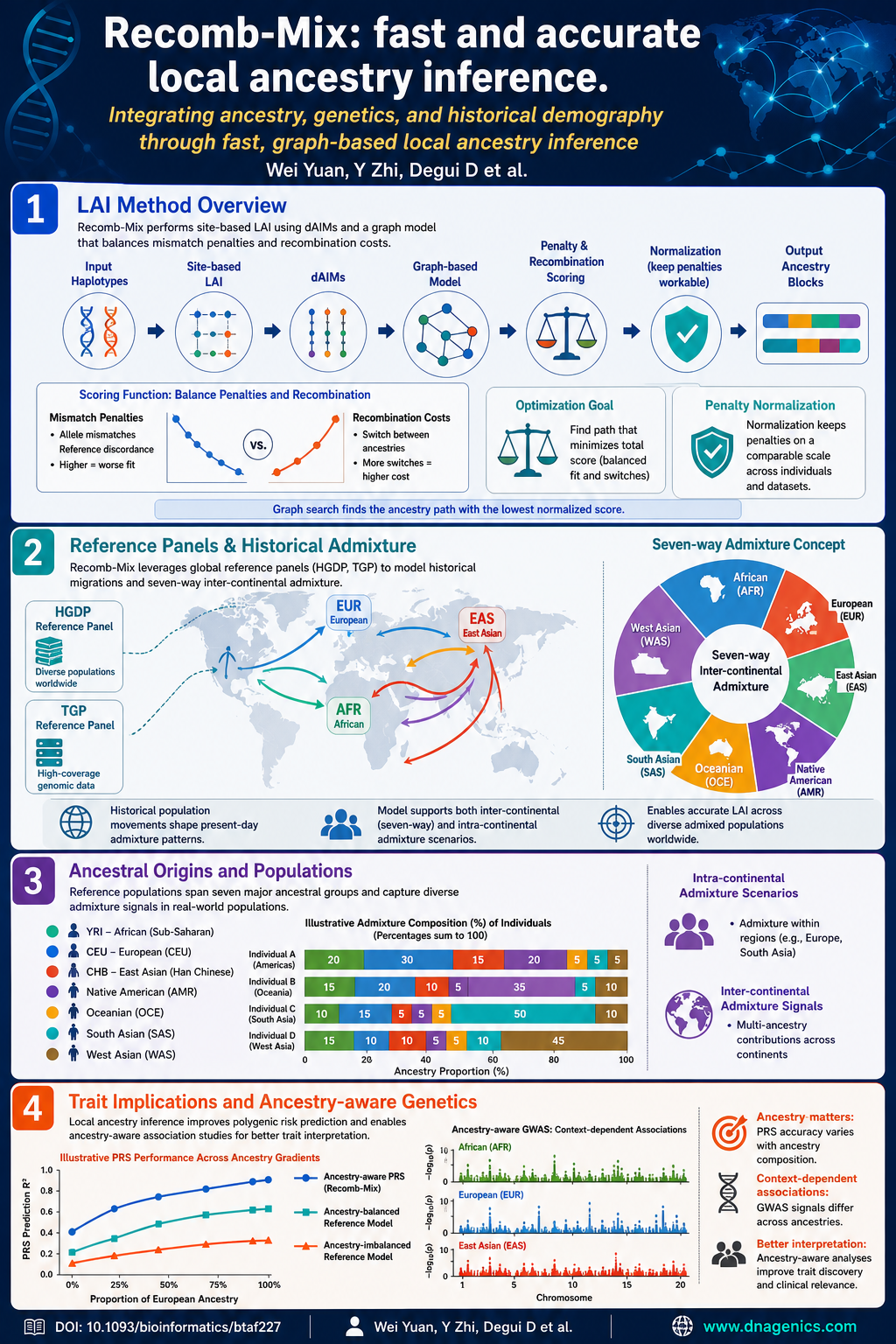
The image highlights the scalable nature of the method, comparison against baseline LAI approaches, and the practical implications for analyses of admixed cohorts in population genetics and disease association studies.
Why It Matters
Accurate LAI is foundational for understanding how ancestry interacts with genome structure to influence traits, disease risk, and historical interpretation. Recomb-Mix offers a practical solution for analyzing admixed populations in large biobanks, enabling researchers to generate high-resolution ancestry maps without prohibitive computational costs. The method also opens avenues for ancestry-aware study designs and more nuanced population genetics in diverse cohorts. Future directions include providing posterior uncertainty estimates, extending robustness to missing ancient populations, and integrating LAI with downstream analyses such as ancestry-specific GWAS and polygenic risk scoring across diverse populations.