


Introduction
The eastern Colombian Andes, home to the Altiplano Cundiboyacense, preserves one of the most continuous archaeological records in the Americas. A new genome-wide ancient DNA study expands the regional dataset by 11-fold, bringing 209 individuals into focus across more than 7,000 years. From late Pleistocene hunter-gatherers to the late Holocene Herrera and Muisca periods, the landscape of ancestry in this high-altitude region reveals a nuanced tale of continuity, migration, and cultural change.
Why does this research matter? It provides a rare, long-span genetic narrative from a single geographic corridor, showing how populations persisted for millennia, then experienced a pronounced turnover linked to the emergence of the Herrera culture. The study also demonstrates that subsistence shifts—like maize (C4) inclusion—can occur without immediate population replacement, highlighting complex interactions between culture and genes. In short, it reshapes our understanding of population genetics and cultural dynamics in northern South America during the Holocene.
This work situates genetic data within a rich archaeological context, connecting migration routes, subsistence strategies, and social transformations. By charting changes in ancestry alongside isotopic dietary signals, the study paints a holistic picture of how ancient people adapted to their environments and interacted over thousands of years.
Key Discoveries
- Five millennia of population continuity in the eastern Colombian Andes prior to Herrera turnover, driven by drift in small groups with no detectable external gene flow.
- Sharp genetic turnover at Herrera emergence around 2200 BP, indicating migration of populations with ancestry divergent by up to ten millennia.
- Admixture history: Herrera/Muisca ancestry derives from a ~4000-year-ago mixture of Chibchan-related groups and populations from the Amazonian–Andean interface.
- Substructure within Altiplano: Genetic differentiation between southern and northern Altiplano during Herrera/Muisca periods mirrors archaeological regional differentiation.
- Maize adoption without population replacement: Two individuals show C4 (maize) dietary signals despite hunter-gatherer genetics, illustrating subsistence shifts prior to turnover.
What This Means for Your DNA
For DNA enthusiasts, this study underscores two practical takeaways. First, population history can unfold in deep time with long stretches of genetic continuity punctuated by discrete migration events. Your own ancestry results may reflect similarly complex patterns: long-standing lineages coexisting with later admixture from distinct source populations. Second, cultural changes—such as a shift to maize-focused diets—don’t always line up with genetic turnover. Dietary transitions can occur within existing populations, driven by trade, adaptation, or cultural diffusion rather than wholesale replacement of people.
If you’re investigating your own ancestry in the Americas, consider that regional lineages may persist much longer than major cultural shifts. This means you might observe stable genetic components across millennia even as archaeological indicators point to new technologies, crops, or social systems. In practice, that translates to interpreting haplogroup signals, admixture proportions, and regional substructure with an eye toward how culture and diet can diverge from population replacement timelines.
Historical and Archaeological Context
The Altiplano Cundiboyacense sits within the Eastern Cordillera of the Northern Andes, a corridor central to Holocene human dispersals. The new data align with a broad narrative: long-term hunter-gatherer continuity in the region, followed by a pronounced population turnover with the Herrera culture around 2200 BP. This turnover is tied to migrations from populations carrying ancestry divergent by up to ten millennia, signaling substantial demographic influx concurrent with social and political changes that culminated in the Herrera–Muisca complex.
Archaeologically, the sequence extends from late Pleistocene hunter-gatherers through the Herrera period (roughly 2200–1300 BP) and into the late Holocene Muisca chiefdoms (approximately 1200–500 BP). The study’s geographic focus on the eastern Andes helps clarify how inland Andean populations related to Chibchan-speaking groups and to populations at the Amazonian–Andean interface participated in broader regional dynamics. The observed north–south substructure within the Altiplano during Herrera/Muisca times echoes phased cultural development and resource use that archaeologists have long linked to changes in settlement patterns and subsistence economies.
The Science Behind the Study
This work builds a genome-wide ancient DNA dataset from 209 individuals spanning over 7,000 years. The authors increase regional sample size by roughly 11-fold, enabling robust inferences about continuity, turnover, and admixture that were previously uncertain due to gaps in dated individuals. Analyses likely included PCA, f-statistics (D and f3), admixture modeling, and tests for population structure and drift, supported by isotopic analyses that trace dietary inputs such as maize-derived C4 signals.
Key methodological takeaways for advanced readers include how long-term continuity can be maintained by drift in small groups with limited external gene flow, and how sharp turnovers can accompany major cultural transitions. The data reveal that some individuals dating to ~2800 years ago retain hunter-gatherer ancestry yet show isotopic evidence for maize in their diet, illustrating subsistence shifts without genetic replacement. The study also identifies internal substructure within the Altiplano during Herrera/Muisca times, suggesting regional differentiation in ancestry paralleling archaeological regionalization.
In Simple Terms: Long-term continuity means the same genetic line persisted for thousands of years, even as people adapted foods and customs. A sharp turnover means a new population moved in and largely replaced the old genetic line. In this case, maize entered local diets while some people remained genetically hunter-gatherers, showing culture can change without immediate population replacement.
Infographic Section
An infographic summarizes the timeline of ancestry and subsistence in the eastern Colombian Andes, highlighting long-term hunter-gatherer continuity, the Herrera turnover, and the maize-diet signals found in individuals with hunter-gatherer genetics.
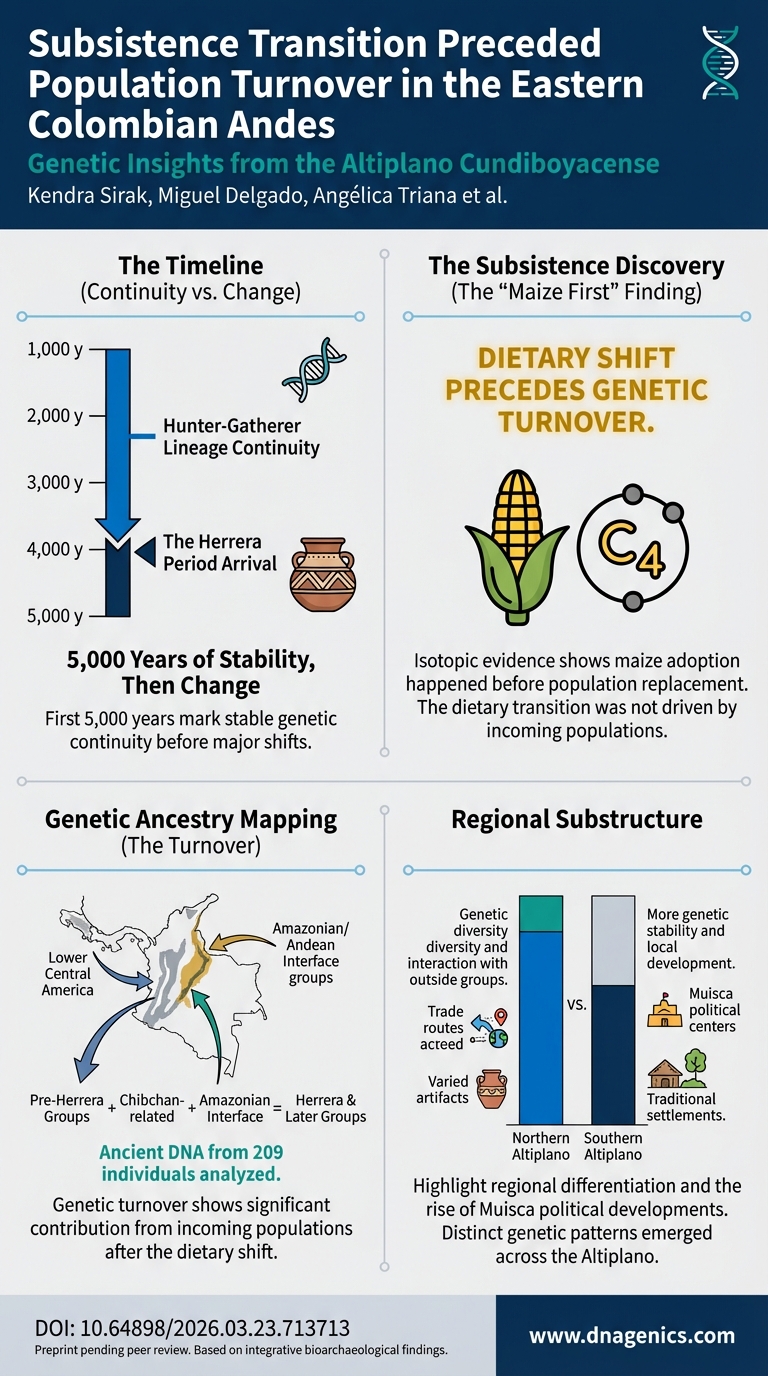
This visual consolidates the study’s core messages: extended genetic continuity, a discrete migration event around Herrera emergence, and decoupled dietary shifts from ancestry in certain individuals.
Why It Matters
These findings refine our understanding of how population dynamics and cultural practices intersect in the northern Andes. The clear signal of five millennia of continuity followed by a distinct migration event around Herrera underscores the importance of integrating ancient DNA with isotopic and archaeological data to interpret subsistence and social change. The identification of admixture sources — notably Chibchan-related lineages and Amazonian–Andean interface populations — illuminates broader migration routes and contact networks in Holocene South America. As sequencing technologies improve and more samples become available, researchers can extend these insights to neighboring regions and refine timelines for population movements and cultural transformations.
Future work will aim to resolve finer-scale timing of admixture events, assess regional variability across the Altiplano, and integrate additional isotopic proxies to map diet, mobility, and ecological adaptation with even greater precision. The study’s integrative approach sets a benchmark for how genetics, archaeology, and anthropology can converge to illuminate the complex tapestry of human history.
References
Subsistence transition preceded population turnover in the eastern Colombian Andes
DOI: 10.64898/2026.03.23.713713