Introduction
The plague of 1720 left an imprint on many communities in Provence, but Martigues in the Bouches-du-Rhône region provides a particularly revealing case. By studying surnames from births before and after 1720, researchers traced how a catastrophic event can jolt the fabric of a town, sparking migration, mortality, and rapid demographic renewal. This approach turns genealogical clues into a broader story about population dynamics and local resilience.
Why does this matter for ancestry research? Epidemics and wars are not just historical footnotes; they can reshape who remains in a community and who arrives. Understanding these patterns helps us interpret surname distributions, genealogical lineages, and potential migration routes when reconstructing family histories. In an era where DNA and ancestry go hand in hand, the surname method offers a complementary lens to archaeology and ancient DNA evidence, linking past events to present genetic backgrounds.
Key Discoveries
- Population renewal after the plague was substantial, with an estimated ~50% renewal of surname stock in Martigues following 1720, signaling major demographic turnover.
- Surname-based categorization reveals movement patterns through categories such as hapax names and the three main types of persistence or change, enabling inferences about local extinction, immigration, and lasting lineages.
- Type 2 surnames indicate post-plague arrivals: many names absent before 1720 appear afterward, suggesting immigration from neighboring towns like Aix-en-Provence and Marseille, or further afield; some show geospatial signatures we term geohapax.
- Type 3 surnames reflect persistence and stability: a core set persisted across both periods, indicating established families whose post-plague trajectories varied with local dynamics.
- Fertility changes linked to plague-affected lineages: lineages present in plague death records exhibited different post-plague fertility patterns, hinting at differential demographic responses by lineage, status, or occupation.
In Simple Terms: The study treats surnames like tiny population markers. Some names vanish after the plague, some arrive after, and a core group persists but with shifting birth rates. This helps us infer who moved, who died, and who stayed.
What This Means for Your DNA
For ancestry enthusiasts, the Martigues findings translate into practical takeaways. First, epidemics can drastically alter local genetic and genealogical landscapes by accelerating migration and replacing a large share of the surname pool. When you map your own surname history or haplogroup trajectory to known plague-era events, you may find gaps or shifts that align with historical crises. This enhances interpretations of population structure beyond a single lineage, highlighting how events shape regional genetic diversity over time.
Second, the study exemplifies how combining traditional records with genetic lineage information can clarify population movements. While the research itself leverages surname data rather than human genome data, it complements DNA-based ancestry by illustrating how large-scale demographic processes leave footprints in present-day genetic variation. For those building family trees, consider contextualizing your DNA results with local historical events such as epidemics, trade shifts, or migrations that could have reshaped who contributed to the gene pool.
Historical and Archaeological Context
The late 17th and early 18th centuries in southern France were times of upheaval and flux. The plague of 1720 arrived amid broader patterns of Mediterranean trade, urban growth, and cross-town movement. The Martigues case shows how an accelerating epidemic can prompt people to relocate to safer or more prosperous locales, or to join clusters with kin or economic opportunity. The data indicate arrivals from nearby cities like Marseille and Aix-en-Provence, supporting a regional mosaic of migration in the wake of the crisis.
Archaeologically, the period is characterized by shifting settlement patterns, changing land use, and evolving family structures. The surname method provides a quantitative bridge between documentary sources and population dynamics, helping situate Martigues within a broader map of Provençal demographic resilience. The study also situates its findings against the backdrop of the plague agent Yersinia pestis and the broader literature on ancient and historical population genetics, even though it does not rely on human genome data.
The Science Behind the Study
The researchers analyzed birth records from Martigues spanning the late 17th century to the early 18th century, focusing on births before and after the 1720 epidemic. After careful lemmatization of surnames to standardize spellings, they distinguished three core categories: names present before 1720 that disappear after the plague, names absent before 1720 that appear after, and surnames continually present but with differing birth frequencies across the two periods. To further refine movement patterns, they cross-referenced surname data with plague victim lists and examined surname frequencies in later regional and national datasets to infer possible destinations or origins for the disappearing and arriving names.
The analysis acknowledges data limitations, including gaps in year-by-year records, district weighting, and uncertainties in lemmatization. It also explicitly separates the discussion of pathogen genetics from human ancestry, noting that paleogenomic evidence for Yersinia pestis provides context rather than a direct link to individual lineages in this study. The synthesis is grounded in historical records and genealogical data, offering a robust quantitative view of population turnover in a small Provençal town.
In Simple Terms: The study uses names like a breadcrumb trail. By tracking which surnames vanish or appear after the plague, and where people likely came from, researchers infer who moved and who stayed, without needing full genome data.
[Infographic Section - ONLY if infographic is available]
The infographic visualizes the core findings: the estimated 50% renewal of surname stock after 1720, the four name-type dynamics (including hapax-like signals), and the inferred migration routes toward and away from Martigues. It helps readers grasp how epidemics can reshape local population structure and how surname data can serve as a proxy for migration and demographic change.
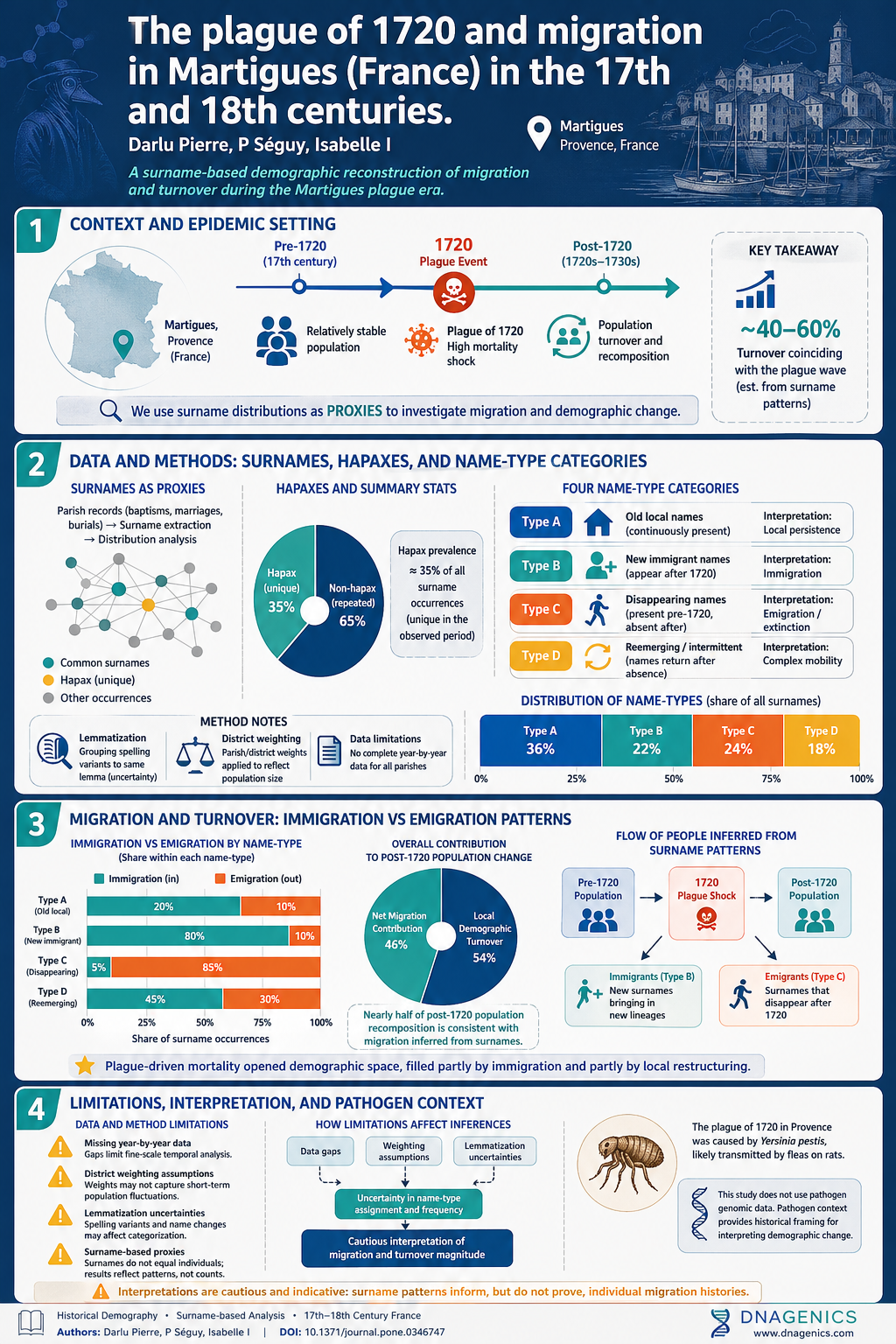
Descriptive text: The image shows pre- and post-1720 surname presence, the proportion of names that disappear versus arrive, and suggested origin districts for incoming families. It also highlights the approximate 50 percent turnover in the surname stock and notes the limitations of the data, including lemmatization uncertainty and district weighting.
Why It Matters
This study offers a concrete demonstration of how a local crisis can reset a population's genealogical and migratory makeup. The concept of substantial surname turnover underscores the importance of considering epidemic and conflict contexts when reconstructing ancestry and population histories. For researchers, the work points to fruitful avenues such as cross-regional surname analyses, integration with parish and civil registries, and aligning historical demographic shifts with genetic data to better understand population structure, fertility patterns, and migration ecology.
Future research could extend the surname methodology to other towns affected by epidemics, compare regions with different trade networks, or integrate ancient DNA where available to validate surname-based inferences with molecular evidence. In practice, this line of inquiry enriches our understanding of how past crises shape present-day genetic and cultural landscapes, influencing how we interpret migration, haplogroup distributions, and population genetics models.
References
- View publication on DnaGenics
- The plague of 1720 and migration in Martigues: genealogy and population turnover
- DOI: 10.1371/journal.pone.0346747