Introduction
In a world where family histories are increasingly diverse, understanding our mixed genetic heritage is more than a curiosity—it informs health, identity, and scientific insight. Precise local ancestry inference (LAI) empowers researchers to map the genome with regional nuance, letting us trace how different ancestral groups contributed to modern populations. The two-stage LAI model, Orchestra, pushes the boundaries of accuracy by leveraging an expansive, diverse reference panel and thousands of single-origin genomes.
This research matters because admixed individuals are central to equitable genomic science. By improving ancestry calls at a fine scale, Orchestra helps reduce bias in studies of complex traits, strengthens population genetics in underrepresented groups, and enhances downstream analyses like GWAS, eQTL mapping, and polygenic risk prediction. The study focuses on Latin Americans, a quintessential admixed population, and the Ashkenazi Jewish lineage, whose origins have long been debated, to illustrate the potential and limits of precise LAI. AI-assisted analyses are available and shed additional light on ancestry patterns and selection signals.
Key Discoveries
- Orchestra achieves high recall/precision in LAI across generations: ~90% recall/precision on 1KGP-16pops; ~80% on custom-35pops; superior performance vs RFmix, Gnomix, and FLARE.
- Latin Americans show broad European, African, and Native American ancestry with strong regional signals (NAM highest in Bolivia, Peru, Ecuador, Mexico; NGA/GLS African signals in the Caribbean; CSA African in Brazil; ITA influence in Argentina/Brazil/Uruguay).
- Trace ancestries reveal complex historical migrations: IND in the Guianas; ASK in Argentina; JPK in Brazil/Peru; JPK-Asian signals in parts of Latin America reflecting 20th century migration waves.
- Ashkenazi Jewish ancestry centers on ITA with notable Levantine and other European contributions; results align with medieval/modern DNA studies of Ashkenazi origins.
- Scandinavian ancestry in Britain is enriched in eastern regions with Viking settlement signatures; chr10 region harboring MAPK8, WASHC2C, MARCH8 shows potential adaptive signals related to immune function and historical infectious disease exposure.
What This Means for Your DNA
For individuals exploring ancestry, LAI offers a more precise read of where your DNA comes from across the genome. Instead of broad continental labels, you can see regional contributions within continents, trace minority or trace ancestries, and understand how historical migrations shaped your genetic makeup. In practical terms, ancestry-aware analyses can improve the interpretability of personal DNA results, support more accurate ancestry storytelling, and refine risk estimates in admixed individuals.
However, consumers should recognize limitations. LAI accuracy depends on the breadth and depth of reference panels and is bounded by the genomic window used for inference (roughly up to 12 generations in this work). As reference datasets expand and methods refine, the granularity and reliability of ancestry calls for admixed individuals will continue to improve.
Historical and Archaeological Context
The findings connect to well-documented historical movements. Latin American admixture patterns reflect centuries of European colonization, African diaspora trades, and persistent Indigenous populations, with regional specificity such as ITA influence in parts of Argentina and Brazil, and CSA African ancestry in Brazil aligning with regional slave histories and migrations. The discovery of trace ancestries like IND in the Guianas and JPK signals in Brazil and Peru mirrors documented labor migrations and diaspora events that shaped local gene pools.
The Ashkenazi Jewish signal, centered on ITA with Levantine and other European inputs, resonates with medieval and modern DNA studies that trace Ashkenazi roots to Mediterranean and European source populations. The British Viking-era signal, especially eastern England, echoes archeological and historical records of Norse settlement and long-range population interactions in the region.
The Science Behind the Study
Orchestra is a two-stage local ancestry inference model trained on more than 10,000 single-origin individuals from 35 worldwide populations. This broad reference panel provides a high-resolution map of fine-scale ancestry across the genome, enabling precise labeling of ancestral segments in admixed individuals. The study benchmarks Orchestra against established LAI methods such as RFmix, Gnomix, and FLARE, reporting recall and precision improvements across multiple population panels (e.g., 1KGP-16pops and custom-35pops).
The research also applies LAI outputs to explore demographic history and signatures of natural selection, revealing population-specific admixture patterns and potential adaptive loci. While the approach demonstrates impressive accuracy, the authors note limitations including a window-based inference scope of roughly 12 generations and the ongoing need for more comprehensive reference panels and peer review. The AI analysis component adds another layer of insight into ancestry patterns and potential selection pressures.
In Simple Terms: LAI tries to split your genome into chunks from different ancestral groups and label each chunk with its origin. Orchestra does this in two stages, first mapping broad ancestry and then refining the labels with a large, diverse reference panel. Think of it as a high-definition lens for tracing where slices of DNA come from on a fine-grained map.
Infographic
The infographic visualizes the Orchestra LAI workflow, population reference panels, and key findings. It shows how the model assigns local ancestry across the genome, highlights notable regional patterns in Latin American populations, and points to regions linked to selection signals.
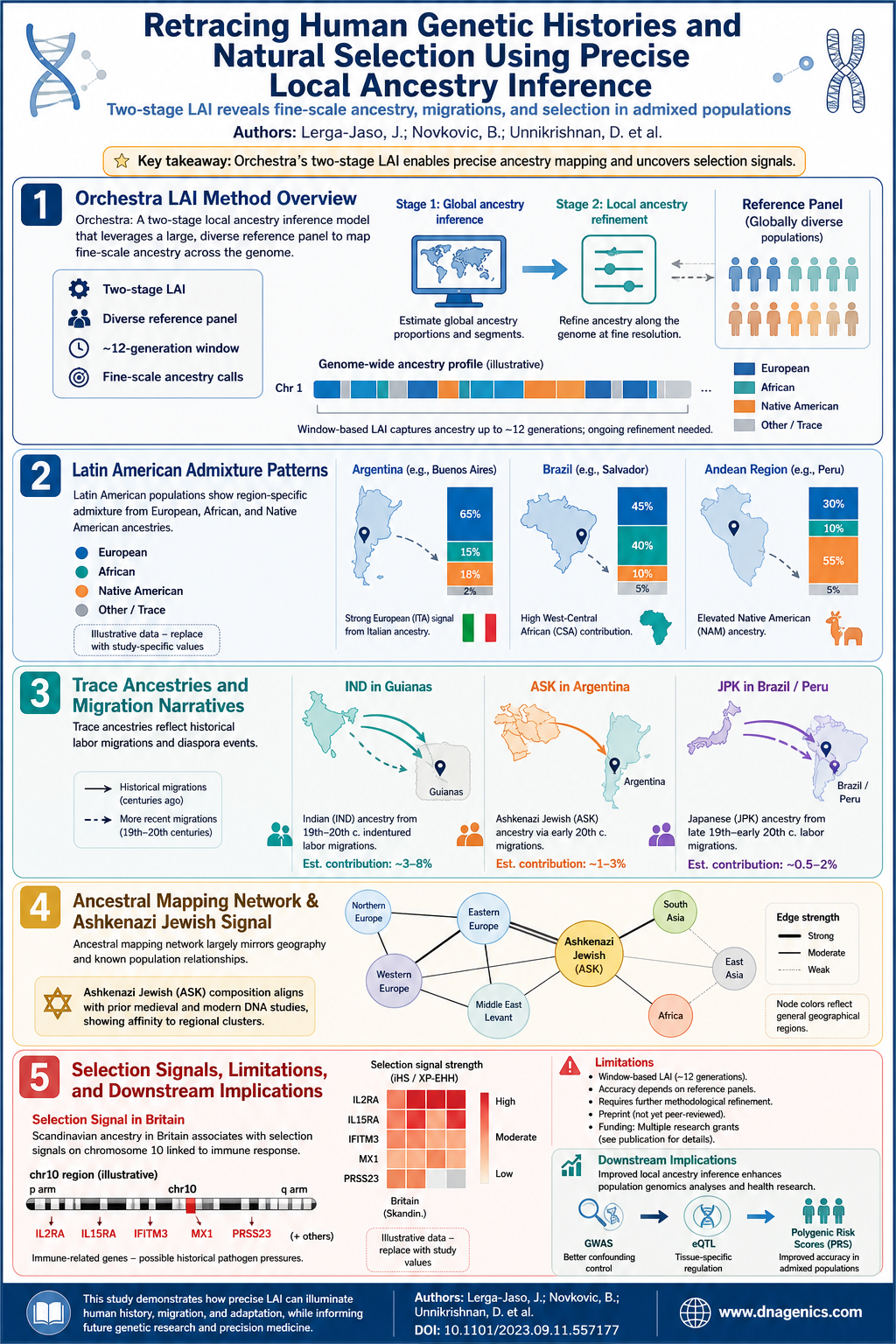
The image serves as a quick reference for the study design, performance benchmarks, and major discoveries across populations.
Why It Matters
This work advances local ancestry inference, offering a more accurate framework for studying admixed populations. By enabling finer-grained ancestry calls, Orchestra can improve the portability and equity of genetic research, including GWAS and polygenic risk prediction, in diverse groups. As reference panels continue to grow and methodologies are refined, ancestry-aware analyses will play an increasingly central role in understanding how historical migrations shape health and trait variation today.
Future directions include expanding population coverage, refining window-based LAI to capture deeper timescales, and integrating LAI with functional genomics to interpret how ancestry-specific regulatory variation contributes to disease risk and trait diversity.
Why It Matters (Broader Significance)
The study highlights the practical and theoretical value of precise local ancestry in population genetics, enabling researchers to reconstruct demographic histories with higher resolution and to investigate how ancestry influences trait architecture in admixed populations. This approach lays groundwork for more inclusive genetic research, better translatability of findings across populations, and the development of more accurate ancestry-informed health insights.
References
Retracing Human Genetic Histories and Natural Selection Using Precise Local Ancestry Inference