The Story
The journey of mtDNA haplogroup B4A1A1M1
Origins and Evolution
mtDNA haplogroup B4A1A1M1 is a downstream branch of the B4A1A1M lineage, itself nested within the broader B4 maternal clade that includes the well-known Polynesian/B4a1a1 motif. Based on the phylogenetic position of B4A1A1M1 beneath B4A1A1M and the archaeological timing of Austronesian dispersals, this subclade most plausibly arose in Island Southeast Asia or Taiwan in the Late Holocene (roughly within the last ~3,000–3,500 years). The lineage represents a localized diversification of B4-derived maternal lineages that accompanied maritime movements spreading Austronesian languages and culture across island Southeast Asia and into Remote Oceania.
Genetically, B4A1A1M1 is defined by private mutations on top of the B4A1A1M backbone; as with many terminal or near-terminal mtDNA branches, it is most readily observed at appreciable frequency in island and coastal populations where Austronesian ancestry is substantial. The identification of B4A1A1M1 in two ancient DNA samples (archaeological contexts) supports its role in past population movements rather than being solely a modern founder effect.
Subclades (if applicable)
At present, B4A1A1M1 is treated as a terminal or near-terminal subclade in published and public phylogenies derived from complete mitogenomes; however, sequencing of more whole mitogenomes from targeted island populations may reveal further internal structure (private subclades) restricted to particular islands or island groups. Because this haplogroup sits within the Austronesian-associated B4A1A1 complex, additional downstream diversity is plausible in regions with long-term Austronesian settlement such as eastern Indonesia and Micronesia.
Geographical Distribution
B4A1A1M1 is concentrated in maritime and island contexts of Island Southeast Asia and parts of Near Oceania and Remote Oceania. The highest relative frequencies and diversity are typically observed in populations with clear Austronesian-speaking ancestry—indigenous Taiwanese groups, populations in the Philippines, eastern Indonesian island communities, and Micronesian islanders. The lineage occurs at lower frequencies in coastal Southeast Asian and southern Chinese groups where Austronesian gene flow or contact has occurred, and it is occasionally detected in modern admixed populations outside Asia (for example, due to recent migration to the Americas).
Historical and Cultural Significance
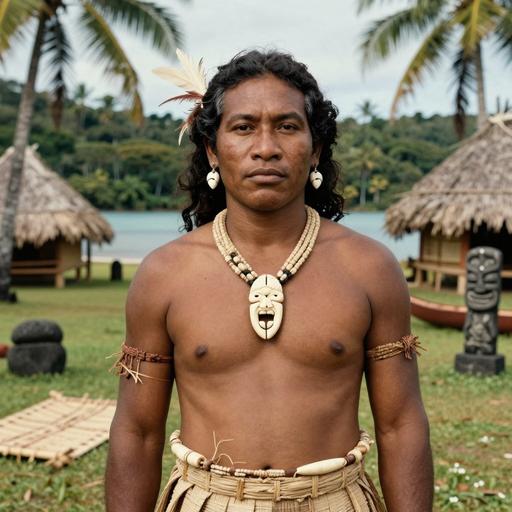
B4A1A1M1 should be understood in the context of the Austronesian maritime expansion, one of the major Late Holocene demographic events in Island Southeast Asia and the Pacific. Maternal lineages in the B4 family notably track prehistoric seafaring and island colonization. The distribution of B4A1A1M1 aligns with archaeological and linguistic evidence for movement of people, plants, and material culture across island chains during and after the Neolithic arrival of Austronesian-speaking peoples. Its presence in Micronesia and parts of eastern Indonesia connects it to the networks that produced the Lapita cultural horizon and later island communities, although B4A1A1M1 itself appears to be a localized offshoot rather than the principal Polynesian motif.
Conclusion
mtDNA haplogroup B4A1A1M1 is a Late Holocene maternal lineage arising within the Austronesian expansion milieu in Island Southeast Asia/Taiwan. It is most informative for studies of island population structure, maternal founder events, and the finer-scale movements of Austronesian-speaking groups into Micronesia and adjacent island regions. Continued sampling and full mitogenome sequencing in underrepresented island populations will refine its internal topology, precise age, and microgeographic patterns of dispersal.
Key Points
- Origins and Evolution
- Subclades (if applicable)
- Geographical Distribution
- Historical and Cultural Significance
- Conclusion