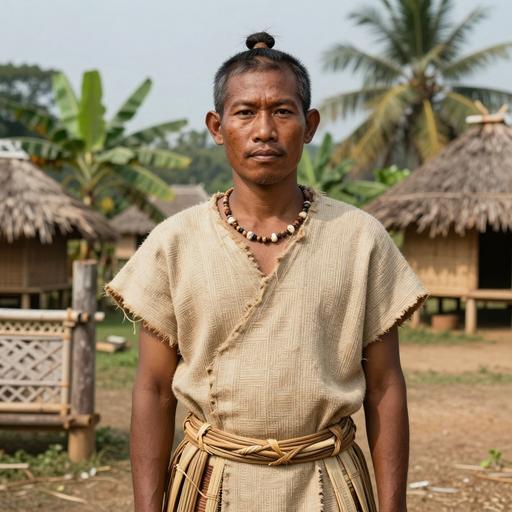
The Story
The journey of mtDNA haplogroup B5A1C
Origins and Evolution
Haplogroup B5A1C is a downstream lineage of B5A1, itself a branch of the broader B5A/B5 maternal radiation associated with East and Southeast Asia. Based on its phylogenetic position under B5A1 and the geographic pattern of related lineages, B5A1C most likely originated in the mid-Holocene (roughly ~6 kya), during a period of intensified coastal settlement, population growth, and increased mobility in mainland and island Southeast Asia. The emergence of B5A1C represents a local diversification of the B5A1 maternal pool rather than a deeply basal event in the B haplogroup tree.
Phylogenetically, B5A1C is nested within the B5A1 clade and shares derived mutations that distinguish it from sister lineages. Because B5A1 and its subclades show strong associations with maritime and coastal expansion routes, B5A1C is best interpreted as part of these Holocene demographic processes.
Subclades (if applicable)
At present, B5A1C appears to be a relatively narrowly defined subclade within B5A1. Published population surveys and sequence data indicate limited downstream structure that is well-sampled; additional sublineages of B5A1C may be discovered as more complete mitochondrial genomes from Island Southeast Asia and Near Oceania become available. Currently there are no widely recognized, deeply-split named subclades of B5A1C with strong geographic structure in the literature, but local variants and private mutations are expected in insular populations.
Geographical Distribution
B5A1C is concentrated in East and Southeast Asia with particular incidence in coastal and island contexts consistent with Holocene maritime movements. Reported occurrences and reasonable phylogeographic inference place the highest frequencies in Island Southeast Asia (Philippines, Borneo, Sulawesi, Lesser Sundas) and among Austronesian-speaking Taiwanese groups, with lower-frequency occurrences in mainland East Asia (southern Han and other southern Chinese groups) and scattered, low-frequency presence in Near Oceania tied to later Austronesian/interaction events.
The lineage is also relatively rare in the continental interior of mainland Southeast Asia but may be found at low levels among riverine and coastal communities that participated in prehistoric coastal dispersals. In archaeological contexts B5A1C has at least one identified ancient DNA occurrence in current databases, supporting its presence in Holocene-era populations.
Historical and Cultural Significance
B5A1C's pattern fits the broader role of B5A1 and related maternal lineages in Holocene demographic expansions across coastal East and Southeast Asia. Its distribution is consistent with maternal lineages that accompanied or were incorporated into the Austronesian maritime expansion from Taiwan into Island Southeast Asia and the Pacific, as well as earlier Neolithic coastal expansions within mainland Southeast Asia. While B5A1C is not diagnostic of a single archaeological culture by itself, its occurrence within Austronesian-speaking groups and coastal communities suggests it was part of the maternal substrate that moved with seafaring populations and later admixed with resident groups.
From a cultural perspective, carriers of B5A1C would have been members of populations engaged in coastal foraging, early agriculture, and later maritime-oriented economies, contributing maternally to the demographic composition of island populations during the mid- to late-Holocene.
Conclusion
B5A1C is a mid-Holocene subclade of B5A1 centered in East and Southeast Asia, particularly associated with coastal and insular populations involved in Holocene maritime dispersals such as the Austronesian expansion. It is relatively narrowly distributed compared to major continental lineages, and evidence from modern and limited ancient DNA indicates a pattern of island-focused presence with low-frequency spillover into nearby mainland and Near Oceanian populations. Continued mitogenome sequencing in under-sampled island and coastal regions will refine the internal structure, age estimates, and migration history of this lineage.
Key Points
- Origins and Evolution
- Subclades (if applicable)
- Geographical Distribution
- Historical and Cultural Significance
- Conclusion