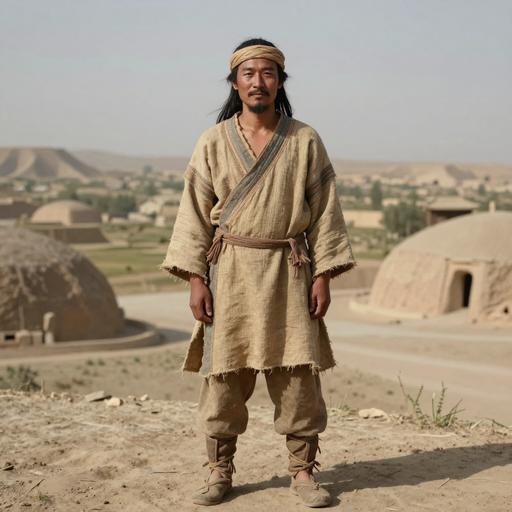
The Story
The journey of mtDNA haplogroup R11
Origins and Evolution
mtDNA haplogroup R11 is a descendant of the broader R lineage, specifically part of the R11'B6 node. As a branch of the globally distributed macro-haplogroup R, R11 most likely formed after the initial R radiation out of western Eurasia and into eastern Eurasia. Based on its phylogenetic position and comparisons with coalescence estimates for neighboring R-derived clades, a conservative estimate for the origin of R11 is in the Late Pleistocene (roughly ~20–30 kya), although precise dating requires dense complete-mtDNA sampling and formal molecular clock analyses.
Because R11 occupies an intermediate position in the mtDNA tree (connecting the R11'B6 node to downstream sublineages), it is especially informative for reconstructing maternal population splits and local expansions in East and Southeast Asia during the terminal Pleistocene and early Holocene.
Subclades (if applicable)
At present R11 is recognized as a discrete clade in Phylotree and related mtDNA catalogs; finer substructure within R11 may exist but is undercharacterized in the published literature. Some sequences placed within R11 form downstream branches that are rare and geographically localized. Additional complete mtDNA sequencing across under-sampled populations (southern China, Mainland Southeast Asia, island Southeast Asia, and Taiwan) is needed to resolve internal subclades, determine a detailed topology, and provide refined age estimates.
Geographical Distribution
Available population genetics studies and public mtDNA databases indicate that R11 is primarily observed in southern East Asia and parts of Mainland and Island Southeast Asia at low-to-moderate frequencies. Reported occurrences are most common among:
- Southern Han Chinese and neighboring southern Chinese minority groups
- Tai-Kadai and Hmong-Mien speaking populations in mainland Southeast Asia and southern China
- Austronesian-speaking groups in parts of Taiwan, the Philippines and ISEA (island Southeast Asia) where rare lineages persist
The distribution pattern suggests a regional origin followed by localized dispersals and persistence in both inland and coastal populations. Very low-frequency occurrences outside East/Southeast Asia are likely the result of historical migration and recent gene flow.
Historical and Cultural Significance
Because R11 appears in regions central to Neolithic transitions in East and Southeast Asia, it is relevant to questions about the spread of early rice agriculture, late Pleistocene/early Holocene hunter-gatherer continuity, and later Holocene population movements such as Austronesian expansions. However, R11 is not generally reported as a marker of any single pan-regional archaeological culture; instead it forms part of the maternal background diversity that contributed to multiple cultural trajectories in the region.
- Neolithic contexts: R11 may have been part of the maternal gene pool involved in Neolithic demographic processes in southern China and adjacent Southeast Asia (for example, rice-farming expansions and local admixture events).
- Austronesian-related contexts: Low-frequency R11 lineages in island populations could reflect either pre-Austronesian substrate lineages assimilated during Austronesian dispersals or later localized founder events.
Overall, R11 is best interpreted as a regional Paleolithic–Holocene lineage that complements archaeological and linguistic evidence when reconstructing maternal ancestry in East and Southeast Asia.
Conclusion
mtDNA haplogroup R11 is an informative but currently under-sampled branch of the R macro-haplogroup with a probable origin in East to Southeast Asia during the Late Pleistocene. Its present-day pattern — localized, low-to-moderate frequencies across southern China and Southeast Asia — highlights the need for denser complete-mtDNA sequencing in target populations to resolve subclades, refine age estimates, and clarify its role in Neolithic and Holocene demographic events. Until larger, geographically targeted datasets are available, inferences about precise timings and cultural associations should remain cautious.
Key Points
- Origins and Evolution
- Subclades (if applicable)
- Geographical Distribution
- Historical and Cultural Significance
- Conclusion