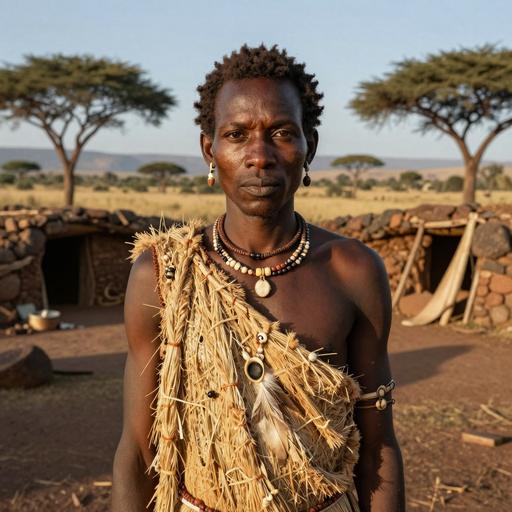
The Story
The journey of Y-DNA haplogroup A1B
Origins and Evolution
Haplogroup A1B is an early sub-branch of the basal African Y-DNA tree derived from haplogroup A1. As a deep lineage, A1B reflects one of the ancient paternal splits within anatomically modern humans in Africa during the Middle Pleistocene. Given its phylogenetic position beneath A1, the lineage likely coalesced hundreds of thousands of years ago in eastern Africa and subsequently persisted through complex demographic episodes in the Late Pleistocene and Holocene.
A1B is not associated with a major Holocene demographic expansion; instead, it is typical of lineages that remained at low-to-moderate frequency in small, often mobile or foraging populations. Its long internal branches and rarity in broad sampling panels make it valuable for reconstructing early population structure within Africa and for understanding deep population continuity in some regions.
Subclades (if applicable)
Substructure within A1B is sparse in the published literature because the clade is rare and under-sampled relative to more recent African haplogroups. Where higher-resolution sequencing has been applied, A1B divides into minor downstream subclades that are geographically localized and often private to particular populations or regions. Continued targeted sequencing of individuals from Khoe-San, central African forager groups, and eastern African hunter-gatherers is likely to reveal additional internal structure and improve coalescence-time estimates.
Geographical Distribution
A1B is primarily an African lineage with its highest representation in populations that retain deep indigenous paternal ancestry. It is observed at notable but generally low-to-moderate frequencies among:
- Southern African forager groups (especially some Khoe-San communities), where deep A-lineages in general are more frequent.
- Central African pygmy groups (e.g., Mbuti and related populations) at low frequencies, reflecting ancient population structure in equatorial Africa.
- East African hunter-gatherer groups such as Hadza and Sandawe, and occasionally among certain Nilotic groups at low frequencies.
- Small numbers occur in Afroasiatic-speaking highland Ethiopian samples and very rarely in North African and West-Central African reports, typically as isolated or low-frequency findings.
Outside Africa, A1B appears only sporadically in the African diaspora as a result of recent historical migrations.
Historical and Cultural Significance
A1B is most informative for deep-time population genetics rather than for association with large archaeological migrations. Because it is concentrated in groups with continuity of foraging or early regional residence, the haplogroup provides genetic support for long-term persistence of lineage diversity in Africa through the Later Pleistocene and into the Holocene. In cultural terms, A1B is best seen as linked to hunter-gatherer and early pastoral contexts rather than to agricultural or Bronze/Iron Age expansions that reshaped much of Africa's later genetic landscape.
Its presence among Khoe-San and some central and eastern African forager groups supports archaeological and linguistic evidence for ancient regional population structure and helps calibrate models of how modern human paternal diversity was partitioned across Africa prior to widespread Holocene movements (e.g., pastoralist and Bantu-associated expansions).
Conclusion
Y-DNA haplogroup A1B is a rare but evolutionarily important African paternal lineage that records deep population history in eastern, southern and central Africa. Because it is an early offshoot of haplogroup A1 and persists in small, often isolated populations, A1B is valuable for studies of ancient population structure, demographic continuity, and the early phases of modern human diversification within Africa. Broader high-coverage sequencing of under-sampled African groups will refine the phylogeny and geographical history of this lineage.
Key Points
- Origins and Evolution
- Subclades (if applicable)
- Geographical Distribution
- Historical and Cultural Significance
- Conclusion