The Story
The journey of Y-DNA haplogroup C2A1A1B
Origins and Evolution
Y-DNA haplogroup C2A1A1B is a downstream branch within the broader C2 (M217) phylogeny, itself characteristic of northern and eastern Eurasia. Based on its position beneath C2A1A1 and the known time depth of that parent clade, C2A1A1B most plausibly arose in Central–East Asia in the later Holocene (approximately ~3.0 kya inferred), during a period of increased mobility on the steppe and intensifying interactions among forest-steppe, steppe and northern Siberian groups. Its emergence likely post-dates the initial C2 expansions of the Bronze Age and corresponds with regional differentiation tied to Iron Age and historic nomadic movements.
Like many C2 subclades, C2A1A1B exhibits a pattern of regional substructure and occasional high-frequency clustering in particular paternal lineages or clans within Mongolic, Tungusic and some Turkic-speaking populations. This pattern is consistent with serial founder effects, social structuring (patrilineal clans), and expansions mediated by pastoralist mobility.
Subclades (if applicable)
C2A1A1B sits beneath C2A1A1 and is one branch among several downstream lineages. Where high-resolution SNP or next-generation sequencing data are available, researchers typically observe that C2 lineages break into multiple geographically structured subclades; C2A1A1B represents one such lineage that has further local diversification within northern Eurasia. In population studies, subclades of C2 often show clan-level concentration (single-lineage amplifications) rather than uniform distribution across all populations, so C2A1A1B may include multiple closely related downstream clusters in different geographic pockets.
Geographical Distribution
C2A1A1B is primarily observed in northern and northeastern Eurasia, with highest frequencies and confidence in Central–East Asian and Siberian populations. Modern occurrences are concentrated among: Mongolic-speaking populations (e.g., Mongols, Buryats), Tungusic groups (e.g., Evenks, Evens, Oroqen), Yakut (Sakha) and other North Siberian peoples, and in varying frequency among southern Siberian Turkic groups (e.g., Tuvans, some Altai and Kazakh clans). Low-frequency occurrences have been reported in neighboring East Asian populations (Korean, Japanese) and extremely rare or secondary occurrences may be present in some Indigenous North American groups reflecting ancient Beringian connections or later drift.
Genetic surveys and ancient DNA studies of steppe and forest-steppe populations indicate that C2-derived lineages were important components of the paternal landscape of Bronze–Iron Age northern Eurasia, and specific downstream branches like C2A1A1B tend to reflect later, geographically localized differentiation and historic era expansions.
Historical and Cultural Significance
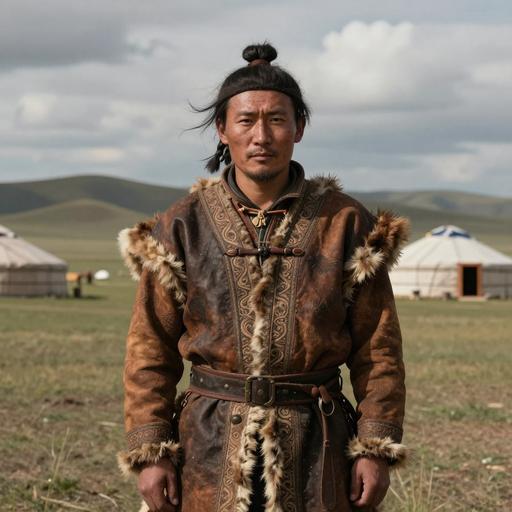
The demographic behavior of C2A1A1B is consistent with the social and migratory patterns of steppe pastoralist and forest-steppe societies: clan-based amplifications, elite-driven expansions, and mobility across large distances. Historically, groups associated with Iron Age and historic nomadic polities in Central–East Asia (e.g., Xiongnu, Xianbei-related groups, and later Turkic and Mongolic confederations) generated conditions that could amplify particular paternal lineages. The medieval Mongol Empire and related movements are especially important for redistributing C2 lineages across Eurasia, and local founder effects after migrations — for example, the northward movement and settlement of Yakut (Sakha) peoples — can explain high frequencies in northern pockets.
However, it is important to emphasize that attributing a haplogroup directly to any single archaeological culture or polity requires careful ancient DNA evidence; modern-day distributions reflect cumulative processes including prehistoric expansions, historic migrations, drift, and social structure.
Conclusion
C2A1A1B is a geographically and historically informative subclade of C2A1A1 that illuminates patterns of paternal ancestry across the northern Eurasian steppe, forest-steppe and Siberia. It likely arose in Central–East Asia around the Iron Age and shows clustered distribution in Mongolic, Tungusic and northern Turkic-speaking groups, with lower-frequency spillover into neighboring East Asian and, rarely, North American populations. As sequencing of modern and ancient samples expands, the internal diversity and precise historical movements of C2A1A1B will become clearer, refining its role in the peopling and social history of northern Eurasia.
Key Points
- Origins and Evolution
- Subclades (if applicable)
- Geographical Distribution
- Historical and Cultural Significance
- Conclusion