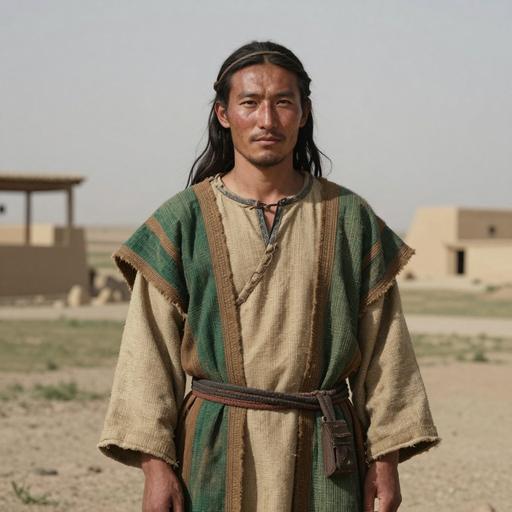
The Story
The journey of Y-DNA haplogroup J1A2
Origins and Evolution
Y-DNA haplogroup J1A2 is a downstream subclade within J1A, itself part of the broader J1 paternal lineage. J1 is one of the major West Asian Y-chromosome branches and is widely interpreted as having diversified in the Near East during the late Pleistocene or early Holocene, with major expansions occurring as Holocene populations spread across the Levant, Arabia, Mesopotamia, Anatolia, and adjacent areas.
As an intermediate branch, J1A2 likely represents one of several regional offshoots that emerged after the initial differentiation of J1 lineages in the Near East. While the exact phylogenetic age of J1A2 depends on the resolution of current sampling and tree structure, a reasonable estimate places its emergence in the early to middle Holocene, broadly consistent with the post-glacial reorganization of populations in Southwest Asia.
Subclades
Because J1A2 is an intermediate haplogroup, its internal branching may include additional downstream lineages that are not yet fully characterized in public datasets. In many Y-DNA trees, intermediate clades like this serve as important connectors between broader ancestral branches and more geographically localized descendant lines. Future high-resolution sequencing may refine its internal structure and reveal more sub-branches linked to specific regional expansions or historical founder effects.
Geographical Distribution
J1A2 is expected to show its highest frequencies and greatest diversity in the Near East and Arabian Peninsula, with substantial presence across the Levant, Mesopotamia, Anatolia, and the Caucasus. Its distribution also extends into North Africa and parts of the Mediterranean, reflecting long-term contact, migration, trade, and religious or cultural dispersals in historic times.
Lower-frequency occurrences in southern Europe and South Asia are consistent with repeated gene flow from West Asia over the last several millennia. In Jewish populations, J1-related lineages are often observed at meaningful frequencies due to ancient Levantine ancestry and later population structure, though the precise frequency of J1A2 specifically varies by community and sampling resolution.
Historical and Cultural Significance
Lineages within J1 are often associated with the demographic history of early Near Eastern pastoralists, Neolithic and post-Neolithic expansions, and later Arabian and Levantine population movements. For J1A2 specifically, the best-supported interpretation is that it reflects regional West Asian paternal continuity rather than a single archaeological culture.
The haplogroup may be encountered in contexts related to:
- Neolithic and Chalcolithic population growth in Southwest Asia
- Bronze Age and Iron Age mobility across the Levant, Mesopotamia, and Anatolia
- Historic expansions associated with Arabian, Levantine, and Mediterranean populations
- Admixture and founder effects in Jewish, North African, Balkan, and southern European groups
Because Y-DNA lineages can spread through both demography and social structure, J1A2 should be understood as a marker of paternal ancestry and population history, not as a proxy for language, ethnicity, or culture on its own.
Conclusion
Y-DNA haplogroup J1A2 is a West Asian paternal lineage rooted in the broad Near Eastern diversification of J1. Its distribution across the Levant, Arabia, Anatolia, the Caucasus, and surrounding regions fits a history of Holocene expansion, local continuity, and repeated historical movements linking Southwest Asia with the Mediterranean and North Africa.
Key Points
- Origins and Evolution
- Subclades
- Geographical Distribution
- Historical and Cultural Significance
- Conclusion