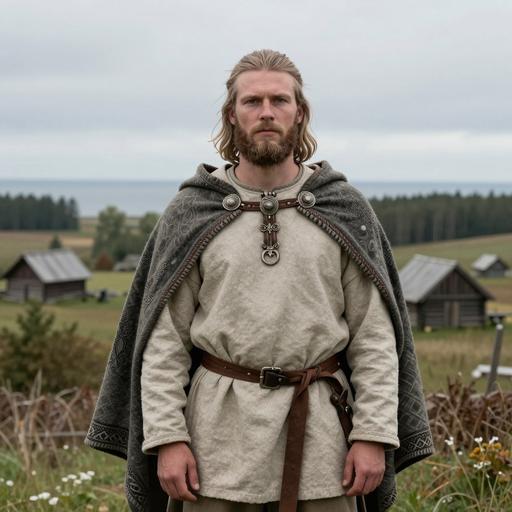
The Story
The journey of Y-DNA haplogroup R1A1A1B1A2B3
Origins and Evolution
Y-DNA haplogroup R1A1A1B1A2B3 is a downstream branch of R1a, one of the major paternal lineages associated with the broad steppe-derived expansions that reshaped much of Eurasia during the late Neolithic and Bronze Age. Because it sits beneath the parent clade R1A1A1B1A2B, this lineage is best understood as a relatively recent sub-branch that likely diversified after the initial spread of R1a-associated populations across Eastern Europe and adjacent regions.
Although direct ancient-DNA evidence specifically for this exact subclade may be limited, its phylogenetic position suggests an origin in Eastern Europe or the Eurasian Steppe, with subsequent branching during the last few thousand years. The deeper R1a trunk is often linked to populations connected with steppe pastoralism and later expansions into Europe and South Asia, while this more derived lineage likely reflects post-Bronze Age regional diversification among historically interconnected Eurasian populations.
Subclades
As an intermediate or derived branch, R1A1A1B1A2B3 would be expected to have further descendant branches not yet widely sampled or characterized in published datasets. Its immediate phylogenetic context places it within a family of lineages that are commonly studied for their role in tracing the spread of Slavic, Baltic, Indo-Iranian, and Central Asian paternal ancestry.
In practical genealogical and population-genetic terms, this kind of subclade often represents a fine-scale lineage marker useful for distinguishing deeper paternal connections within broader R1a-bearing populations. It may therefore be more informative for recent population history than for the original emergence of R1a itself.
Geographical Distribution
The distribution of R1A1A1B1A2B3 is inferred from the broader pattern of its parent clade and closely related branches. It is most likely to be found at low to moderate frequencies across Eastern Europe, especially in populations with strong R1a prevalence such as Poles, Ukrainians, Belarusians, Russians, Lithuanians, and Latvians. Related branches of R1a are also common in parts of Scandinavia, particularly among Swedes and Norwegians, reflecting historical movement and admixture across northern Europe.
Beyond Europe, this lineage may appear in Central Asia among groups such as Kazakhs and Kyrgyz, and in populations of South Asia with Indo-Aryan linguistic and historical connections. Additional occurrences are plausible in some Iranian-speaking groups, as well as selected Siberian and Uralic-speaking populations, where R1a lineages are known to have entered through ancient and medieval population movements.
Historical and Cultural Significance
The broader R1a phylogeny has been associated with major prehistoric and historic processes including the Corded Ware horizon, later Bronze Age steppe expansions, and the spread of populations into Eastern Europe, Central Asia, and South Asia. While R1A1A1B1A2B3 itself is too derived to be directly tied to a single archaeological culture with confidence, it almost certainly belongs to a lineage family shaped by these broader demographic events.
In historical contexts, such lineages are often enriched in populations linked to Slavic ethnogenesis, Baltic continuity, and Indo-Iranian dispersals, though paternal haplogroups alone cannot define language or ethnicity. Instead, they provide a biological record of male-line ancestry that complements archaeology, linguistics, and ancient DNA evidence.
Conclusion
R1A1A1B1A2B3 is a recent and regionally informative subclade of R1a with likely roots in the Eastern European or Eurasian Steppe genetic landscape. Its significance lies less in representing the original emergence of R1a and more in capturing later paternal diversification among populations spanning Europe and inner Eurasia.
Population Genetics Context
As with many derived R1a subclades, the most informative interpretation comes from comparing modern distribution patterns with ancient DNA and neighboring branches. The lineage likely reflects a combination of steppe ancestry, post-Bronze Age demographic growth, and regional founder effects, making it relevant for both deep ancestry research and genealogical reconstruction.
Key Points
- Origins and Evolution
- Subclades
- Geographical Distribution
- Historical and Cultural Significance
- Conclusion