Introduction
The explosion of ancient DNA (aDNA) data over the past decade has transformed how we study human history. Researchers can now compare genomes from people who lived thousands of years ago, tracing migrations and demographic changes with unprecedented depth. Yet the raw data behind these studies come in a patchwork of formats, metadata conventions, and quality controls. The Allen Ancient DNA Resource (AADR) addresses this challenge by providing a centralized, version-controlled compendium of published ancient human genomes.
Since its launch in 2019, the AADR has evolved into a comprehensive backbone for ancestry research, consolidating data from more than two hundred studies into a unified genotype framework. By representing data at over a million single nucleotide polymorphisms (SNPs) and including essential metadata such as contamination estimates and kinship information, AADR makes it easier for scientists to reproduce analyses, compare populations, and build new insights on population genetics and migration patterns. This descriptor note summarizes what the AADR is, what it reveals about our past, and how both scientists and consumers can benefit from its standardized, open data model.
Key Discoveries
- AADR consolidates data for >10,000 ancient individuals across a single SNP framework (~1.23 million sites), enabling broad-scale population-genetic analyses.
- Europe remains the dominant source of ancient DNA data, with a growing contribution from East Asia and Africa over time, reflecting sampling and methodological expansion.
- Ancient genomes reveal complex admixture histories, including Neolithic farmer–hunter-gatherer mixing, Steppe-related ancestry, and later migrations influencing the European gene pool.
- Modern reference panels integrated in AADR enhance interpretability of ancient signals, allowing context within present-day population structure.
- Methodological transparency and quality control (e.g., deamination-aware filtering, contamination estimates, kinship identification) improve reliability, while acknowledging limitations inherent to ancient DNA data.
What This Means for Your DNA
For someone curious about their own ancestry, AADR offers a powerful lens to connect personal DNA to deep history without needing to sift through disparate datasets. When you analyze your own genetic data alongside the AADR, you gain access to a standardized baseline of ancient genotypes that researchers use to reconstruct population movements and admixture events. This enables more robust interpretations of where your ancient ancestors may have interacted with Neolithic farmers, Steppe populations, or other ancient groups, and how those interactions shaped modern diversity.
Keep in mind that consumer and laboratory data differ in coverage, quality, and context from ancient genomes. AADR provides the public high-level scaffolding and reference points, but individual results still depend on the methods and datasets used in your specific analysis. As a result, you can use AADR as a comparative framework to interpret your DNA in light of well-documented ancient population dynamics, while recognizing uncertainties and sampling biases that influence all paleogenomic inferences.
Historical and Archaeological Context
The AADR sits at the intersection of genetics and archaeology, translating genetic signals into patterns of past human behavior. The literature underpinning the resource highlights major population movements that archaeology has long tracked: the Neolithic expansion of farming into Europe, large-scale Steppe migrations that reshaped European ancestry, and subsequent migrations that brought diverse lineages into the Near East, North Africa, and beyond. These events left signatures in autosomal DNA, as well as mitochondrial and Y-chromosome lineages, creating a layered view of population structure over millennia.
By standardizing data from thousands of individuals across different regions and time periods, the AADR helps researchers place genetic signals in a coherent historical timeline. Radiocarbon dating, artifact assemblages, and linguistic and cultural shifts can be aligned alongside genomic data to build more nuanced narratives of how cultures interacted, traded, and merged across continents. The resulting picture emphasizes long-range connections among hunter-gatherers, farmers, and pastoralists, and how these interactions evolved from the Neolithic through the Bronze Age and into later periods.
The Science Behind the Study
The AADR is a curated, open, and version-controlled compendium designed to harmonize genome-wide data from ancient humans. It integrates data from public repositories and new sequencing efforts, providing a consistent genotype framework across thousands of individuals represented at approximately 1.23 million SNPs. Since 2019, the project has progressed through multiple public releases and surpassed 10,000 individuals by the end of 2022.
The methodology centers on uniform data processing, quality control, and metadata curation. Key steps include deamination-aware filtering to mitigate damage patterns typical of ancient DNA, estimation of contamination levels, determination of molecular sex, runs of homozygosity analyses, and kinship detection. By pairing ancient data with modern reference panels, researchers can place ancient signals in the context of contemporary population structure, improving the interpretability of ancestry inferences. This framework supports reproducible analyses and facilitates downstream studies in population genetics, including haplogroup assignments, admixture modeling, and trait-era allele tracking.
In Simple Terms: The AADR is like a master library card for ancient genomes. It cleans up and standardizes data from many studies so scientists can compare thousands of ancient individuals using the same questions and the same reference point.
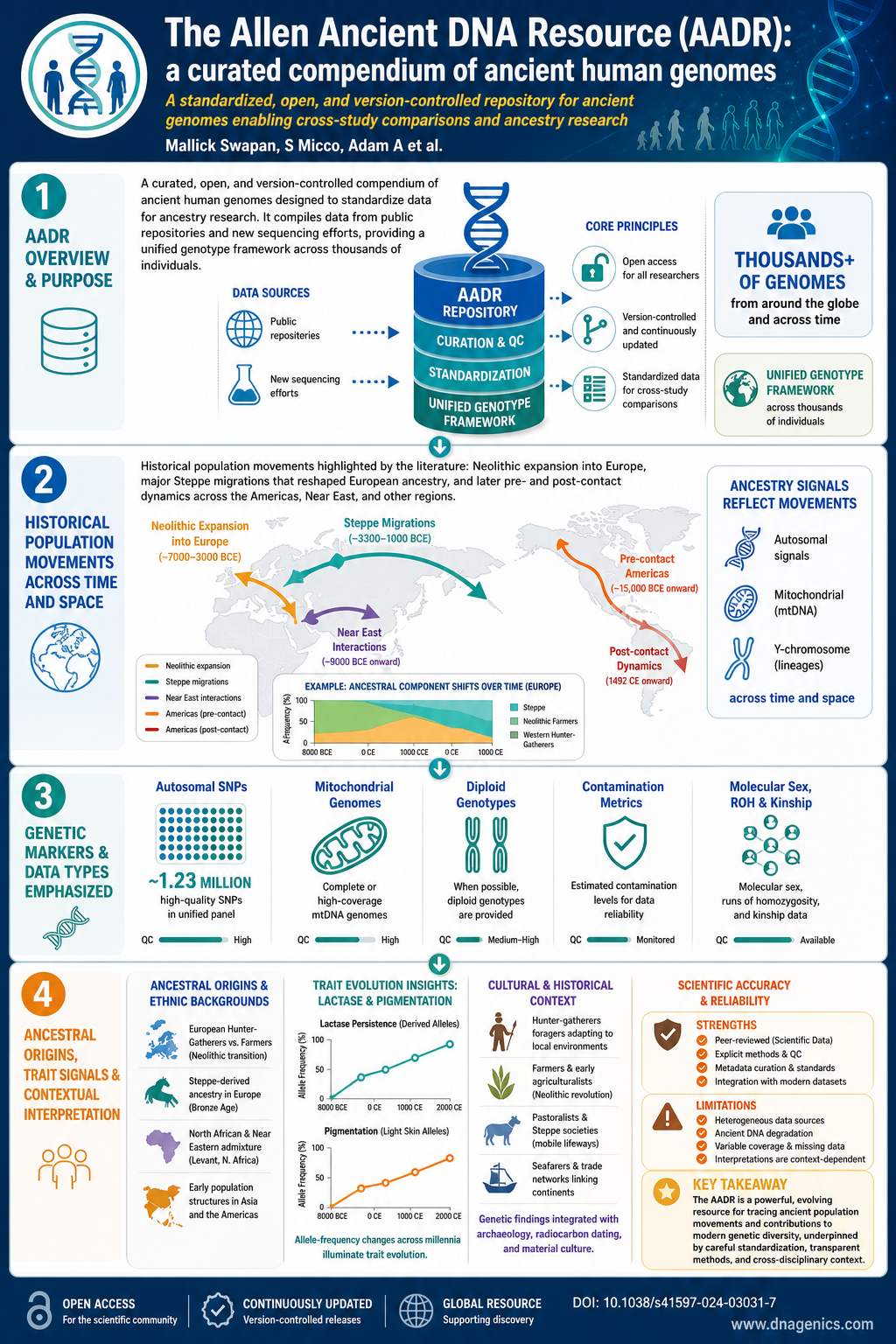
Infographic Section – Infographic provided
- Infographic: AADR overview
- URL: https://dgwebcontent.blob.core.windows.net/publication-infographics/pub_v1_e6shAKL1WeID-38341426_20260506-060147.png
Infographic: AADR overview The infographic summarizes how AADR consolidates ancient genomes, the SNP coverage, and the integration with modern reference panels. It also highlights quality control steps and the open data paradigm that underpins reproducible paleogenomic research.
Why It Matters
The AADR represents a turning point in ancestry research by delivering a scalable, transparent, and openly accessible dataset of ancient human genomes. For researchers, it accelerates discovery by enabling large-scale, cross-study comparisons and robust replication. For educators, students, and DNA enthusiasts, it offers a clearer view of how ancient populations contributed to modern genetic diversity and how methodological standards improve confidence in our interpretations of the past. Looking ahead, expanding the diversity of sampled regions and time periods will further refine migration narratives and trait evolution across continents.
Future directions include expanding the SNP panel to capture additional informative variants, refining contamination and kinship metrics with newer methods, and integrating with complementary data types such as ancient epigenetics where available. As more data are generated and added to the AADR, the resource will continue to enhance our understanding of population genetics, migration, and the complex tapestry of human history.
References
-The Allen Ancient DNA Resource (AADR) a curated compendium of ancient human genomes -DOI