Introduction
In the rugged landscapes of Northern Portugal, a hidden map of male ancestry unfolds through the Y chromosome. Short tandem repeats (STRs) on the Y chromosome, which pass from father to son, create a mosaic of paternal lineages that researchers can read to understand population history and forensic potential. This study genotyped 26 Y-STR loci in 252 men to illuminate how paternal diversity is structured in this region and how it compares to nearby populations.
Why this research matters goes beyond academic curiosity. Y-STR panels are pivotal in forensics for individual discrimination, in genealogy for tracing paternal lines, and in population genetics for understanding migrations and exchanges that shaped Iberia. By evaluating a robust 26-locus panel and depositing the data in a reference database, the study strengthens both practical forensic tools and our knowledge of Northern Portuguese paternal diversity.
Key Discoveries
- Dominant paternal lineage: The Northern Portuguese sample shows a strong R1b haplogroup signal, comprising about 58.7% of haplogroups, consistent with Western European paternal lineages.
- Mediterranean and North African contributions: E1b1b and related lineages indicate historical gene flow from the Eastern Mediterranean and North Africa into Iberia.
- High Y-STR diversity: The dataset yields 250 distinct haplotypes among 252 samples, indicating near-maximal haplotype diversity (HD ≈ 0.999) and high discriminative capacity (DP ≈ 0.992).
- Geographic affinities: Northern Portugal clusters more closely with Spain and Italy than with Greece, Morocco, or newer African populations, reflecting Mediterranean connections and Iberian continuity.
- Caution on haplogroup inference: Y-STR based haplogroup predictions carry uncertainty; SNP typing is recommended for robust phylogeny.
What This Means for Your DNA
For individuals exploring their own ancestry, the study highlights several practical takeaways. First, a 26 Y-STR panel can achieve very high resolution within a regional population, which improves the clarity of paternal lineage matching in forensic and genealogical contexts. Second, even when a haplogroup appears dominant in a population, the presence of diverse lineages such as E1b1b, I, and J demonstrates the role of historical migrations and admixture in shaping paternal diversity.
In practical terms, people tracing paternal lines should be aware that Y-STR data alone provides a powerful, but incomplete, view of ancestry. Haplogroup predictions from Y-STRs offer useful clues about broad origins, but they require confirmation with Y-SNP data for precise phylogenetic placement. Integrating these results with autosomal DNA and mitochondrial DNA analyses yields the most complete ancestry portrait.
Historical and Archaeological Context
The Northern Portuguese paternal landscape is characterized by a predominant Western European signal, underscored by R1b lineages, which aligns with known patterns of male-mediated expansion in Iberia and Western Europe. The detected contributions from E1b1b and related lineages point to historical gene flow from the Eastern Mediterranean and North Africa, reflecting centuries of Mediterranean trade, conquest, and intermarriage that left marks on the Iberian gene pool.
Comparative analysis showing genetic affinity with Spain and Italy fits archaeological and historical narratives of long-standing connections across the Iberian Peninsula and the broader Mediterranean corridor. Differentiation from Greece and Morocco emphasizes the complex, multilayered history of migration routes and population interactions. The study also notes differentiation from some Atlantic and African populations, including newer African communities, highlighting regional specificity within the broader Atlantic and Mediterranean contexts.
Timeline-wise, these patterns are compatible with long-term population continuity in Iberia interwoven with later shifts during Roman, medieval, and early modern eras. The geographic focus on Northern Portugal helps clarify how local demography integrates with regional and cross-continental movements.
The Science Behind the Study
The researchers used the Investigator Argus Y28 QS Kit to amplify 26 Y-STR loci from male DNA samples, followed by capillary electrophoresis to analyze fragment sizes. They assessed forensic parameters and haplotype diversity, and attempted haplogroup predictions from Y-STR data. A multidimensional scaling (MDS) plot was employed to visualize RST genetic distances against reference populations, providing a graphical sense of clustering and relatedness.
Key methodological points include a sample size of 252 males and the calculation of haplotype diversity (HD) and discriminative power (DP), with 250 unique haplotypes observed across 252 individuals. While the approach yields strong forensic resolution and informative population structure, the authors caution that Y-STR only inferences have limitations without direct Y-SNP confirmation. They propose SNP-based typing in future work to refine phylogenetic conclusions and more accurately anchor haplogroups in the Y chromosome tree.
In Simple Terms: Y-STRs are short, repeating DNA sequences on the Y chromosome that pass from father to son. They help identify paternal lineages and distinguish individuals, but predicting exact family trees from Y-STR data alone is imperfect without SNP confirmation. The study shows very high diversity in Northern Portugal and connections to nearby Mediterranean populations, with a strong signal for the R1b lineage.
Infographic Section
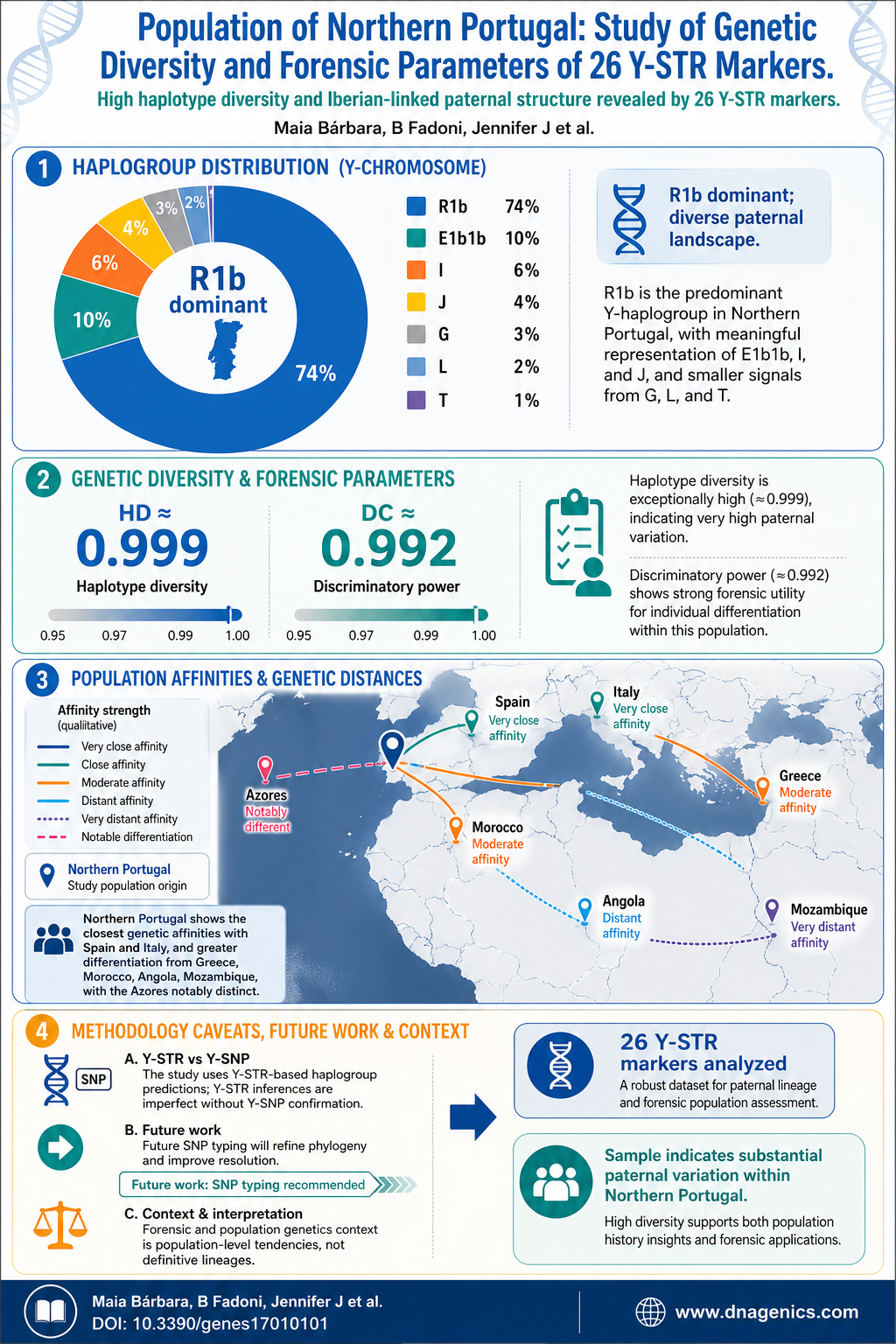
The infographic summarizes the study's main findings: the high haplotype diversity (HD ~ 0.999), the DP value (≈ 0.992), the dominant R1b haplogroup, and the Mediterranean connections with E1b1b and related lineages. It also visually compares Northern Portugal to reference populations, highlighting closer ties with Spain and Italy while showing differentiation from Greece, Morocco, and some African populations. This visual aid helps readers grasp the complex interplay of genetics, geography, and history at a glance.
Why It Matters
This work enhances both forensic science and population genetics in several ways. For forensic applications, the demonstrated high discriminatory power of the 26-locus panel supports robust individual identification in the Northern Portuguese context and adds a valuable regional reference to international databases like YHRD. For ancestry research, the study illuminates how Mediterranean and North African gene flows have shaped Iberian paternal lineages, enriching our understanding of population structure in Western Europe. Looking ahead, integrating Y-SNP data will refine haplogroup assignments and enable deeper phylogenetic inferences, including finer-scale migrations and timelines. The dataset also contributes to broader comparative studies that map paternal lineages across Europe, the Mediterranean, and the Atlantic world.