Introduction
The genomic story of the Central Plains is not a simple script of one culture replacing another. A recent ancient DNA study from Archaeological Research in Asia analyzes a single Luoyang tomb (M262) dated to the Northern Wei period, offering direct biological insight into how Xianbei and Central Plains populations interacted. By examining genome-wide data from an individual linked to Xianbei elite contexts, the research moves beyond textual accounts to ask: did genetic ancestry mirror cultural identity, and how did intermarriage and population movements shape the region's past?
This work matters because it expands our understanding of population dynamics during a critical era of Chinese history. It shows that the move to Luoyang and the reign of Emperor Xiaowen did not simply forge a top-down Sinicization process, but occurred within a broader, bidirectional tapestry of interaction. The findings illuminate how historical narratives, archaeology, and genetics combine to depict a more nuanced portrait of identity, belonging, and admixture in the Central Plains.
Key Discoveries
- M262 exhibits substantial local Central Plains (Yellow River) ancestry, clustering with Central Plains populations on genome-wide analyses.
- Two non-exclusive scenarios are plausible: (i) Xianbei elites with admixture into Central Plains populations after relocation to Luoyang; (ii) Central Plains individuals incorporated into Xianbei networks via intermarriage and elite integration.
- Cultural identity and genetic ancestry need not coincide, illustrating bidirectional population dynamics during the Northern Wei transition.
- The study provides direct ancient genomic evidence that informs, but does not single-handedly determine, the broader Northern Wei population history; additional samples are needed for robust generalization.
- Data authenticity is supported by characteristic ancient DNA damage patterns and fragment lengths, with 0.37× coverage across ~301k SNPs on the 1240K panel, and data deposited in GSA PRJCA046091.
What This Means for Your DNA
For people exploring ancestry, this study reinforces a key idea: genetic ancestry and cultural identity do not always align. The M262 case suggests that an individual with Xianbei-associated mortuary practices could carry local Central Plains ancestry, or conversely, a person with Central Plains origins might be incorporated into Xianbei networks and display that affiliation in material culture and burial context. In practical terms, it means that your DNA test may reflect broad regional admixture or time-specific population dynamics that do not map one-to-one onto ethnicity, language, or cultural identification.
When interpreting ancestry, consider the historical context, sampling period, and the possibility of two-way exchanges. The Luoyang findings illustrate how population genetics can reveal subtle, bidirectional interactions that textual sources alone might miss. For enthusiasts, this highlights the value of combining autosomal data with historical and archaeological context to craft a more nuanced personal narrative.
Historical and Archaeological Context
The Xianbei emerged as a dominant nomadic group on the eastern Eurasian steppe after the decline of the Xiongnu, with the Tuoba Xianbei eventually founding the Northern Wei Dynasty and moving the capital to Luoyang in the Central Plains. The relocation and Emperor Xiaowen's reforms are often framed as a top-down Sinicization of Xianbei elites. Yet archaeological and historical scholarship emphasizes reciprocal exchange: Central Plains communities adopted steppe practices, institutions, and material culture through ongoing interaction with Xianbei networks.
The M262 find sits at a crossroads of migration, elite consolidation, and cultural negotiation. The tomb’s Xianbei-associated context, coupled with genomic signals of substantial Central Plains ancestry, aligns with a broader pattern of social integration and exchange during the Northern Wei period. This supports a timeline in which population movements and intermarriage contributed to a mosaic of identities, rather than a simple unidirectional assimilation model.
The Science Behind the Study
The authors present genome-wide data from a single individual (M262) excavated in Luoyang and dated to the Northern Wei period. Despite the low-coverage nature of the sample (approximately 0.37×), the dataset includes around 301,000 SNPs on the 1240K panel, with DNA damage patterns and fragment lengths consistent with ancient DNA authentication. Analyses place M262 in the genomic space of Central Plains populations, indicating substantial local ancestry despite the elite Xianbei mortuary context. These results support two non-exclusive admixture scenarios and stress that ancestry cannot be inferred from culture alone.
- The study highlights the value and limits of single-sample genomic inferences for broad population histories. While M262 provides a direct data point showing admixture during the Northern Wei transition, broader conclusions require additional ancient genomes across time and space to validate the proposed models of population dynamics.
In Simple Terms: This research shows that DNA from one long-ago person can tell us two big things at once: (1) the person may have Xianbei social ties, yet carry a lot of local Central Plains ancestry, and (2) culture and genes do not always tell the same story about a community’s past. In practice, you can have a culturally Xianbei person with local ancestry, or a locally born person who belongs to Xianbei networks through social ties.
Infographic Section - Infographic: Northern Wei genetic integration in Luoyang
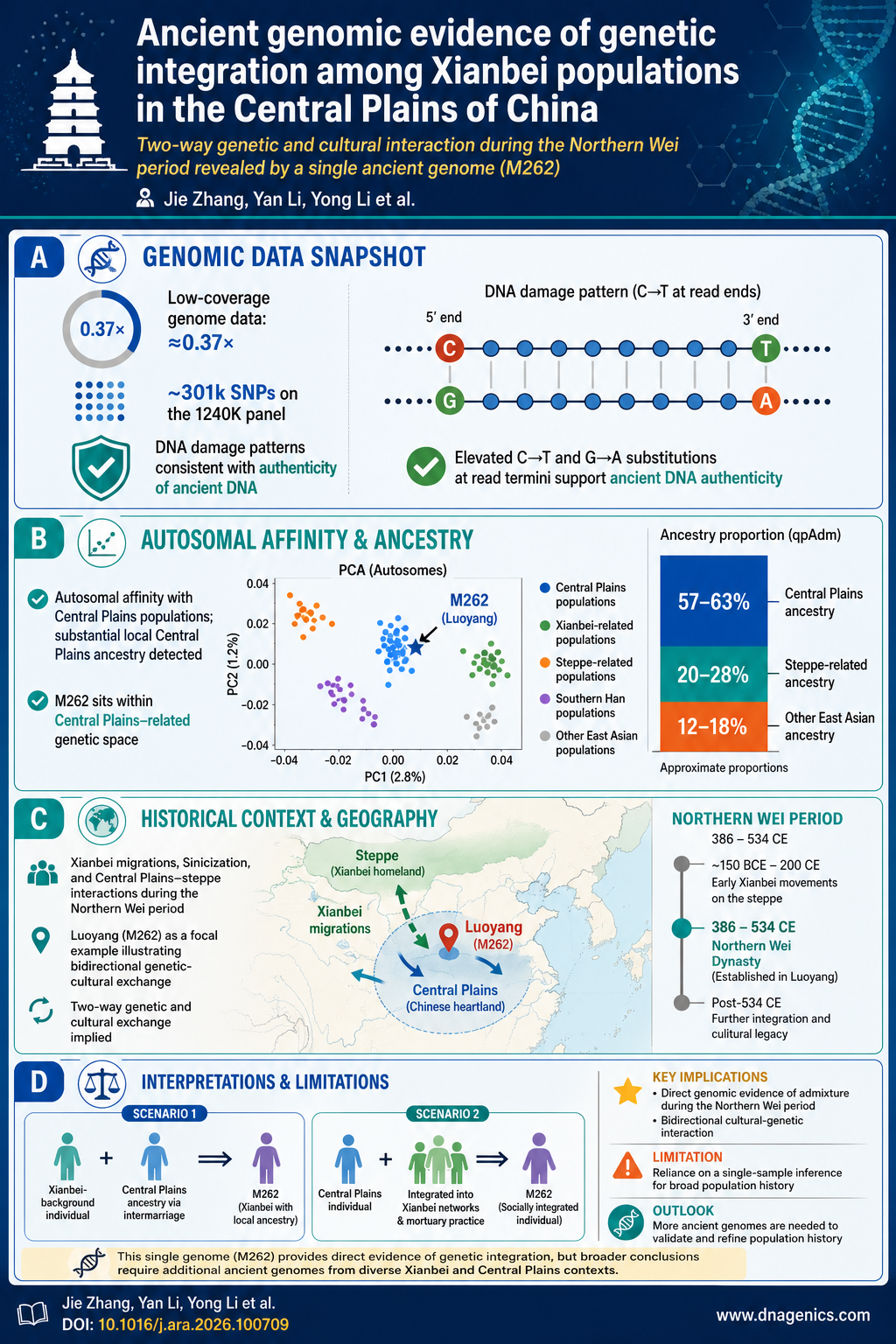 This infographic visualizes the study's core message: M262's genome shows strong affinity with Central Plains populations despite its elite Xianbei context, highlighting bidirectional population dynamics during the Northern Wei period. It also outlines the two admixture scenarios and the caution against overgeneralizing from a single sample.
Why It Matters
This work contributes a direct genomic layer to the narrative of Xianbei and Central Plains interactions, validating two-way cultural-genetic exchange during a pivotal era. It underscores the importance of combining ancient DNA with archaeology and history to avoid assuming that cultural identity always aligns with genetic ancestry. The study also serves as a methodological reminder that broader population histories require multiple ancient genomes across regions and centuries to test admixture pathways and demographic patterns.
Future research expanding sampling across time and space in the Central Plains and steppe corridors will help refine models of interaction, migration, and integration, further illuminating how ancient populations shaped the genetic landscape of modern Asia.