Introduction
The paternal lineage of a nation can reveal surprising chapters of its past. In a comprehensive study of the Netherlands, researchers analyzed Y-chromosome data from nearly 350 individuals dating to the Early Middle Ages through the Middle Modern period (500–1850 CE) across 13 sites, combining these ancient samples with data from today’s Dutch population. This long view lets us watch how male lineages shift over time and space, offering a rare window into population dynamics that shaped modern Dutch genetics.
Why does this matter for you? Y-chromosomal haplogroups (YHGs) track paternal ancestry, and their frequencies can reflect migrations, regional isolation, and demographic drift. By comparing ancient and present-day data, the study tests whether modern Dutch YHG patterns arose gradually through drift or were driven by notable historical events. The findings emphasize that modern distributions formed relatively recently and caution against assigning frequency changes to single historical episodes without supporting evidence.
Set in the broader context of European population history, the Dutch case illustrates how a country’s male lineages can reflect a mosaic of regional histories rather than a single national narrative. The work also highlights an intriguing outlier (see Key Discoveries) that invites multidisciplinary follow-up—from archaeology to social history—to understand medieval communities in the Netherlands more fully.
Key Discoveries
- Y-chromosomal haplogroup (YHG) diversity across the Netherlands shows evolving paternal lineages from the Early Middle Ages to the present.
- Population continuity cannot be rejected despite spatial and temporal differences in YHG distributions, indicating that drift and gradual change both shaped the pattern we observe today.
- Genetic drift emerges as a key factor explaining many modern YHG frequency differences, suggesting caution when linking changes to specific events.
- YHG T frequency is notably high in late medieval Eindhoven, a striking departure from the overall Dutch pattern.
- Jewish diaspora signal: the Eindhoven finding raises the possibility of a medieval Jewish community imprint in the region, a signature not detected in the archaeological record alone.
What This Means for Your DNA
For everyday DNA enthusiasts, the study reinforces a practical lesson: modern Y-chromosome frequencies are the product of long histories shaped by drift and local dynamics, not just large-scale migrations. If your paternal line falls into a rare or regionally specific YHG today, that pattern may reflect centuries of small-scale changes rather than a single historical event. The integration of ancient samples with today’s data demonstrates why one should interpret Y-chromosome results with nuanced context—especially when inferring ancestral geography or population moves from a single time slice.
For beginners, think of YHGs as branches on a family tree that accumulate changes over generations. This Dutch study shows that those branches can emerge, shift, or fade over centuries, so a present-day label doesn’t always reveal when or how that lineage first arrived in a region.
Historical and Archaeological Context
The research situates Dutch Y-chromosome patterns within the broader tapestry of medieval and early modern Europe. By spanning 500–1850 CE across 13 Dutch locales, the study captures the regional diversity of male lineages during periods of consolidation, trade, and population movement that characterize the Early Middle Ages through the late Middle Ages and into modern times.
These findings align with known historical processes—local endogamy, interregional contact, and demographic shifts—while emphasizing that modern distributions may reflect complex mixtures of drift and modest migrations rather than single, dramatic population replacement. The Eindhoven outlier hints at localized social histories that merit further archaeological and documentary investigation to connect genetic signals with historical communities and behaviors.
The Science Behind the Study
The team assembled a robust dataset combining ancient Y-chromosome data from roughly 350 individuals sampled at multiple Dutch sites with genome-wide data from the present-day Dutch population. Their approach integrates ancient DNA (aDNA) techniques with modern population genetics to compare YHG frequencies across time and space and to test for population continuity between ancient and modern Dutch groups.
Key methodological elements include haplogroup assignment from Y-SNPs, spatial-temporal comparisons across 13 locations, and formal tests for continuity that evaluate whether observed frequency shifts can be explained by genetic drift alone. The study’s design—anchored in well-dated ancient samples and complemented by contemporary reference data—provides a robust framework for interpreting how paternal lineages have shaped the Dutch male gene pool over 1.5 millennia.
In Simple Terms: Y-chromosome lineages are passed from father to son with limited reshuffling. Over centuries, their frequencies can change just by chance (drift), or because some families have more male descendants. This study shows that modern Dutch Y-chromosome patterns likely result from many small changes over time, not one big migration. The Eindhoven signal suggests a localized historical community may have left a distinctive paternal trace.
Infographic
Infographic: Dutch Y-chromosome haplogroup patterns across time
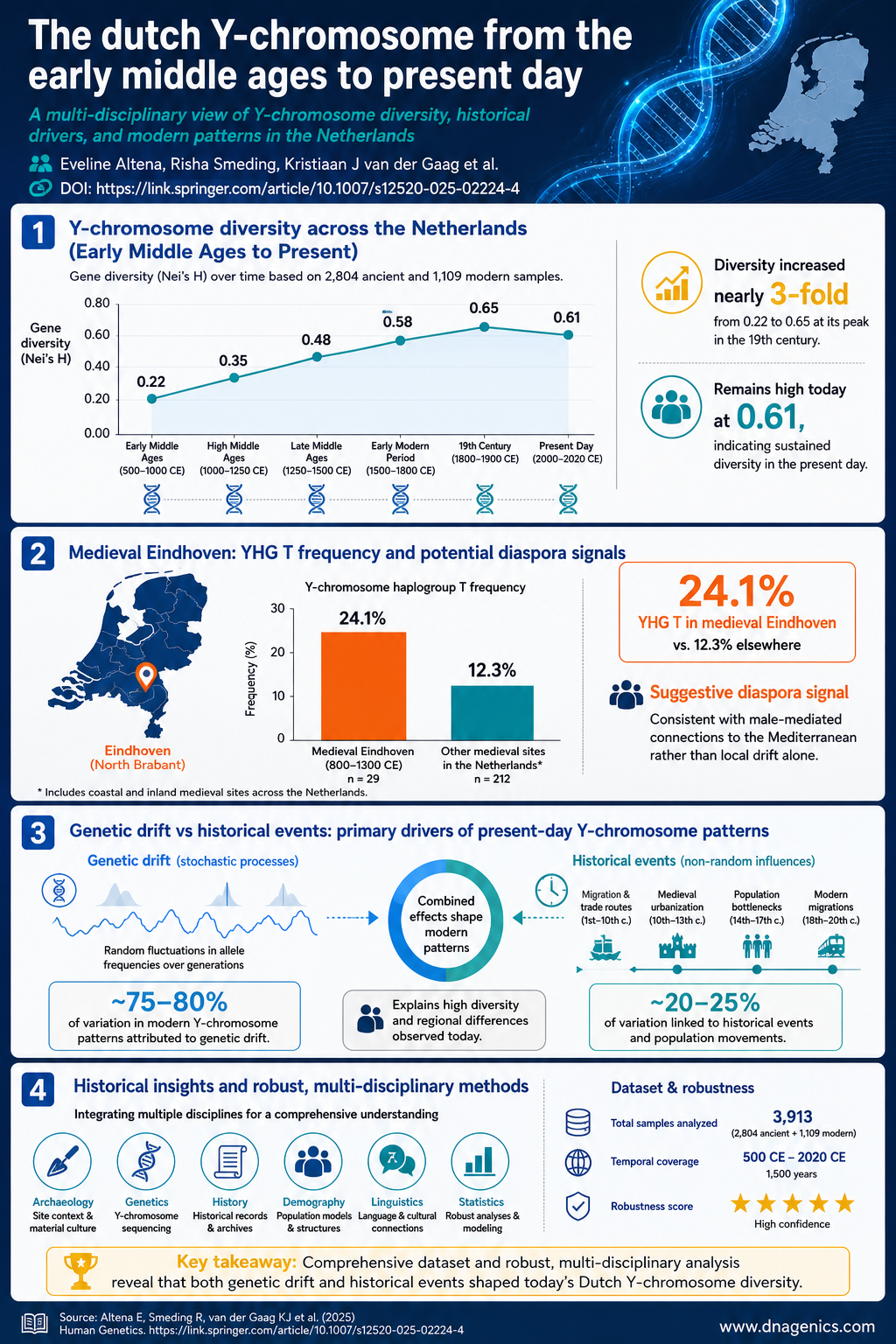
The infographic summarizes the temporal and geographic shifts in YHG frequencies across the Netherlands, highlighting the pronounced Eindhoven anomaly and the overall drift-driven dynamics that shape modern patterns.
Why It Matters
This work advances our understanding of how a national genetic landscape forms over long periods, underscoring the central role of genetic drift in shaping present-day Y-chromosome diversity. By integrating ancient and contemporary data, it promotes a more nuanced narrative of Dutch population history and demonstrates a powerful methodological model for other regions seeking to link archaeology, history, and genetics. Looking ahead, expanding ancient datasets to additional sites and time periods could refine estimates of continuity and drift, while deeper historical and documentary work may illuminate the social contexts behind unusual signals like the Eindhoven YHG T surplus.
References
The Dutch Y-chromosome from the early middle ages to present day
DOI: 10.1007/s12520-025-02224-4