Introduction
The Ryukyu Archipelago sits at the southern edge of Japan, home to a distinctive archaeological and cultural history. A new preprint examining genome-wide data from both modern and ancient individuals sheds light on how the Ryukyu Jomon contributed to the genetic fabric of contemporary Japanese populations. By sequencing 273 modern genomes and 25 ancient genomes dating to roughly 6,700–900 years before present, the study reveals a deep split between Ryukyu and mainland Jomon lineages and unexpected demographic dynamics that shaped today’s diversity.
Why this research matters goes beyond academic curiosity. It demonstrates how region-specific population histories—such as those of the Ryukyu Islands—leave lasting imprints on modern DNA. The integration of ancient DNA with archaeology helps connect cultural transitions, like tool use and agricultural change, to tangible genetic signatures. For people exploring ancestry, these findings offer a nuanced picture of how subregional histories contribute to personal DNA stories.
This work emphasizes subregional complexity within Japan, illustrating how distinct demographic events in the Ryukyus and the mainland contributed to the broader population structure we observe today. While the study is in the preprint stage and awaits replication, its approach showcases the power of combining genome-wide data with archaeological context to interpret migration and cultural change.
Key Discoveries
- Divergence between Hondo Jomon and Ryukyu Jomon dated to approximately 6,900 YBP, indicating long-standing separate demographic histories.
- Ryukyu Jomon experienced severe bottlenecks with an effective population size (Ne) around 2,000.
- Admixture with historic Hondo migrants occurred around 1,000 YBP, aligning with the spread of iron tools and agriculture in Central Ryukyus.
- Different rates of Jomon ancestry in modern populations (Hondo vs Ryukyu) reflect their distinct post-admixture demographic histories.
- The study leverages genome-wide data from 273 modern and 25 ancient genomes to illuminate Ryukyu peopling and regional diversity in Japan.
What This Means for Your DNA
For those curious about their own ancestry, the Ryukyu findings underscore that Japan’s genetic landscape is not uniform. Modern Japanese individuals may carry varying levels of Jomon ancestry depending on whether their family origins trace to the mainland or the Ryukyus. The distinct historical trajectories of these regions—ancient divergence, bottlenecks, and later admixture—mean that a person from the Ryukyu region could show different ancestral components than someone from Honshu, Shikoku, or Kyushu.
From a practical standpoint, these insights help explain why some DNA tests report regional or subregional admixture signals that don’t align with a simple, single-source narrative. As ancestry testing becomes more granular, consumers may see clearer distinctions between Ryukyu-related and mainland Jomon contributions in their profiles. However, readers should note that the study is a preprint and its interpretations await further replication.
Beginner takeaway: think of the Jomon contributions as a long-running ancestral thread that varies by region within Japan. Your own DNA snapshot may reflect a mosaic built from multiple prehistoric and historic population movements, not a single source.
Historical and Archaeological Context
The Jomon culture is famous for some of the earliest pottery in the world and a long-lived hunter-gatherer way of life in Japan. Archaeological evidence indicates that Jomon hunter-gatherers colonized the southern Ryukyu Islands by roughly 7,000 years before present. The new genetic findings place a deep split between Ryukyu Jomon lineages and mainland (Hondo) Jomon dating to about 6,900 YBP, implying independent demographic histories long before later cultural changes swept across the archipelago.
A key archaeological signal associated with this period is the emergence and spread of iron tools and agricultural practices in Central Ryukyus, which coincides with the inferred admixture between Ryukyu Jomon and historic Hondo migrants around 1,000 YBP. This admixture reflects a major cultural and demographic transition in the region and helps explain how genetic exchange aligned with technological and economic shifts. The study thereby links genetic history with cultural transitions, including shifts in material technology and subsistence strategies across the Ryukyus.
In the broader timeline, the Ryukyu archipelago exhibits contextual connections to the wider Japanese archipelago, with distinct demographic events in the islands versus the mainland. The geographic separation of the Ryukyus, coupled with later migrations, shaped a mosaic of lineages that contribute to modern population structure in Japan.
The Science Behind the Study
This study uses genome-wide sequencing data from both modern and ancient individuals to reconstruct population history. Specifically, 273 modern genomes and 25 ancient genomes dating from roughly 6,700 to 900 YBP were analyzed to infer divergence times, bottlenecks, and admixture events. The authors report a deep divergence between Ryukyu Jomon and Hondo Jomon around 6,900 YBP, followed by a pronounced bottleneck in the Ryukyu lineage (Ne ≈ 2,000). They identify admixture with historic Hondo migrants around 1,000 YBP, temporally associated with cultural changes such as iron tool use and agricultural intensification in Central Ryukyus. The results also indicate differential Jomon ancestry proportions in modern Hondo versus Ryukyu populations, reflecting region-specific demographic histories after admixture.
Given the preprint status, methodological details and replication are important for solid conclusions. Nevertheless, the work demonstrates the value of combining whole-genome data with ancient DNA and archaeological context to decipher population movements and cultural transitions across Japan.
In Simple Terms: This study looks at the entire genomes of many people today and a smaller set from ancient times to figure out when the Ryukyu Jomon split from mainland Jomon, how small their populations became, and when these Ryukyu lineages mixed with mainland groups. It’s like a genetic timeline that also lines up with historical and tool-use changes in the region.
Infographic
The infographic summarizes the key timelines and demographic events reported in the study. It visually links divergence times, bottlenecks, and admixture events for Ryukyu Jomon, Hondo Jomon, and modern Japanese populations, illustrating how subregional history shapes present-day DNA across Japan.
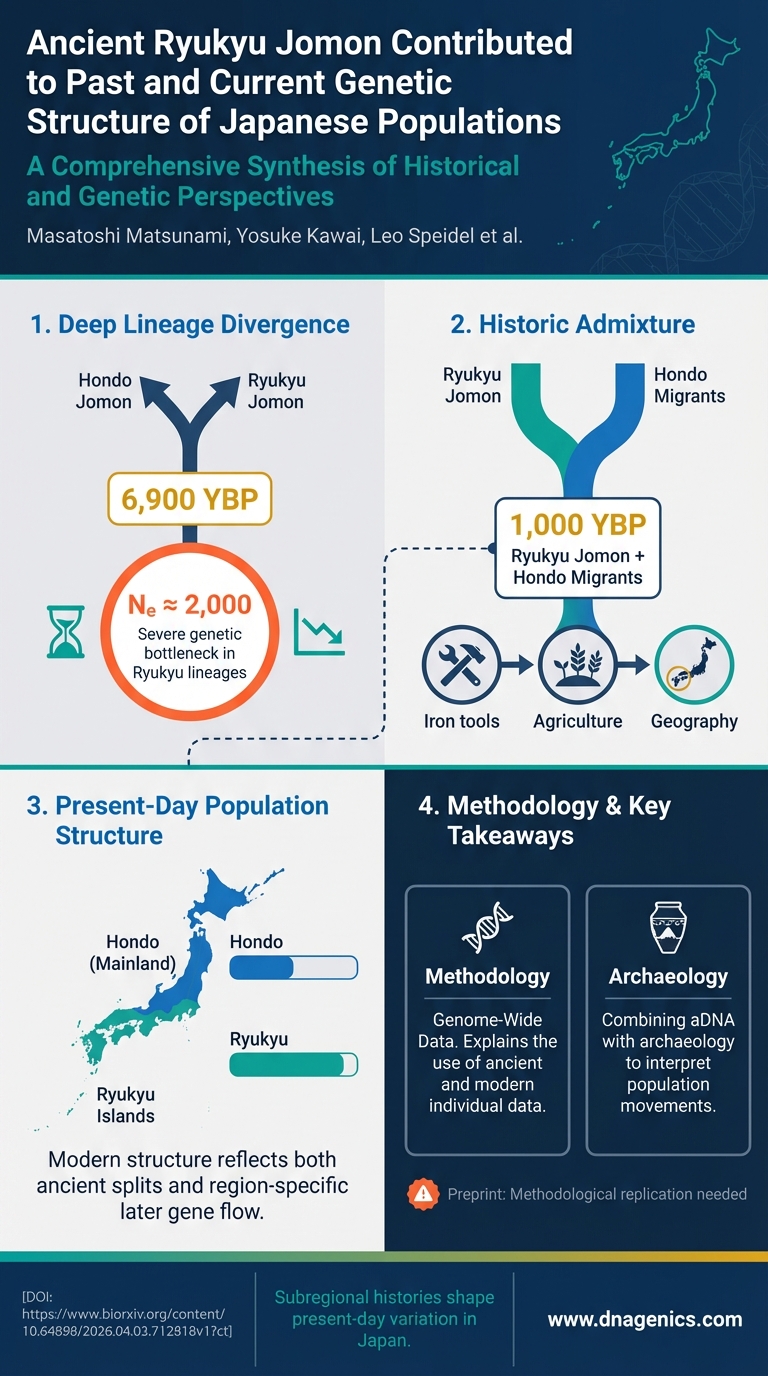
The infographic provides a visual overview of the deep Ryukyu–Hondo divergence, the bottleneck in Ryukyu Jomon, and the later admixture event around 1,000 YBP, alongside the distribution of Jomon ancestry in modern Japanese populations.
Why It Matters
This research highlights how subregional histories within a country can leave meaningful imprints on the modern genetic landscape. For population genetics, it underscores the importance of regional context when interpreting ancestry signals. For archaeology and anthropology, it demonstrates the payoff of integrating genome-wide data with cultural timelines to understand how migrations and cultural transitions interact. Future work will likely refine the timing and magnitude of these events, expand ancient sampling across more Ryukyuan locales, and validate the findings through replication and additional methodologies.
References
Ancient Ryukyu Jomon contributed to past and current genetic structure of Japanese populations
DOI: 10.64898/2026.04.03.712818v1