Introduction
In the landscapes of late medieval to early modern Greater Poland, graves tell stories beyond the moment of death. Atypical or seemingly deviant burials can reflect how communities perceived disease, provenance, or religious difference, offering a window into social dynamics that textual records often miss. This interdisciplinary study examines three Polish cemeteries—Dzwonowo, Skoki, and Wągrowiec—dating from the 14th to the 18th centuries CE, focusing on twelve individuals and integrating archaeological context, anthropological analysis, and ancient DNA (aDNA) data to interpret social status, health, and community perception.
Why this matters is simple yet powerful: by combining skeletal, cultural, and genetic evidence, we can reconstruct how past populations responded to disease and outsiders, and how those responses shaped burial practices. The study not only sheds light on Greater Poland’s historical networks, but also informs broader European patterns of migration, disease, and social organization during a period of intense mobility and upheaval. It sets a context for interpreting atypical burials elsewhere in Europe through aDNA and archaeological lenses.
Key Discoveries
- Yersinia pestis DNA detected in S57 (Skoki), with reads mapping to the CO92 genome and the pPCP1 plasmid, supporting a plague-associated death and a regional epidemic history.
- Parvovirus B19 DNA detected in five individuals across the cemeteries (S49, S51, W56, W57, DZ23), indicating exposure or infection across multiple communities and potential morbidity in vulnerable individuals.
- AI-assisted genome-wide analyses project nine individuals (Skoki and Dzwonowo) onto modern West Eurasian populations, revealing a split pattern: some cluster with Northern/Western Europe (e.g., S49, S52), others with Eastern Europe (e.g., S50, S53, S57, S58), and one outlier (S54) showing Finnish and Bedouin-like components plus Siberian drift signals.
- mtDNA haplogroups spanning J1c3, X2e2a1, H36, H13b1, V, etc., with Y-haplogroups represented (e.g., J in DZ23; T2a1a6 in W57), illustrating diverse maternal and paternal lineages within a small geographic region.
- Shovel-shaped incisors observed in three Skoki individuals, a dental trait that aligns with population affinity signals and demonstrates how cranial features complement genomic data; the discovery of Orthodox Russian soldiers among the Skoki burials suggests substantial historical mobility and multi-ethnic contact in Greater Poland during the studied period.
What This Means for Your DNA
For modern readers exploring ancestry, the study highlights how genetic data can reveal a mosaic of origins even within a restricted geographic area. The presence of multiple West Eurasian signals—split between Northern/Western Europe and Eastern Europe components, plus a distinctive outlier—emphasizes that populations were not monolithic. Your own DNA can similarly reflect layered histories shaped by migration, trade routes, and demographic shocks like disease.
Importantly, the study shows that health and disease can intersect with lineage in complex ways. The detection of plague DNA in one individual and parvovirus B19 across several individuals illustrates how pathogens contributed to mortality and community experiences of illness. When interpreting ancestry results, consider that haplogroups and genome-wide affinities provide clues about broad origins, while archaeological context helps explain how individuals were perceived and treated in their communities.
Historical and Archaeological Context
The cemeteries studied occupy a crossroads of historical dynamics in Greater Poland, a region that experienced ongoing interactions with northern, eastern, and southeastern peoples over several centuries. The discovery of Orthodox Russian soldiers among Skoki burials points to military and mercantile networks that stretched beyond contemporary Polish borders, aligning with known periods of mobility between the Baltic, Slavic, and Orthodox spheres. The presence of diverse maternal and paternal lineages within a small geographic catchment suggests repeated waves of movement and intercultural contact during the 14th–18th centuries.
From an archaeological perspective, the three cemeteries reveal a spectrum of burial practices and contexts associated with social status, disease, and religious identity. The double burial holding hands in Skoki, interpreted in conjunction with a plague signal, hints at the social meanings assigned to death and to individuals who may have occupied outsider or marginalized roles within their communities. The integration of burial context, skeletal traits, and ancient DNA provides a nuanced view of how health, mobility, and social perception intersected in late medieval and early modern Poland.
The Science Behind the Study
This study represents a robust, multidisciplinary approach to ancient population genetics and bioarchaeology. Archaeological evidence established grave context, age-at-death estimates, and evidence for special burial treatments that marked social distinctiveness. Anthropological analysis included nonmetric skeletal traits and dental morphology, notably shovel-shaped incisors, to infer population affinity alongside genetic data. Ancient DNA was recovered from twelve individuals, with targeted sequencing and metagenomic screening to detect human and microbial DNA.
Genomic analyses included mitochondrial and Y-chromosome haplogroup assignment, as well as genome-wide profiling that allowed projection onto modern reference populations. The team employed careful authentication methods to assess DNA damage patterns and contamination, given the degraded nature of ancient samples. Pathogen detection used metagenomics and targeted enrichment to identify Yersinia pestis and Parvovirus B19, providing direct evidence of infectious disease exposure within burial communities. Small sample size and DNA degradation are acknowledged limitations, but the integrative approach yields a credible, if preliminary, view of historical migrations, disease, and social identity in this region.
In Simple Terms: This study combines bones, teeth, and ancient DNA to understand who lived in early Poland, what diseases they faced, and how communities saw them, using both genetics and archaeology to paint a fuller picture of the past.
Infographic summarizing the study design, pathogen findings, and ancestry signals across the Dzwonowo, Skoki, and Wągrowiec cemeteries is provided below. It highlights plague evidence, parvovirus detection, and the diverse ancestry patterns revealed by genome-wide analyses.
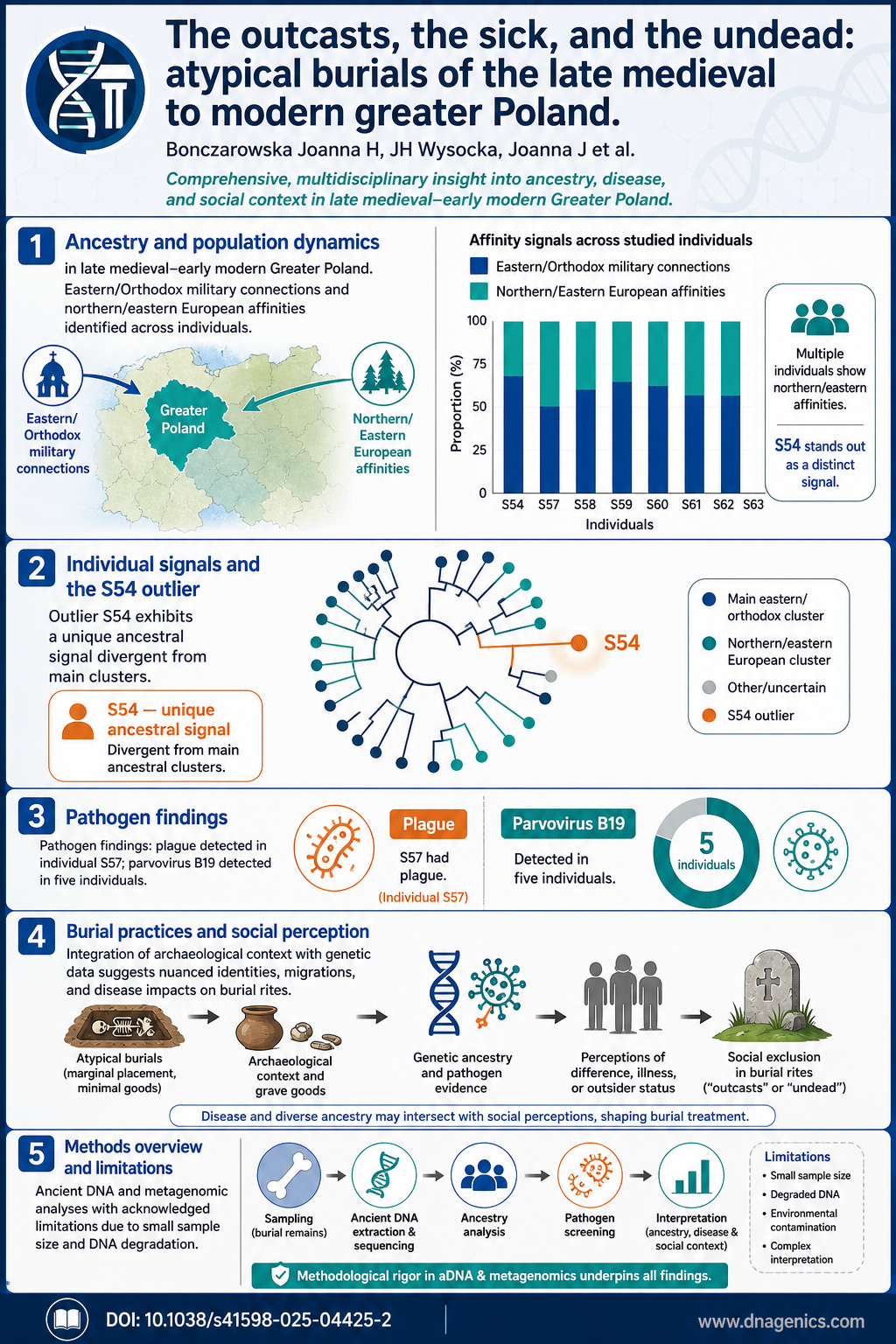
The infographic helps readers visually grasp how disease, skeletal analysis, and DNA data converge to illuminate social dynamics in historical Poland.
Why It Matters
This research expands our understanding of how health, mobility, and social perception interacted in a key region of Europe during a period of substantial change. By integrating aDNA with archaeology and anthropology, the study provides a more textured picture of past populations, their movements, and their responses to disease. The identification of plague and parvovirus signals in a small set of burials adds a valuable data point to European epidemiology, and the observed ancestry diversity within a compact locale underscores the complexity of medieval and early modern population dynamics. Future work with larger samples and more sites will refine these patterns and deepen our understanding of how communities in Greater Poland navigated disease, identity, and migration.