Introduction
From a shoreline fort to a household name in American history, St. Mary’s City in Maryland helped anchor the earliest English settlement in the colony in 1634. The genomes of 49 individuals excavated from this colonial cemetery offer a genetic lens on a population whose stories exist in records and genealogies but remain poorly understood in the details of who these founders were and where they came from. This study uses an innovative IBD (identity-by-descent) framework to link ancient individuals to living relatives in large private genetic databases, opening a new avenue to recover lost identities and better understand migratory links across time.
Why this research matters goes beyond the thrill of solving names. By combining ancient genomes with modern reference data, researchers illuminate population movements, reveal hidden layers of ancestry, and demonstrate a powerful approach for historical genetics that can be applied to other sites. The work also highlights important ethical considerations when blending private genetic data with archaeology and genealogy, reminding us that scientific insight must be paired with privacy and consent safeguards.
Set in a broader context, the study reveals how founder populations carried European ancestral signals into the American landscape, shows regional migration patterns that echo historical accounts, and offers a replicable blueprint for connecting past and present through genetics. It is a milestone in genomic archaeology that translates ancient remains into living family connections.
Key Discoveries
- IBD (identity-by-descent)–based linkage to 23andMe participants: 49 St. Mary’s individuals share genetic ties with over 1.3 million living relatives.
- European ancestry predominance with an exceptional case: All but one individual are of European descent; burial 42 shows African-related ancestry with European admixture.
- British Isles origin signals: Strong connections to participants from Great Britain and Ireland, especially Wales and western England.
- US regional patterns and Kentucky migration: Elevated IBD sharing in the southern US and a pronounced Kentucky cluster reflect historical Catholic Maryland settlers moving westward during 1780–1820.
- Identity reconstruction framework: Triangulation of IBD, genealogies, and isotopes yields plausible identifications for three individuals (Burial 56: Leonard Greene; Burial 63: Anne Cox; V07C: Governor Thomas Greene), while acknowledging probabilistic limits.
What This Means for Your DNA
For people curious about ancestry, this study shows how a single cemetery can illuminate broad migratory signals that reach far beyond its physical borders. The IBD-based linking approach demonstrates that distant relatives can be discovered even when genealogical records are incomplete or when names have changed across generations. For beginners, think of it as tracing family connections through shared segments of DNA that stretch across centuries and continents.
The work also highlights how modern DNA databases, when used responsibly and with consent, can help reconstruct historical lineages and confirm or refine family stories. For advanced readers, the integration of genetic data, genealogical information, and isotopic evidence provides a multi-layered method to triangulate origins, assess population structure, and propose candidate identities for individuals whose names were lost to time.
Historical and Archaeological Context
St. Mary’s City, founded in 1634 as the first English settlement in Maryland, sits at a crossroads of colonial administration, religious migration, and early American life. The discovery of a diverse set of ancestries within the cemetery reflects the complexity of a frontier society that included European settlers from Britain and Ireland as well as enslaved individuals and others who contributed to a multicultural early colony. The genetic signals align with historical records of Catholic Maryland settlers who moved westward in the late 18th and early 19th centuries, creating a migratory footprint that reaches the southern United States and the Kentucky region.
By linking ancient genomes to living populations, researchers can place St. Mary’s City within a broader tapestry of Atlantic world migrations. The detected connections to Great Britain and Ireland and the regional clustering in Kentucky reflect documented demographic shifts and help anchor the site within a timeline that spans pre colonial settlement through post Revolutionary War mobility.
The Science Behind the Study
The study applies a rigorous, multi-layered approach to ancient genomes and modern reference data. Key elements include sequencing of 49 individuals from the 17th-century cemetery, authentication of ancient DNA, coverage considerations, and robust statistical testing. The core innovation is an IBD-based framework that does not require a priori identities. Instead, it triangulates living relatives, genealogies, and isotopic data to infer origins and migrations, producing a probabilistic map of ancestry rather than single definitive identities.
Sample sizes (n = 49 ancient genomes) provide enough power to detect broad European signals while enabling the discovery of meaningful links to contemporary populations. Techniques include haplotype sharing analysis, IBD segment detection across large reference panels, and population-genetic methods to interpret admixture, regional origins, and relatedness within a cemetery. The authors also discuss ethical considerations and privacy protections when combining private genetic databases with ancient remains, emphasizing transparent governance and consent frameworks.
In Simple Terms: Genetic IBD looks for long, shared blocks of DNA that two people inherit from the same ancient ancestor. If many living people each share pieces of DNA with you, it suggests you all come from a common forebear. This study uses that idea across thousands of living relatives to connect 17th-century St. Mary’s residents to today’s populations.
[Infographic Section - ONLY if infographic is available]
The study provides an infographic that visualizes the connection network between ancient St. Mary’s City individuals and modern populations, illustrating regional origins, IBD sharing patterns, and the proposed identities. See the image below for a concise, data-driven overview of the findings.
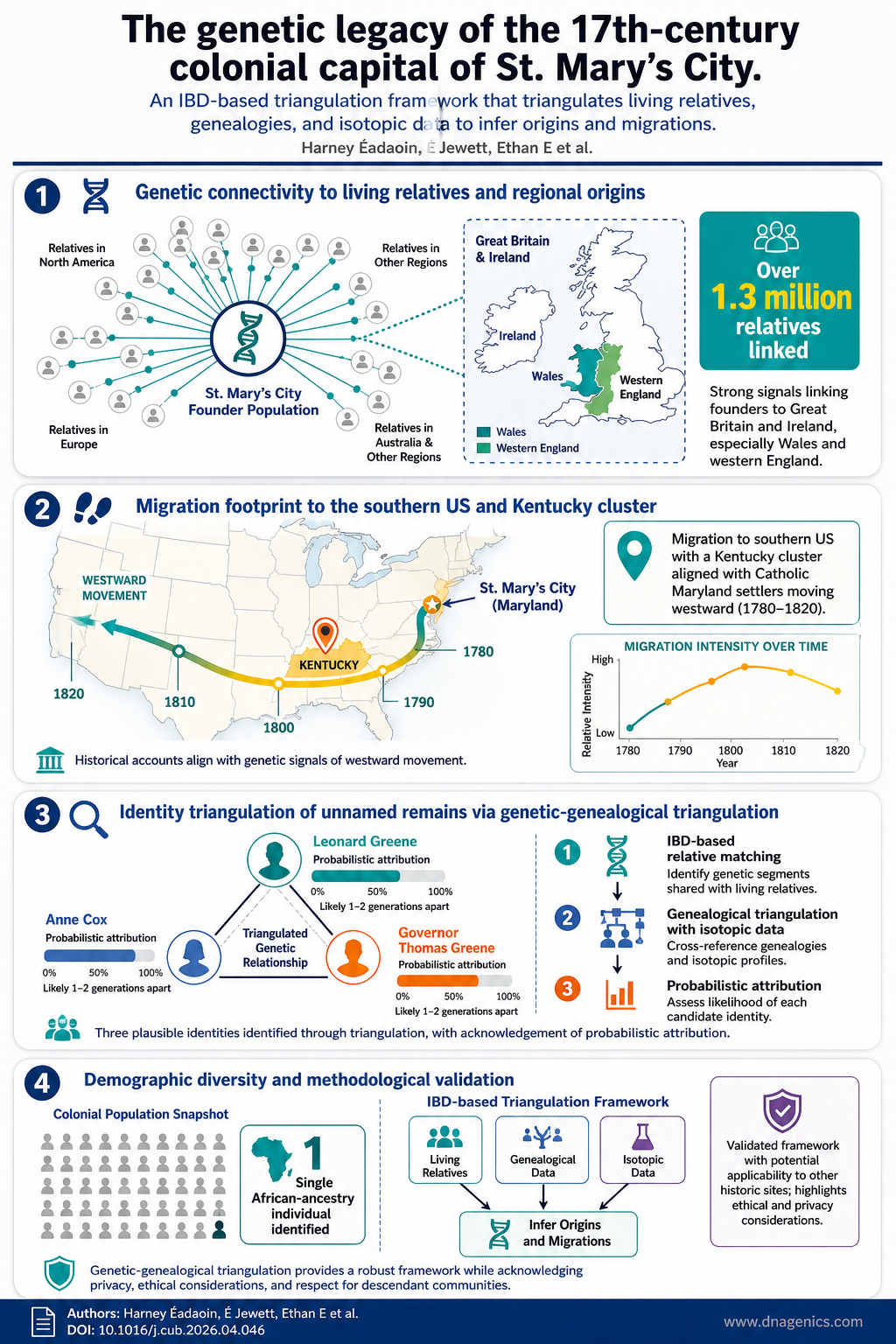
The infographic highlights how IBD links extend from the buried residents to living participants, with emphasis on British Isles origins, the Kentucky migration signal, and the reconstructed identities for Burial 56, Burial 63, and V07C.
Why It Matters
Beyond solving individual identities, this work demonstrates a robust, transferable framework for historical genetics. The IBD-based triangulation approach can be applied to other historic sites to illuminate founder populations, migration routes, and demographic structure. It also showcases how genetics can complement archival research and isotopic analyses to reconstruct past lives more comprehensively.
Ethical considerations are central to this line of inquiry. The use of private genetic databases requires careful consent management, privacy safeguards, and ongoing dialogue with descendant communities and research participants. Looking forward, the methodology could be extended to broader colonial contexts, integrate more isotopic data, and refine probabilistic identifications as more reference panels become available.
References
-The genetic legacy of the 17th-century colonial capital of St. Mary's City -DOI